

Tire Pressure: The Number That Changes Everything
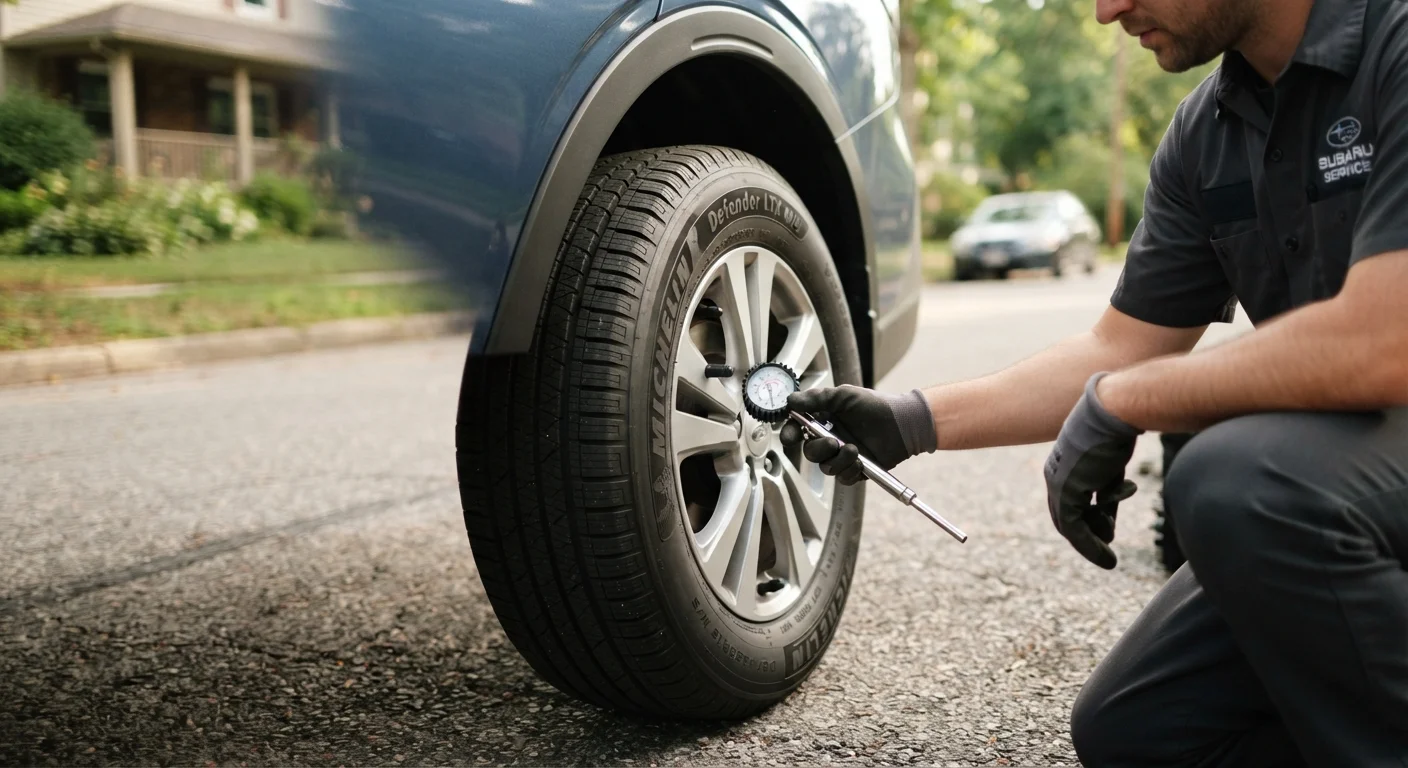
Tire pressure is measured in PSI and affects how your car handles, how quickly your tires wear, and how efficiently your engine uses fuel. The right PSI for your vehicle isn't printed on the tire sidewall - that number is the maximum the tire can hold. Your correct target pressure is found on the driver's door jamb sticker or in the owner's manual, and front and rear tires often carry different recommended values.
| Recommended pressure source | Driver's door jamb sticker or owner's manual |
| When to check pressure | Cold tires - parked 3+ hours or driven under 1 mile |
| Typical monthly pressure loss | ~1 PSI per month naturally |
| Pressure drop per 10°F temperature fall | ~1 PSI |
| Legal minimum tread depth (most U.S. states) | 2/32 inch |
| Recommended rotation interval | Every 5,000-7,500 miles (confirm in owner's manual) |
Check pressure when tires are cold - meaning the car has been parked for at least three hours or driven fewer than a mile. Driving heats air inside the tire, raising pressure readings by 4-8 PSI and giving a falsely high number. A quality dial or digital gauge costs a few dollars and gives readings within seconds. Most gas stations also have air pumps, though their built-in gauges vary in accuracy.
Tires naturally lose roughly 1 PSI per month and about 1 PSI for every 10°F drop in ambient temperature. That means a tire that was correctly inflated in September may be noticeably low by December without a single slow leak. Checking pressure monthly is a reasonable habit for most drivers. For a deeper look at how this connects to fuel economy, see how tire pressure affects fuel efficiency.
Tread Depth: Reading the Warning Signs
Tread channels water away from the contact patch between tire and road. As tread wears down, wet-weather grip degrades - and so does your ability to stop quickly. New tires typically start at 10/32" to 11/32" of tread depth. The legal minimum in most U.S. states is 2/32", but most safety organizations recommend replacing tires well before that point.
PSI (Pounds Per Square Inch)
The unit used to measure tire air pressure in the U.S. Your vehicle's recommended PSI is set by the manufacturer based on vehicle weight and handling design, not the tire itself.
Cold Inflation Pressure
The tire pressure reading taken when a tire has not been driven on for at least three hours. This is the baseline your manufacturer's recommended PSI is based on.
Tread Depth
The measurement from the top of a tire's rubber tread to the bottom of its grooves, expressed in 32nds of an inch. Lower depth means reduced grip, especially in wet conditions.
Tread Wear Indicator
Small raised bars molded into the bottom of tire grooves at 2/32" depth. When the tread surface is level with these bars, the tire has reached the legal minimum and should be replaced.
Tire Rotation
The practice of moving tires to different wheel positions on the vehicle at regular intervals to even out wear patterns and extend the life of the full set.
TPMS (Tire Pressure Monitoring System)
A federally mandated sensor system, standard on U.S. passenger vehicles since 2008, that alerts the driver when one or more tires drops significantly below recommended pressure.
The fastest field test is the penny test: insert a penny into the tread groove with Lincoln's head pointing down. If you can see the top of Lincoln's head, tread is at or below 2/32" and the tire should be replaced promptly. A more conservative check uses a quarter: if Washington's head is fully visible, tread is at or below 4/32", a point at which wet stopping distances begin to increase noticeably.
Check multiple grooves across the tire width and at several spots around the circumference. Uneven wear - heavier on one edge, or a wavy pattern - signals alignment or inflation problems that need a mechanic's attention. Driving in rain and snow with low tread is a meaningful safety risk; wet and icy road techniques matter far less if tread is gone.
Rotation: Why Position on the Car Matters
Front tires wear faster than rears on most vehicles because they handle steering and bear more braking force. On front-wheel-drive cars, the front tires also deliver engine power - tripling their workload. Rotation moves tires to different positions on the vehicle so wear distributes more evenly across all four, extending the overall set's usable life.
The general guideline is to rotate every 5,000-7,500 miles, though your owner's manual is the authoritative source for your specific vehicle. Many drivers pair rotation with oil changes for an easy schedule. The pattern used - straight swap, cross, or side-to-side - depends on whether tires are directional (designed to spin only one way) and whether your car has a full-size spare you want to include in the rotation cycle.
Skipping rotation doesn't cause immediate failure, but it does mean front tires may need replacement thousands of miles before the rears, forcing you to buy in pairs rather than sets and costing more over time. Tire rotation is typically inexpensive at a shop and is often included in tire purchase packages. For drivers building their overall maintenance calendar, see the annual car ownership checklist for where rotation fits among other milestones.
Putting It Together: A Practical Routine
These three checks work as a system. Correct pressure keeps the contact patch geometry right, which helps tread wear evenly. Even wear means rotation intervals make sense. And regular rotation gives you frequent opportunities to visually inspect tires for cracks, bulges, embedded objects, or unusual wear before they become hazards.
A monthly walkaround - checking pressure, eyeballing tread, and looking for visible damage - takes under five minutes. Before any extended highway drive, run through the same steps; for a full pre-departure routine, see pre-trip checks every driver should make before a long road journey. If your dashboard's TPMS light illuminates, check all four tires manually - the system alerts you when pressure drops roughly 25% below recommended, which is already a meaningful deficit. Learn more about what TPMS and other warning icons mean in our guide to dashboard warning lights.
New to car ownership and building these habits from scratch? The car maintenance habits guide for new drivers is a good next step.
The content provided on our blog site traverses numerous categories, offering readers valuable and practical information. Readers can use the editorial team’s research and data to gain more insights into their topics of interest. However, they are requested not to treat the articles as conclusive. The website team cannot be held responsible for differences in data or inaccuracies found across other platforms. Please also note that the site might also miss out on various schemes and offers available that the readers may find more beneficial than the ones we cover.