

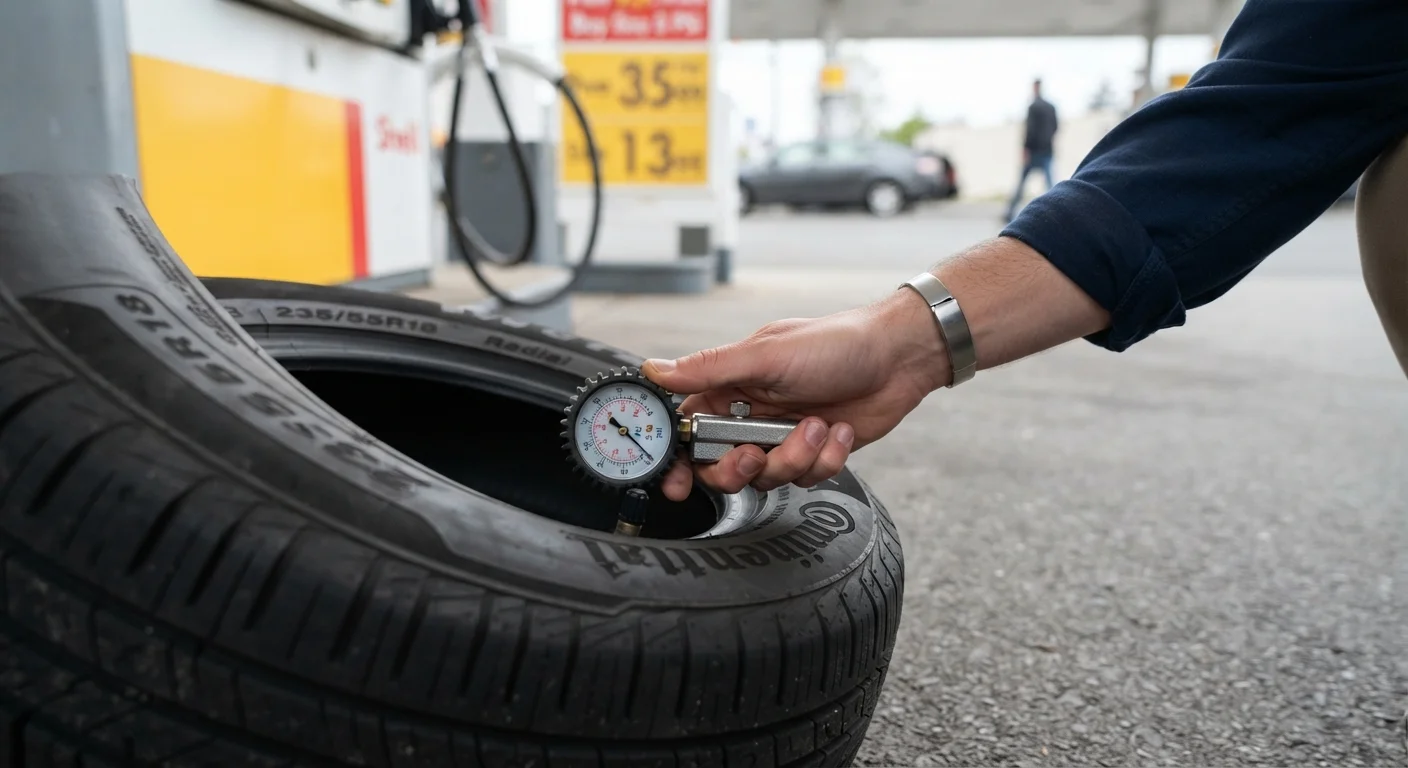
Why Tire Pressure Has a Direct Line to Your Fuel Economy
Most drivers think about fuel efficiency in terms of speed, engine size, or driving habits. Tire pressure rarely enters the conversation - yet it operates constantly, on every mile of every trip, regardless of how smoothly you drive.
The mechanism is straightforward. When a tire is properly inflated, it holds its shape efficiently and rolls with minimal energy loss. When it's low, the tire flattens slightly under the vehicle's weight, increasing the size of the contact patch and causing the rubber to flex and deform more with each rotation. That constant deformation generates heat and consumes energy - energy that has to come from burning fuel.
This is the essence of rolling resistance: the more a tire flexes, the harder the engine works to maintain speed. The relationship is well-documented. According to the U.S. Department of Energy, tires under-inflated by just 1 PSI reduce fuel economy by approximately 0.2%. That figure sounds small, but tires commonly run 5-8 PSI low without triggering any dashboard warning - a shortfall that can reduce fuel economy by 1-2% or more across your entire fleet of four tires.
~0.2%
Fuel economy lost per 1 PSI under-inflation
According to the U.S. Department of Energy, each PSI below the recommended level reduces fuel economy by approximately 0.2%.
Up to 3%
Potential fuel economy improvement from proper inflation
The U.S. Department of Energy estimates that keeping all four tires at the correct pressure can improve overall fuel economy by up to 3%.
1-2 PSI/month
Natural pressure loss in typical conditions
Tires lose pressure gradually through rubber permeation, making monthly checks a practical necessity rather than an optional task.
1 PSI per 10°F
Pressure drop for every temperature decrease
Cold weather accelerates pressure loss; tires properly inflated in warm conditions can become significantly low during winter months.
For drivers interested in reading the full picture of what shapes their fuel use, our guide to fuel economy gauges explains how to interpret your vehicle's real-time and average MPG readouts.
The Pressure Number That Actually Matters
A common source of confusion is which pressure number to follow. Look at a tire sidewall and you'll find a number like "Max. Press. 51 PSI" - this is the maximum pressure the tire structure can safely contain, not a target. Inflating to that figure would make the tire dangerously hard and prone to blowout.
The correct specification for your vehicle is the manufacturer's recommended pressure, found on a sticker inside the driver's door jamb or in the owner's manual. This number is calculated for your vehicle's specific weight, suspension geometry, and intended load - and it balances efficiency, comfort, handling, and safety together.
Check Pressure When Tires Are Cold
Always measure tire pressure before driving or after the vehicle has been parked for at least three hours. Heat from driving temporarily increases internal air pressure, giving a falsely high reading. A cold reading gives you the accurate baseline you need to compare against the door jamb specification.
Front and rear tires sometimes carry different recommended pressures, especially on larger vehicles or those with uneven weight distribution. Always check both axles independently.
For a broader look at tire care - including tread depth checks and rotation schedules - see our tire maintenance field guide.
How Pressure Changes Over Time - and Why You Can't Just Set It and Forget It
Tires are not airtight in the way a sealed container is. Nitrogen and oxygen molecules gradually permeate through the rubber, causing a natural pressure loss of roughly 1-2 PSI per month under normal conditions. Temperature amplifies this: for every 10°F drop in ambient temperature, tire pressure typically falls by about 1 PSI. A tire sitting at a correct 35 PSI on a 70°F afternoon can read 31-32 PSI after a cold overnight drop to 30°F.
This is why the Tire Pressure Monitoring System (TPMS) - required on all U.S. passenger vehicles sold after 2007 - is not a substitute for manual checks. TPMS alerts are generally calibrated to trigger when pressure falls roughly 25% below recommended levels. A tire can be meaningfully low, wasting fuel and wearing unevenly, without ever triggering that warning light.
Monthly checks with a quality gauge take under five minutes. Check tires when they're cold - ideally before driving or after parking for at least three hours - since driving heats the air inside and temporarily inflates the reading.
Tire pressure is one of several factors explored in our road trip cost breakdown, which covers how tire condition and fuel efficiency intersect with real per-mile travel expenses.
The Compound Effect: Tread Wear, Safety, and Cumulative Savings
Fuel economy is only one consequence of chronic under-inflation. Low pressure causes a tire's shoulders - the outer edges of the tread - to carry disproportionate load, wearing those areas faster than the center. This uneven wear shortens overall tire life and can require premature replacement.
Over-inflation creates the opposite pattern: the center of the tread bears too much weight, wearing faster than the edges. Both deviations shorten the usable life of an otherwise healthy tire.
There's also a handling dimension. Under-inflated tires respond more sluggishly to steering input and take longer to stop, particularly on wet roads. Proper inflation is as much a safety maintenance task as an efficiency one.
When combined with other fuel-conscious habits - smooth acceleration, anticipating traffic flow, consistent speed on the highway - tire pressure becomes part of a system rather than an isolated fix. Our guide to smooth driving habits covers the behavioral side of the equation in detail.
The broader category of car maintenance exists precisely because small, overlooked tasks like tire inflation accumulate into significant vehicle performance and cost outcomes over time. A monthly five-minute check is one of the highest-return habits any driver can develop.
Frequently Asked Questions
The savings are modest but real and cumulative. The U.S. Department of Energy estimates properly inflated tires can improve fuel economy by up to 3% compared to significantly under-inflated tires. Over thousands of miles, that adds up to a meaningful reduction in fuel costs.
The manufacturer's recommended pressure is printed on a sticker inside the driver's door jamb or in the owner's manual. The number molded into the tire sidewall is the maximum pressure the tire can hold, not the target - always use the vehicle specification.
Most automotive professionals recommend checking monthly and before any long trip. Temperature swings accelerate pressure changes, so checking more frequently in winter or during sudden weather shifts is wise.
Over-inflated tires reduce the contact patch and can actually lower rolling resistance slightly, but they cause uneven tread wear, reduce grip, and make the ride harsher. Staying at the recommended PSI balances efficiency, safety, and tire longevity.
Air contracts when temperatures fall. As a general rule, tire pressure drops roughly 1 PSI for every 10°F decrease in ambient temperature. Tires that are properly inflated in warm weather can become noticeably low during a cold snap.
The Tire Pressure Monitoring System (TPMS) only triggers a warning when pressure is significantly low - often 25% below the recommended level. By that point, efficiency and safety are already compromised. Manual checks with a gauge catch smaller drops the TPMS won't flag.
The content provided on our blog site traverses numerous categories, offering readers valuable and practical information. Readers can use the editorial team’s research and data to gain more insights into their topics of interest. However, they are requested not to treat the articles as conclusive. The website team cannot be held responsible for differences in data or inaccuracies found across other platforms. Please also note that the site might also miss out on various schemes and offers available that the readers may find more beneficial than the ones we cover.