

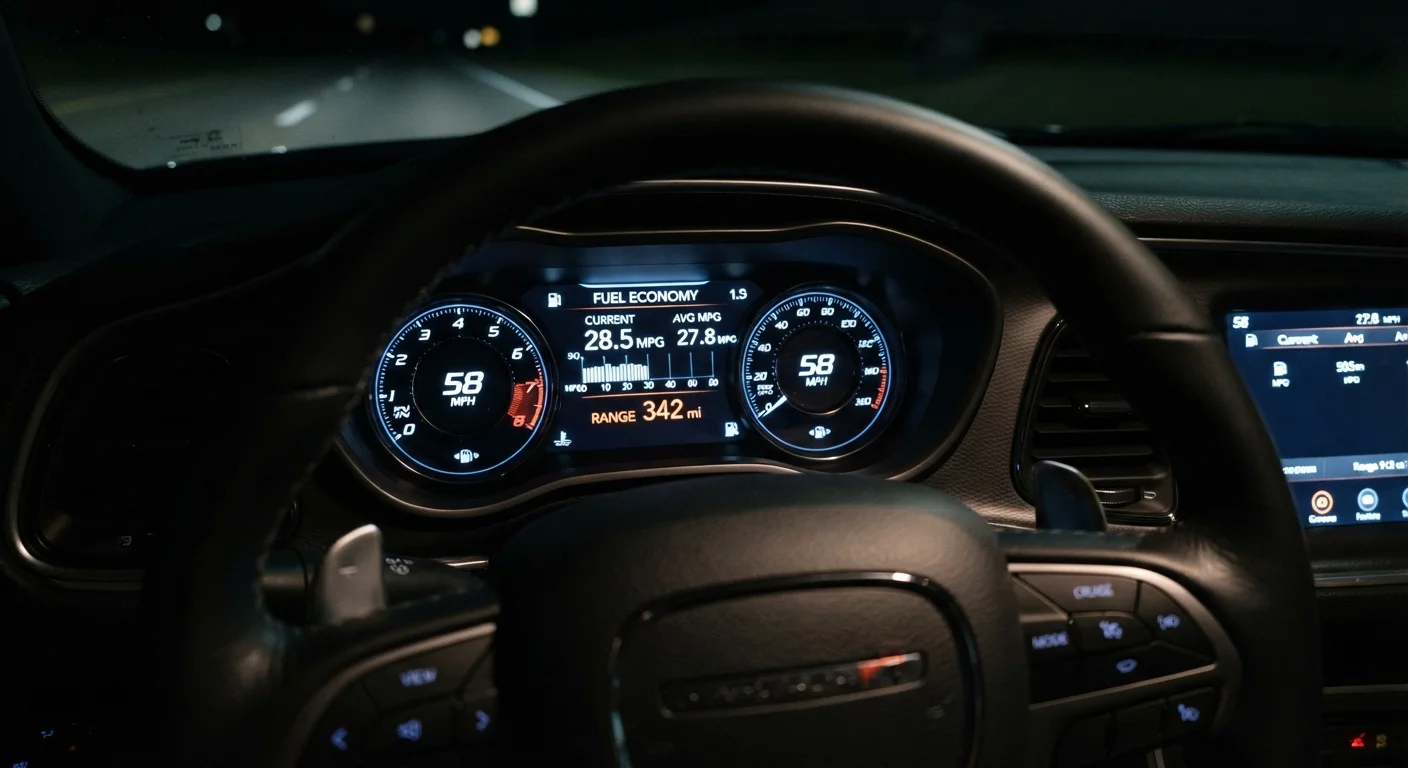
The Two Core Readouts: Instant vs. Average MPG
Nearly every fuel economy display presents two distinct numbers, and confusing them leads to misreading what your vehicle is actually doing.
Instant MPG updates continuously - often several times per second - showing how many miles per gallon your engine is achieving at this exact moment. Floor the accelerator and watch it plunge. Lift off the throttle going downhill and it may spike dramatically, sometimes showing 50 MPG or more as the fuel injectors cut back. Instant MPG is essentially a pressure gauge for your right foot: it tells you, in real time, whether your inputs are efficient or wasteful.
Average MPG is a rolling calculation across all the miles driven since the last reset. It smooths out the spikes and drops, giving you a true picture of your overall fuel efficiency for that trip or tank. This is the number to benchmark against your vehicle's EPA rating.
Use Each Readout for Its Intended Purpose
Instant MPG is your real-time coaching tool - watch it during acceleration and coasting to build fuel-efficient habits. Average MPG is your performance scorecard - reset it at each fill-up and compare it to your vehicle's EPA rating over time. Mixing up these two roles leads to misreading what your vehicle is actually doing.
Use instant MPG as a coaching tool during a drive, and average MPG to evaluate your efficiency over time. They answer different questions.
What the Range Estimate Is - and Isn't
The estimated range (sometimes labeled DTE - Distance to Empty) projects how far you can travel on your remaining fuel, based on your recent average consumption. It sounds precise, but it's really an educated forecast.
If you've spent the last 20 miles in stop-and-go traffic and now merge onto a freeway, the range estimate will likely climb as your fuel economy improves. Conversely, if you've been cruising the highway and enter heavy city traffic, the estimate will fall faster than the fuel gauge. The system is always looking backward to predict forward.
A practical rule: treat the range estimate as a planning aid, not a guarantee. Most automotive engineers recommend refueling when the range drops to around 50 miles, rather than testing its lower boundary. Running a tank dry can damage a fuel pump, which relies on gasoline for cooling.
Range Estimates Shift With Driving Conditions
The Distance to Empty figure recalculates constantly based on recent fuel consumption. A switch from highway to city driving - or turning on the air conditioning in extreme heat - can cause the estimate to drop noticeably even without burning much additional fuel. See our guide to how driving conditions affect fuel use for a deeper look at why your range estimate can shift so dramatically between city and highway driving.
See our guide to how driving conditions affect fuel use for a deeper look at why your range estimate can shift so dramatically between city and highway driving.
How to Use These Readings to Drive More Efficiently
Fuel economy displays are most useful when you treat them as active feedback rather than passive information. Here's how to get real value from each readout:
- Watch instant MPG during acceleration. Gradual, steady acceleration keeps the bar from crashing. This translates directly to less fuel burned and less wear on drivetrain components.
- Use instant MPG when coasting. Lifting off the throttle well ahead of a stop - rather than braking at the last moment - lets fuel consumption drop near zero on many fuel-injected engines. This technique, called engine braking, is one of the highest-return habits a driver can develop. Learn more in our overview of smooth driving habits that save fuel.
- Reset average MPG at each fill-up. This gives you a per-tank efficiency score you can track over time. A consistent downward trend that isn't explained by weather or route changes is worth investigating - potentially a sign of a maintenance issue.
- Compare your average to EPA figures. The gap between your real-world average and the EPA highway or city rating tells you something meaningful. Factors like tire pressure, cargo weight, and climate all shift that gap.
Fuel economy readouts won't make your car more efficient on their own, but they turn abstract consumption into a number you can actually respond to - and that visibility is where better driving habits begin.
~15-20%
Potential fuel savings from smoother driving habits
The U.S. Department of Energy estimates that aggressive driving - rapid acceleration and hard braking - can lower fuel economy by 15-30% on highways and up to 40% in stop-and-go traffic.
Up to 1%
Fuel economy loss per PSI of underinflation
According to U.S. Department of Energy guidance, tires underinflated by just 1 PSI can reduce fuel economy by approximately 0.2%, with larger deficits as underinflation increases.
30 seconds
Idling threshold before shutting off the engine saves fuel
The U.S. Department of Energy notes that restarting a modern fuel-injected engine uses less fuel than idling for more than roughly 30 seconds.
Frequently Asked Questions
When your engine is running but the vehicle isn't moving, it consumes fuel without covering any distance - making MPG mathematically undefined or displayed as zero. Some vehicles show a very low number or a dashed line instead. Extended idling is one of the least efficient states your engine can be in.
Range estimates are calculated from your recent average fuel consumption combined with the fuel remaining in the tank. They are projections, not precise predictions. If your recent driving was mostly highway, the estimate may be optimistic for city conditions ahead. Always refuel before the estimate reaches zero.
Your car's displayed average reflects your actual driving conditions - traffic, speed, climate, and load - while EPA ratings are derived from controlled lab tests. Real-world figures often differ from EPA numbers. Your display is more accurate for your habits, but only after covering enough miles for a meaningful average to form.
Resetting at the start of each trip or each tank of fuel gives you the most actionable data. A lifetime average accumulated over months can mask recent changes in your driving habits or vehicle health, making it harder to spot problems or improvements.
Yes. A sustained, unexplained drop in fuel economy can indicate issues such as a failing oxygen sensor, clogged fuel injectors, low tire pressure, or a dragging brake. If your average MPG falls noticeably without a change in driving conditions, it's worth having a qualified mechanic inspect the vehicle.
The content provided on our blog site traverses numerous categories, offering readers valuable and practical information. Readers can use the editorial team’s research and data to gain more insights into their topics of interest. However, they are requested not to treat the articles as conclusive. The website team cannot be held responsible for differences in data or inaccuracies found across other platforms. Please also note that the site might also miss out on various schemes and offers available that the readers may find more beneficial than the ones we cover.