

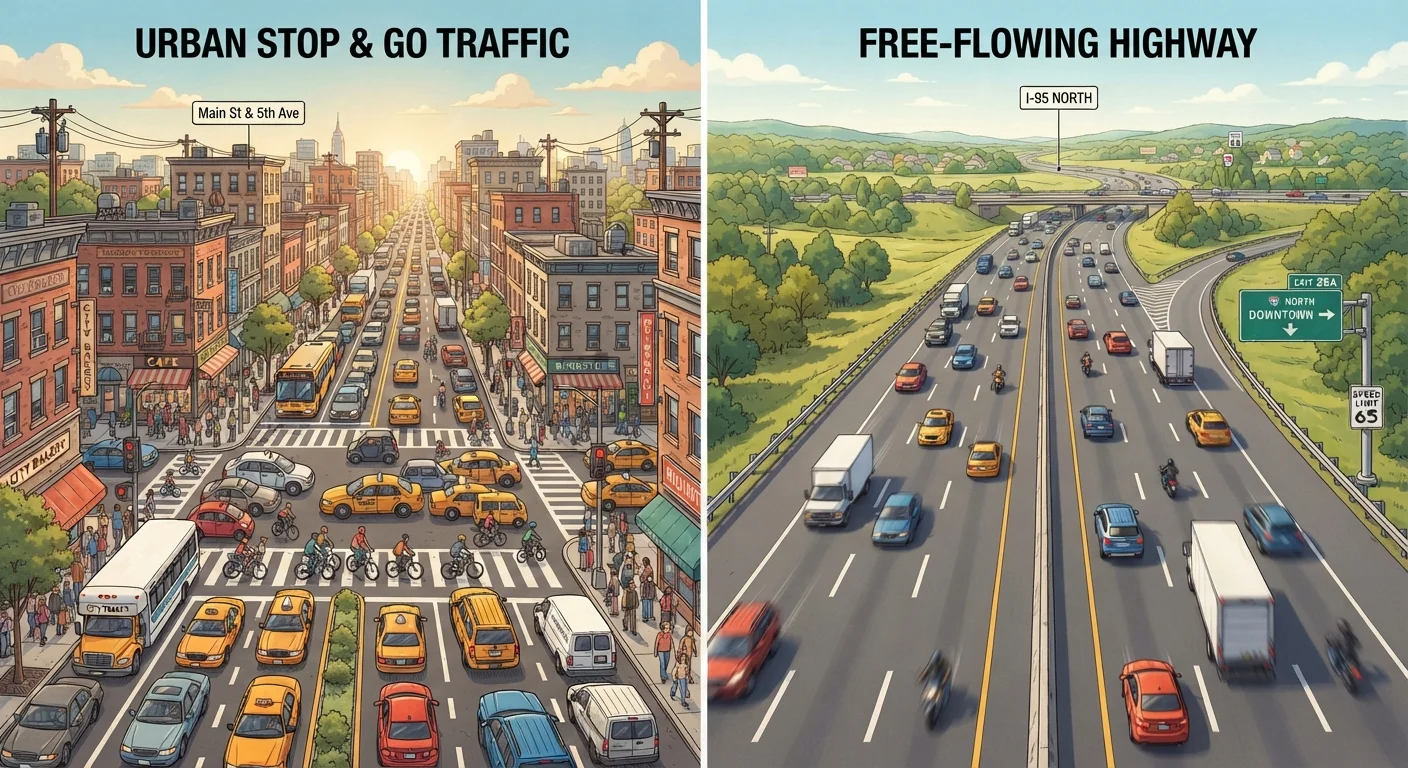
Option A
Highway Driving
The steady, aerodynamically demanding cruise.
Best for: Drivers covering long distances who want predictable, consistent fuel consumption at sustained speeds.
Option B
Stop-and-Go Traffic
The fuel-hungry cycle of acceleration and idle.
Best for: Understanding why urban commutes drain your tank faster and where the biggest efficiency losses hide.
Why the Same Car Gets Different Mileage in Different Conditions
Most drivers have noticed the gap: the EPA window sticker shows one city figure and a higher highway figure, yet the real-world numbers rarely match either. That difference isn't a measurement error - it reflects genuinely different physics at work depending on where you drive.
A vehicle's engine has to overcome two fundamentally different energy demands depending on conditions. In highway driving, the dominant challenge is aerodynamic drag - the resistance of air pushing against a moving vehicle. In stop-and-go traffic, the dominant waste is kinetic energy loss - the fuel spent accelerating a vehicle from rest, only to discard that energy as heat through the brakes moments later.
Understanding which force costs you more fuel in which situation is the first step toward doing something practical about it. See our guide to reading your fuel economy gauge to understand exactly how your dashboard readouts reflect these conditions in real time.
The Physics of Stop-and-Go: A Fuel Economy Drain
Every time a vehicle accelerates from a complete stop, the engine must convert fuel into kinetic energy - the energy of motion. When that vehicle then brakes to a stop again, that kinetic energy isn't stored or recovered in a conventional gas-powered car; it's released as heat through the brake pads and rotors. The fuel that built it is simply gone.
Idling compounds the problem. An engine sitting at idle in traffic burns fuel continuously while producing zero forward motion. The exact consumption varies by engine size and vehicle, but no useful work is done during that time.
Frequent cold-ish starts - short urban trips that never let the engine reach full operating temperature - add a third layer of inefficiency. Engines running below optimal temperature operate on a richer fuel mixture, meaning they consume more fuel per mile until they warm up fully.
| Criterion | Highway Driving | Stop-and-Go Traffic |
|---|---|---|
| Primary fuel drain | Aerodynamic drag | Kinetic energy lost to braking |
| Engine operating efficiency | High - steady RPM, warm engine | Lower - repeated warm-up cycles, idle |
| Idle fuel waste | Minimal | Significant at red lights and congestion |
| Typical MPG vs. EPA estimate | Often meets or exceeds estimate | Often falls below city estimate |
| Impact of speed on efficiency | Notable above 65-70 mph | Less relevant than stop frequency |
| Hybrid vehicle advantage | Moderate improvement | Significant - regenerative braking helps greatly |
| Driver behavior impact | Speed and drag management | Anticipation and smooth acceleration |
The result is that city driving consistently produces lower miles-per-gallon figures for conventional vehicles. Learning to read the road further ahead so you brake less abruptly is one of the most direct ways to reduce this waste.
Highway Driving: More Efficient, But Not Without Costs
At a steady highway cruise, a conventional engine operates in its most fuel-favorable range: the engine is warm, gear ratios are optimized for low RPM at speed, and there's no repeated stop-start cycle. This is why highway MPG figures are higher for most gasoline-powered vehicles.
However, aerodynamic drag grows with the square of speed. A vehicle traveling at 70 mph faces roughly 36% more aerodynamic resistance than one traveling at 60 mph. This is why fuel economy often drops noticeably above 65-70 mph, even though the driving feels effortless. Roof racks, open windows, and large cargo also add drag.
~14%
Fuel economy drop from 65 to 70 mph
The U.S. Department of Energy estimates fuel economy decreases roughly 7-14% for each 5 mph driven above 60 mph, depending on the vehicle.
Up to 30%
City MPG improvement in hybrids vs. conventional
According to the U.S. Department of Energy, hybrid vehicles can achieve city fuel economy up to 30% better than comparable conventional vehicles due to regenerative braking.
For drivers planning longer trips, maintaining a consistent, moderate speed matters more than most realize. Our article on road trip costs beyond the gas pump walks through how these factors compound over long distances.
Practical Habits That Close the Gap
Knowing the physics points directly to what helps. In city driving, the highest-impact habit is anticipating stops early - lifting off the throttle sooner and coasting toward a red light rather than accelerating right up to it. This preserves kinetic energy as long as possible and reduces brake heat waste. Smooth driving techniques amplify this effect across every commute.
On the highway, keep speed moderate and consistent. Using cruise control on flat terrain helps avoid the subtle speed fluctuations that add up over hundreds of miles. Reduce drag where you can - remove unused roof cargo carriers, keep windows up at highway speeds, and maintain proper tire inflation. Under-inflated tires increase rolling resistance and quietly drain efficiency in both environments.
Finally, if you're curious which fuel-saving tips actually hold up under scrutiny, our overview of common fuel-saving myths separates evidence-based practices from outdated advice worth dropping.
The content provided on our blog site traverses numerous categories, offering readers valuable and practical information. Readers can use the editorial team’s research and data to gain more insights into their topics of interest. However, they are requested not to treat the articles as conclusive. The website team cannot be held responsible for differences in data or inaccuracies found across other platforms. Please also note that the site might also miss out on various schemes and offers available that the readers may find more beneficial than the ones we cover.