

Why Anticipation Is a Driving Skill, Not a Personality Trait
Anticipatory driving - sometimes called forward scanning or defensive driving - is the habit of processing road information far enough ahead that your responses are smooth rather than reactive. It isn't an innate gift; it's a learned perceptual skill that most drivers can develop with deliberate practice.
The payoff is threefold. First, smoother inputs mean less mechanical stress: brakes wear more slowly, tires scrub less, and drivetrain components experience fewer shock loads. Second, fuel economy improves because kinetic energy is preserved rather than converted to heat at the brake rotors and then rebuilt by burning more fuel. Third, driver stress drops measurably when every traffic event feels anticipated rather than sudden.
Many drivers operate with a visual horizon of only one or two seconds - just enough to not hit the car directly in front. Expanding that horizon to 10-15 seconds ahead is the single most effective technique shift available to an everyday driver. The steps below build this habit systematically.
What you will need
Step-by-Step: Building the Anticipation Habit
The following steps progress from basic perception training to integrated techniques you can apply across different road environments. Work through them sequentially on familiar roads before applying them in new or complex situations.
Your vehicle's mirrors (rear-view and side)
Extend your visual field behind and beside you so you can anticipate merges, lane changes, and following traffic behavior.
Cruise control (where available)
Maintains a steady speed on open highways, reducing the micro-accelerations that waste fuel when you're distracted by immediate traffic.
Train your eyes to look further down the road
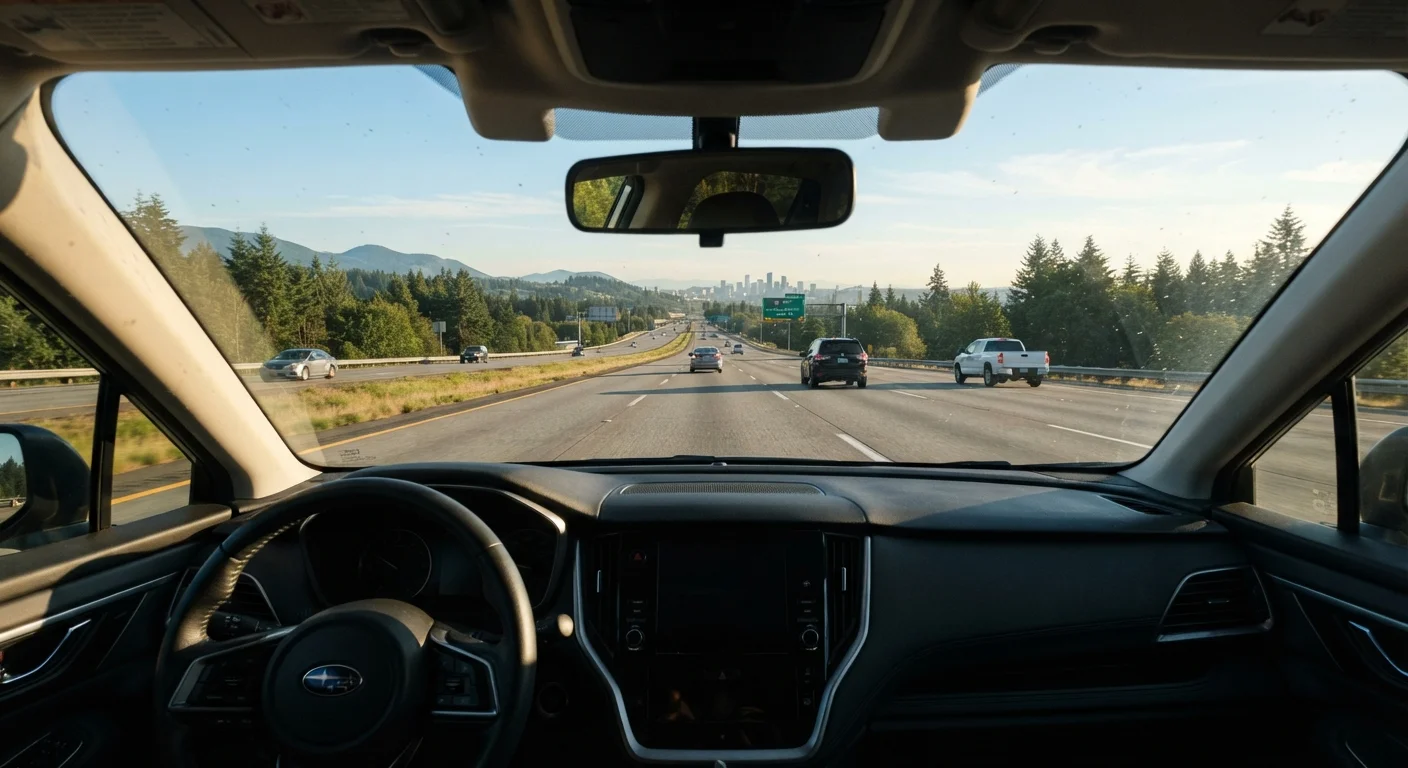
Most drivers fix their gaze on the vehicle directly ahead. Skilled anticipatory driving starts by deliberately shifting where your eyes rest. On a highway or open road, aim to scan 10 to 15 seconds of travel time ahead - at 60 mph that's roughly 880 feet, or about three city blocks.
In urban traffic the distance compresses, but the principle holds: look through the vehicle in front of you to the two or three cars beyond it. Notice brake lights rippling back through the pack before they reach the car ahead of you.
Use following distance as your reaction buffer
Anticipation without space to act on it is useless. A following distance of at least three seconds (more in adverse weather or at highway speeds) gives your perception-to-action chain room to work without emergency braking. Count the gap: when the car ahead passes a fixed marker, your vehicle should pass the same marker no sooner than three seconds later.
Larger gaps also flatten the accordion effect - the phenomenon where slight braking in heavy traffic amplifies rearward into a full stop. For a deeper look at how this shapes traffic patterns, see our guide to understanding traffic flow.
Read brake-light patterns, not just individual vehicles
Brake lights are information, not just warnings. When you see a ripple of red several cars ahead, begin gently lifting off the throttle immediately - before the car in front of you brakes. This single habit eliminates most hard-braking events, which are the primary cause of accelerated brake-pad wear and unnecessary fuel consumption (since kinetic energy lost to brakes is energy you had already paid for at the pump).
Watch for patterns: a cluster of brake lights at a highway on-ramp usually signals a merge conflict. Lights near an intersection may indicate a poorly timed signal. Anticipating the cause, not just the effect, lets you time your deceleration even more smoothly.
Manage your speed through coast-and-hold instead of brake-and-accelerate
When you've spotted a slowdown early enough, the goal is to arrive at the lower speed without touching the brake pedal at all - by simply coasting. Lift off the throttle gradually and let engine braking and rolling resistance do the work. If you time it well, traffic may have already cleared by the time you reach the congestion point, allowing you to resume speed with minimal acceleration.
This technique - sometimes called hypermiling-light - is central to fuel-efficient driving. Our smooth driving habits guide covers the broader set of techniques that compound these savings over time.
Anticipate intersections, merges, and lane changes
Fixed road features - traffic signals, on-ramps, pedestrian crossings - are predictable triggers for speed changes. Identify them early and adjust speed proactively. For a green light two blocks ahead, consider whether it is likely to cycle before you arrive; if so, coasting now means you may not need to stop at all.
For highway merges, anticipating the geometry and adjusting your position or speed to create a clean gap is safer and more fuel-efficient than reactive braking. See our guide to on-ramp merging for the underlying logic.
Check mirrors regularly to anticipate pressure from behind
Anticipatory driving isn't only forward-facing. Scanning your mirrors every five to eight seconds tells you whether a fast-approaching driver is about to pressure you into a rushed lane change, or whether slowing gradually is safe given the gap behind you. Knowing what's behind you lets you make confident, unhurried decisions rather than reactive ones.
This rearward awareness becomes especially important in low-visibility conditions. Our night driving article addresses how reduced sight distances change the margin for error after dark.
Practice on a Route You Already Know
Familiar roads remove the cognitive load of navigation, freeing mental bandwidth to focus purely on scanning technique. Commute routes or regular errands are ideal practice environments. Once the habit feels automatic on known roads, it transfers naturally to unfamiliar ones.
When Conditions Demand Even More Anticipation
Anticipatory driving pays its biggest dividends when conditions compress your margins. Rain, fog, and road construction all lengthen stopping distances and obscure visual cues - situations where a 10-second scan horizon may need to stretch to 15 or 20 seconds. Our guide to driving in rain, snow, and ice details the specific technique adjustments those conditions require.
Fatigue is a less obvious but equally important factor: a tired driver narrows their visual attention without realizing it, defaulting to the reactive near-field focus that anticipatory driving is designed to replace. If you notice your scan distance shortening or your reactions feel sluggish, treat it as an early warning sign. Our article on driver fatigue covers why self-assessment in this area is harder than it seems.
Before any long trip where sustained anticipatory awareness matters most, a few minutes of pre-trip vehicle checks ensures your car's systems - mirrors, brakes, tires - are ready to support the demands you'll place on them.
Don't Let Anticipation Become Distraction
Scanning far ahead is not the same as daydreaming or scanning your phone. Your eyes should be active and moving - near, mid, far, mirrors - in a continuous cycle. If you find yourself fixating on a distant point and losing awareness of the immediate lane, refocus your scanning pattern to be dynamic rather than locked.
The content provided on our blog site traverses numerous categories, offering readers valuable and practical information. Readers can use the editorial team’s research and data to gain more insights into their topics of interest. However, they are requested not to treat the articles as conclusive. The website team cannot be held responsible for differences in data or inaccuracies found across other platforms. Please also note that the site might also miss out on various schemes and offers available that the readers may find more beneficial than the ones we cover.