

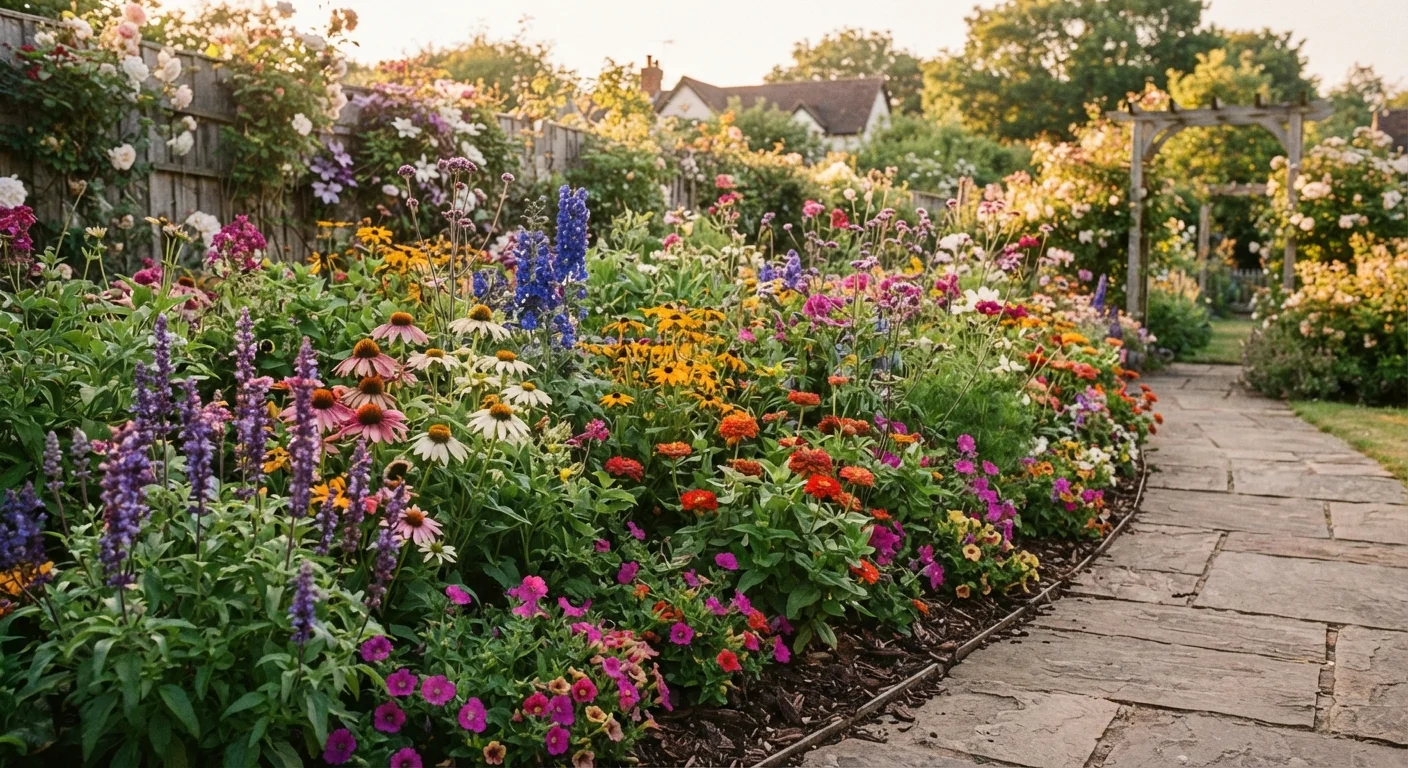
Option A
Perennials
The long-game investment that returns year after year.
Best for: Gardeners who want a lower-maintenance, cost-efficient foundation that builds in beauty over time.
Option B
Annuals
The flexible, high-impact choice for continuous seasonal color.
Best for: Gardeners who want maximum color, creative flexibility, or quick results each season.
What Sets Perennials and Annuals Apart
The core difference is lifespan. Perennials are plants that live for more than two years, dying back to their roots in winter and re-emerging each spring. Annuals complete their entire life cycle - germination, flowering, seed production, and death - within a single growing season.
This distinction drives nearly every practical consideration in garden planning: how much you spend, how often you replant, and how your garden changes from one year to the next. Understanding it lets you stop guessing and start designing with intention.
A few plants occupy a middle ground. Biennials live for two years, typically blooming in their second year before dying. Some plants sold as annuals in northern climates - such as certain salvias - are actually tender perennials that simply cannot survive frost. Knowing your USDA hardiness zone helps clarify which category a plant truly falls into for your location. See how plant labels translate to real conditions for more context on reading plant tags accurately.
| Criterion | Perennials | Annuals |
|---|---|---|
| Lifespan | 3+ years from same root system | One growing season only |
| Upfront cost | Higher per plant | Lower per plant |
| Long-term cost | Lower - no annual repurchase | Higher - replanted each season |
| Bloom duration | Defined window (weeks) | Full season continuous bloom |
| Maintenance after establishment | Low to moderate | Moderate to high |
| Design flexibility | Lower - plants return in place | High - replant fresh each year |
| Drought tolerance | Often high (native species) | Generally lower |
| Speed to impact | Slower (1-3 years to mature) | Immediate from transplant |
The Real Cost and Effort Comparison
Annuals appear cheaper at the garden center - a flat of impatiens or marigolds typically costs far less than a single established perennial. But that calculus changes quickly. Because annuals must be repurchased and replanted every year, their cumulative cost often exceeds that of perennials within two to three growing seasons.
Perennials require a larger initial investment, but many spread through clumping or self-seeding, meaning you can divide them to fill new areas at no additional cost. A single coneflower or black-eyed Susan planted today may yield a dozen divisions within three seasons.
2-3 years
When perennials typically break even vs. annuals
General horticultural guidance suggests perennial beds often become more cost-effective than replanting annuals within the first two to three growing seasons.
~30%
Less watering needed by established perennials
Cooperative Extension research from multiple U.S. land-grant universities indicates established perennial beds commonly require significantly less supplemental irrigation than annual beds.
Effort follows a similar pattern. Annuals demand seasonal bed preparation, replanting, and often more frequent watering and fertilizing since they push hard toward flowering before dying. Perennials need more attention in years one and two while establishing, but generally become more self-sufficient over time. Good mulching practices significantly reduce maintenance for both - proper mulching technique suppresses weeds and retains soil moisture, which benefits established perennial beds especially.
Designing a Garden That Uses Both Strategically
The most effective home gardens rarely rely on one plant type alone. A practical approach is to build a perennial backbone - reliable plants that return each year and anchor the bed's structure - then weave in annuals to fill color gaps and extend visual interest across the full growing season.
Perennials typically have defined bloom windows. A spring-blooming iris gives way to a summer coneflower, which transitions to fall-blooming asters. The gaps between these windows are exactly where annuals earn their place. Planted in drifts between perennial clumps, they maintain color continuity without disrupting the underlying structure.
When selecting your perennial foundation, consider mature plant size, bloom time, and foliage texture - not just flower color. Layering low edging plants in front of mid-height bloomers with tall focal specimens behind creates depth that looks intentional year-round, even when nothing is in flower. For gardeners weighing how the bed itself is structured, raised beds versus in-ground planting affects soil control and drainage, which in turn influences which perennials establish well.
Annuals are also ideal for containers, window boxes, and border edges where you want maximum flexibility. Swapping them seasonally - cool-season pansies in spring replaced by heat-tolerant zinnias in summer - keeps those focal points fresh without disturbing your perennial planting.
Climate, Zone, and Timing Considerations
Your climate is non-negotiable. A plant labeled a perennial in Georgia may behave as an annual in Minnesota. Always verify whether a plant is cold-hardy in your specific USDA zone before treating it as a permanent fixture. The USDA Plant Hardiness Zone Map, available through the USDA Agricultural Research Service, is a reliable free reference.
Frost dates matter for both types. Annuals should not be transplanted outdoors until after your last expected spring frost. Perennials planted in fall have time to establish roots before winter - often a better strategy than spring planting for many species. Seasonal timing guides can help you align planting schedules to your region's conditions.
Self-Seeding Annuals: A Useful Middle Ground
Some annuals - including cosmos, cleome, and bachelor's button - drop seeds prolifically and re-sprout the following spring without replanting. While not true perennials, these self-seeders blur the line and can give you recurring color with minimal effort. Keep in mind they may not come back exactly where you want them, and in some regions, aggressive self-seeders can spread beyond intended areas.
Drought tolerance also varies significantly within each category. Many native perennials - such as lavender, yarrow, and coneflower - develop deep root systems that make them resilient in dry conditions, while most annuals need more consistent moisture to sustain their rapid growth and continuous blooming. If water conservation is a priority, lean toward drought-adapted perennials as your foundation and be selective with annuals. For food-growing contexts, managing gardens through drought offers useful techniques that translate to ornamental beds as well.
The content provided on our blog site traverses numerous categories, offering readers valuable and practical information. Readers can use the editorial team’s research and data to gain more insights into their topics of interest. However, they are requested not to treat the articles as conclusive. The website team cannot be held responsible for differences in data or inaccuracies found across other platforms. Please also note that the site might also miss out on various schemes and offers available that the readers may find more beneficial than the ones we cover.