

Our Verdict
Lawn aeration is a genuinely useful practice - but only when soil compaction or thick thatch is actually limiting your grass. Applied at the right time on the right lawn, it can meaningfully improve root depth, drainage, and overall turf health. Applied without cause, it's extra work with little payoff.
Homeowners with high-traffic lawns, heavy clay soils, or visibly thinning turf who want a science-backed approach to improving grass health before the growing season.
What Aeration Actually Does to Your Soil
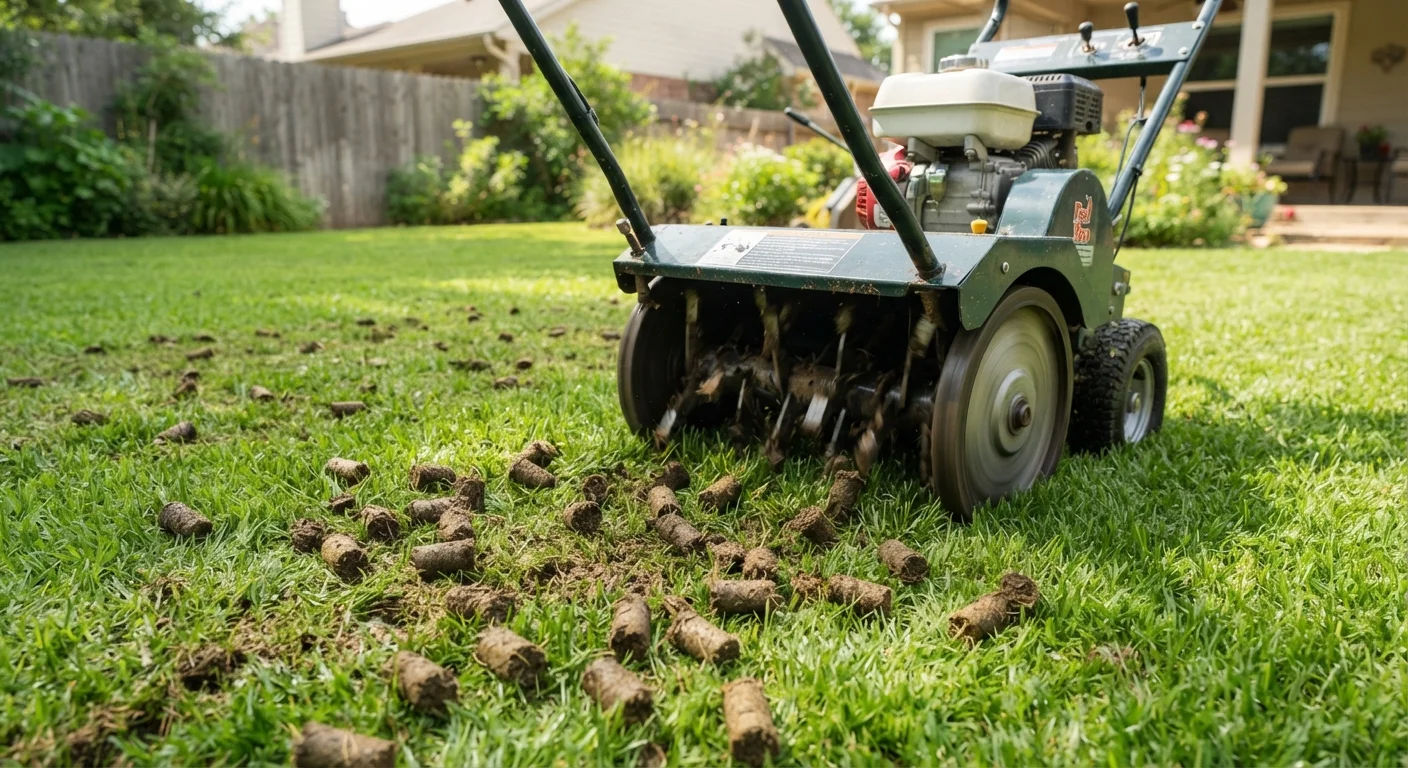
Aeration is the process of creating small openings in your lawn's soil to relieve compaction and improve the movement of air, water, and nutrients down to the root zone. The most effective method - core (or plug) aeration - uses a machine with hollow tines that pull out cylindrical plugs of soil roughly two to four inches deep, depositing them on the surface. Spike aeration, by contrast, simply pokes holes without removing material and is generally considered less effective for compaction relief.
Over time, foot traffic, mowing, and natural settling press soil particles together, closing the pore spaces that roots depend on. When those pores tighten, grass roots struggle to grow deep, water pools or runs off rather than soaking in, and fertilizer sits near the surface instead of reaching where it's needed. Core aeration physically breaks that compression cycle. The removed plugs break down naturally within a few weeks, returning organic matter to the surface.
Aeration also opens channels that make overseeding significantly more effective - seed-to-soil contact improves dramatically when there are fresh holes ready to receive new grass seed. See our spring lawn prep guide for how aeration fits into a complete pre-season routine.
When Aeration Genuinely Helps
Relieves soil compaction in high-traffic areas
Core aeration physically removes soil plugs to open pore space, allowing roots to expand deeper and access the moisture and nutrients they need.
Improves water infiltration and reduces runoff
Compacted soil sheds water rather than absorbing it; aeration channels allow rainfall and irrigation to reach the root zone more efficiently.
Reduces thatch buildup over time
By mixing soil microorganisms into the thatch layer, aeration accelerates decomposition and prevents the half-inch threshold where thatch becomes a barrier.
Dramatically improves overseeding success rates
Open cores provide direct seed-to-soil contact, increasing germination rates compared to overseeding on an intact, compacted surface.
Enhances fertilizer efficiency
Nutrients applied after aeration reach the root zone directly rather than sitting in thatch or running off the soil surface.
The strongest candidates for aeration share a few clear characteristics. If your lawn sees regular heavy use - kids, pets, backyard gatherings - soil compaction is almost inevitable, and aeration will likely produce visible improvement. Lawns with heavy clay soils compact faster than sandy or loamy soils and tend to respond well to annual or biennial aeration.
Thatch - the layer of decomposing stems and roots that builds up between the grass blades and the soil surface - is another reliable indicator. When thatch exceeds about half an inch thick, it acts as a barrier rather than a buffer, preventing water and fertilizer from reaching roots. Aeration disrupts and reduces this layer by mixing it with soil organisms brought to the surface.
Timing is critical. Cool-season grasses (fescue, bluegrass, ryegrass) recover best when aerated in early fall, giving roots time to expand before winter. Warm-season grasses (Bermuda, zoysia, St. Augustine) respond best when aerated in late spring or early summer during active growth. Aerating outside these windows reduces the benefit and can stress turf unnecessarily.
If you fertilize regularly, aeration improves how efficiently nutrients reach the root zone - a meaningful efficiency gain covered in detail in our lawn fertilizer numbers guide.
When Aeration Isn't Worth the Effort
Unnecessary on loose, sandy, or well-draining soil
Sandy soils don't compact the way clay soils do, so aeration provides little benefit and may worsen moisture retention issues.
Can stress newly seeded or drought-weakened lawns
Young turf and drought-stressed grass lack the root resilience to recover quickly from the disruption aeration causes, potentially worsening thinning.
Opens soil to weed seed colonization if not followed up
The exposed channels created by aeration are an opportunity for weed seeds as much as grass seed - overseed promptly to close that window.
Timing errors reduce or eliminate the benefit
Aerating outside the active growth window for your grass type leaves the lawn with holes and no capacity to fill them in quickly, increasing stress.
Rental equipment requires physical effort and skill
Core aerators are heavy machines that can be difficult to maneuver on slopes or around obstacles, and improper use can leave uneven results.
Aeration is frequently oversold as a seasonal must-do, but many lawns simply don't need it every year - or at all. Sandy soils drain freely and resist compaction, so regular aeration offers minimal benefit and may even dry out the soil faster. Newly established lawns, whether from seed or sod, should generally be left alone for at least a full growing season before aeration is considered, as young root systems are vulnerable to the disruption.
Drought-stressed turf is another situation to avoid. Aerating a lawn that's already struggling extends recovery time and leaves openings that dry out even faster. Similarly, aerating during peak summer heat in cool-season grass zones or during winter dormancy accomplishes little and risks weed seeds finding exposed soil to colonize.
If your soil is already loose and well-draining, and your grass is visibly healthy with good color and density, annual aeration is largely unnecessary maintenance theater. Test for compaction first: press a screwdriver or a pencil into dry soil. If it resists easily sliding in four to six inches, compaction is likely present. If it sinks with minimal effort, aeration probably isn't your issue - other factors like soil pH imbalances or nutrient gaps may be limiting your lawn instead.
How to Get the Most from Aeration
If your lawn does warrant aeration, a few practices significantly improve the results. Water your lawn one to two days beforehand so the soil is moist but not saturated - dry, rock-hard soil prevents tines from penetrating to effective depth. Make two overlapping passes with the aerator in perpendicular directions for more uniform coverage.
Don't Remove the Soil Plugs
After core aeration, the cylindrical soil plugs left on the surface may look untidy, but they serve a purpose. As they break down over two to four weeks, they reintroduce organic matter and soil microbes back into your lawn. Raking or removing them eliminates this benefit without any meaningful advantage for the turf.
Leave the soil plugs on the surface after aeration. They'll break down within two to four weeks, returning organic matter and soil microbes to your lawn. Raking them up removes that benefit without helping the grass.
Immediately after aeration is the ideal window to overseed, fertilize, or topdress with compost. The open channels created by the tines dramatically improve seed-to-soil contact and nutrient uptake. Pair this with a light top dressing of organic compost to further improve soil structure over time - a principle that connects directly to the guidance in our mulching guide. Most established lawns benefit from aeration once every one to three years, depending on soil type, traffic, and grass variety.
The content provided on our blog site traverses numerous categories, offering readers valuable and practical information. Readers can use the editorial team’s research and data to gain more insights into their topics of interest. However, they are requested not to treat the articles as conclusive. The website team cannot be held responsible for differences in data or inaccuracies found across other platforms. Please also note that the site might also miss out on various schemes and offers available that the readers may find more beneficial than the ones we cover.