

Why pH Is the Hidden Driver of Plant Health
You can water faithfully, fertilize on schedule, and choose well-suited plants - and still watch them limp along season after season. More often than gardeners expect, the culprit isn't what's being added to the soil; it's the soil's pH making those nutrients unavailable in the first place.
Think of pH as a gatekeeper. Nutrients like nitrogen, phosphorus, iron, and manganese are present in most soils, but they only become chemically accessible to plant roots within specific pH ranges. When pH drifts too far in either direction, those nutrients get locked up - and no amount of fertilizer will fully compensate. Before reaching for a new fertilizer, it's worth checking whether your soil's pH is working against you.
6.0-7.0
Optimal pH range for most lawn grasses and vegetables
This range is widely cited by university cooperative extension programs across the US as the sweet spot for nutrient availability.
~10x
Change in acidity per one pH unit shift
The logarithmic pH scale means a soil at pH 5.0 is ten times more acidic than one at pH 6.0 - a small number representing a large chemical difference.
4.5-5.5
Preferred pH for acid-loving plants like blueberries
Acid-loving shrubs and berries need a substantially lower pH than most lawn grasses to access the specific nutrients they depend on.
The Nutrient Lock-Out Problem Explained
In highly acidic soils (below pH 5.5), nutrients like phosphorus become bound to aluminum and iron compounds, making them nearly impossible for roots to absorb. At the same time, manganese and aluminum can reach concentrations that are actually toxic to plants. In alkaline soils (above pH 7.5), iron, zinc, and manganese become scarce, which often shows up as interveinal chlorosis - that telltale yellowing between leaf veins while the veins themselves stay green.
This is why two gardens side by side, both receiving identical care, can perform so differently. Soil composition varies by region, neighborhood, and even yard-to-yard. Rainfall leaches calcium and magnesium from soil over time, naturally pushing pH lower in wet climates. In arid regions, mineral buildup tends to push pH higher. Neither outcome is a gardening failure - it's just chemistry that needs a response.
How to Test and What the Results Mean
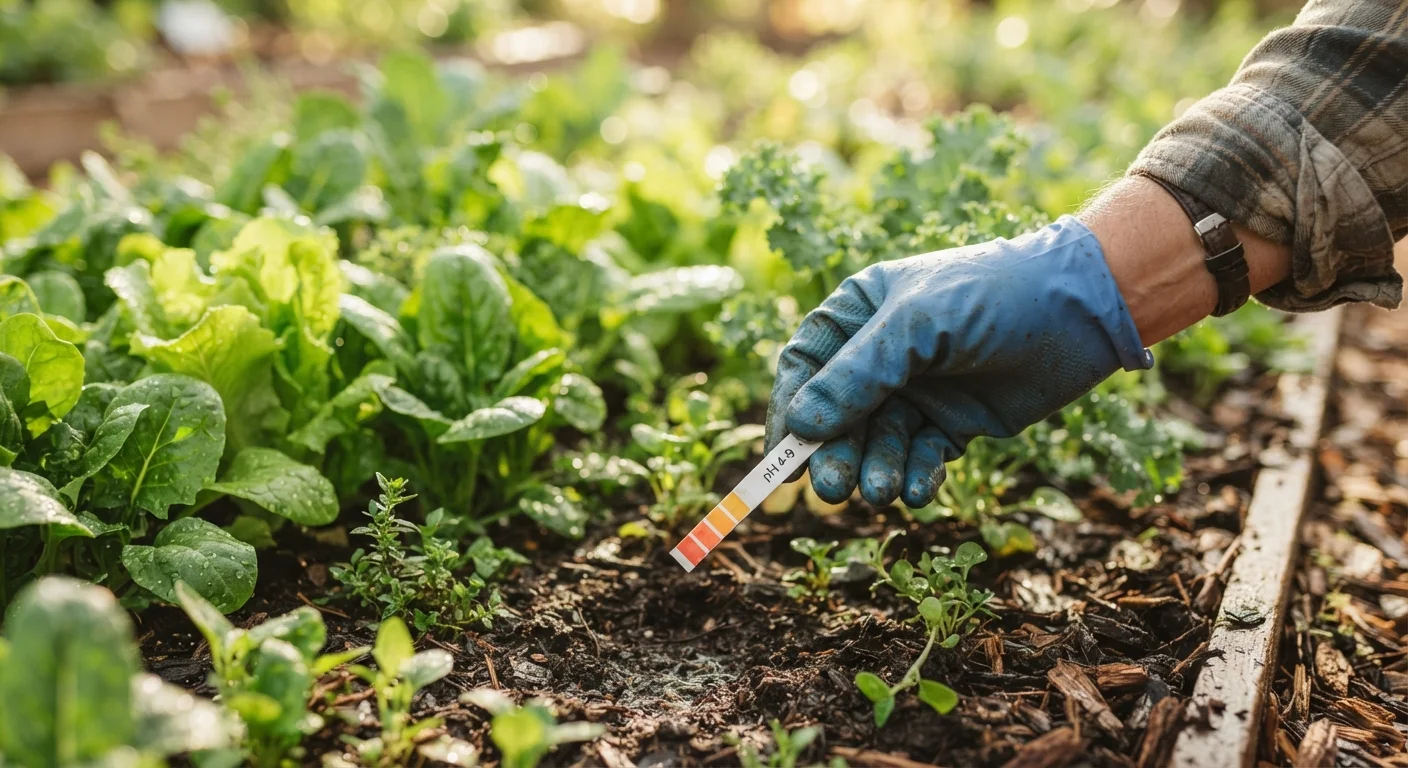
Home test kits use indicator solutions or strips that change color based on pH, giving a reliable ballpark reading. For more detailed guidance - including specific amendment recommendations for your soil type - a cooperative extension service lab test is worth the modest cost. These university-affiliated programs analyze soil texture, organic matter, and pH together, which gives you a much clearer action plan.
When you collect samples, take small amounts from several spots across the area you're testing and mix them together. A single scoop from one corner rarely represents your whole yard. Aim for samples from about 4-6 inches deep for lawn areas and 6-8 inches for garden beds.
Get the Most From Your Soil Test
Avoid testing right after applying fertilizer, lime, or compost - wait at least six to eight weeks so the amendments have stabilized. Label your samples by zone (lawn, vegetable bed, shrub border) since different areas of your yard may need different treatments.
Adjusting pH: Lime, Sulfur, and Patience
To raise pH in acidic soil, ground limestone (calcitic or dolomitic) is the standard recommendation. The amount needed depends on your current pH, your target pH, and your soil's texture - clay soils require more amendment than sandy ones to shift the same number of points. To lower pH in alkaline soil, elemental sulfur is commonly used; soil bacteria convert it into sulfuric acid over time, gradually reducing pH.
Both processes are slow. Apply amendments in fall when possible so they have the winter to integrate before the growing season. If you're preparing for spring planting, soil amendment planning fits naturally into a broader pre-season lawn prep checklist. Always follow the application rate guidelines based on your test results - more is not better with pH amendments, and over-correction creates new problems.
It's also worth noting that organic matter - compost, leaf mold, aged manure - acts as a natural buffer, helping soil resist dramatic pH swings over time. Incorporating it regularly is one of the most durable things you can do for long-term soil health. For related context on how surface materials interact with soil chemistry, see our guide on effective mulching practices.
Frequently Asked Questions
The simplest approach is a pH test kit or test strips, available at most garden centers. For more precise results, send a soil sample to your local cooperative extension service lab, which often provides testing for a low fee along with tailored recommendations.
Testing every two to three years is generally sufficient for established gardens and lawns. If you've recently amended your soil or notice persistent plant problems, annual testing gives you a clearer picture of what's changing.
pH adjustment is a gradual process. Lime and sulfur amendments typically take several weeks to months to fully alter soil chemistry. Rushing the process by over-applying amendments can cause more harm than good.
Blueberries, azaleas, rhododendrons, and camellias are classic acid-lovers that thrive at pH levels between 4.5 and 5.5. Trying to grow them in neutral or alkaline soil usually leads to yellowing leaves and poor fruit production.
Some organic mulches, like pine needles or wood chips, can gradually lower pH as they decompose. The effect is usually minor, but it's worth factoring into your overall soil management - especially in garden beds that receive heavy mulching annually.
The content provided on our blog site traverses numerous categories, offering readers valuable and practical information. Readers can use the editorial team’s research and data to gain more insights into their topics of interest. However, they are requested not to treat the articles as conclusive. The website team cannot be held responsible for differences in data or inaccuracies found across other platforms. Please also note that the site might also miss out on various schemes and offers available that the readers may find more beneficial than the ones we cover.