

How Engineers Set Speed Limits
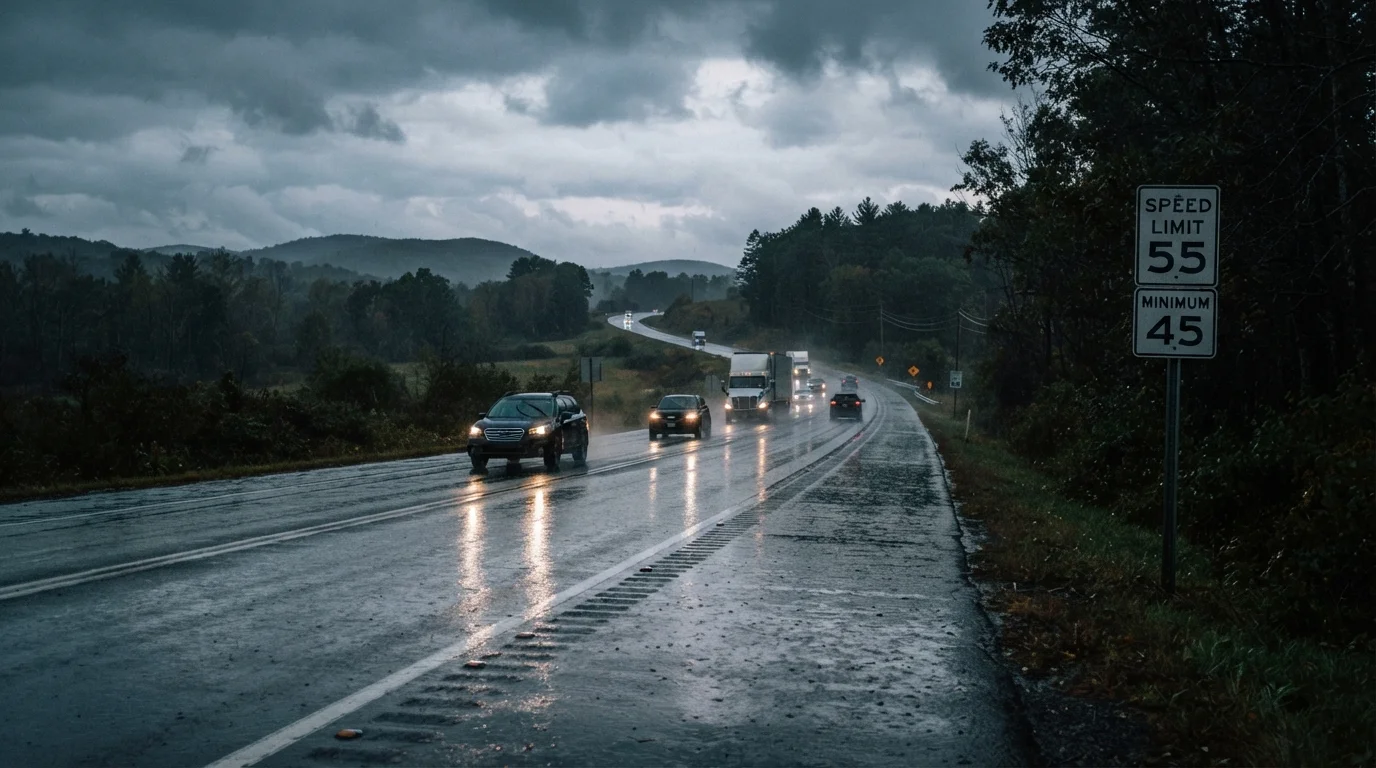
Speed limits are not arbitrary numbers painted on a sign. In the United States, they are typically the product of formal traffic engineering studies. The dominant method used by transportation agencies is the 85th-percentile rule: engineers observe free-flowing traffic on a road and identify the speed at or below which 85% of drivers naturally travel. That figure is then reviewed alongside road geometry, intersection spacing, pedestrian exposure, and historical crash data before a limit is set.
The logic behind this approach is that most drivers self-regulate reasonably well in ideal conditions. Setting the limit near the 85th percentile produces a number that reflects natural traffic behavior while leaving a legal buffer below the reckless tail of the distribution.
What this means practically: a posted limit is calibrated for typical, ideal conditions on that road. It is a legal ceiling, not a precision safety prescription valid in all weather, at all hours, with all road surfaces.
Advisory Speed Signs Are Not the Posted Limit
Yellow diamond-shaped signs with a speed number - often seen before curves or ramps - are advisory, not legally enforceable limits. They indicate the speed engineers consider comfortable for that specific feature under normal conditions. Treating them as suggestions rather than minimums is prudent; many drivers exceed them without consequence in dry weather, but they carry real meaning in wet or adverse conditions.
When the Posted Limit Stops Being the Safe Speed
The gap between the posted limit and a truly safe speed widens the moment conditions degrade. Several factors routinely push safe speed well below the sign:
- Wet or icy pavement: Stopping distances increase dramatically on slippery surfaces. Tires lose traction gradually before the driver feels it, so the margin for error shrinks fast.
- Reduced visibility: Fog, heavy rain, snow, or nighttime darkness mean your eyes receive less information about what lies ahead. As our guide to night driving challenges explains, the distance your headlights illuminate may be far shorter than your stopping distance at highway speeds.
- Curves and elevation changes: A road engineered for 55 mph on a straight, flat section may have curves where the same speed produces dangerous lateral forces - especially in a high-center-of-gravity vehicle.
- Heavy or erratic traffic: Surrounding traffic creates a constantly shifting obstacle field. Dense conditions require more reaction time, which means you need more space - and less speed.
- Tire and vehicle condition: Worn tires, under-inflated tires, or mechanical issues reduce a vehicle's ability to stop and steer predictably at any speed.
Understanding how stopping distance scales with speed is foundational here - even a 10 mph difference can add dozens of feet to the distance needed to stop safely.
Slow Down Before the Curve, Not During
Braking while turning divides your tires' grip between slowing and steering - reducing control in both directions. The correct technique is to reduce to an appropriate speed before entering a curve, then maintain or gently accelerate through it. This applies at any posted limit.
The Driver's Role: Matching Speed to Reality
Most U.S. states have what lawyers call a basic speed law - a statute holding that drivers must travel at a speed that is reasonable and prudent for current conditions, regardless of the posted limit. This means driving 55 mph in freezing fog is not legally protected simply because the sign says 55.
Skilled, attentive driving means continuously reading the environment and adjusting speed accordingly. Scanning further ahead and anticipating hazards gives you more time to adjust gradually rather than reacting abruptly - which reduces both crash risk and unnecessary wear on brakes and tires.
Speed also interacts with how traffic flows overall. Drivers who maintain appropriate spacing and adjust speed smoothly help prevent the accordion-like compression that causes phantom traffic jams. See our driver's guide to understanding traffic flow for a deeper look at how individual speed choices ripple through an entire roadway.
~4x
Stopping distance increase when speed doubles
Because kinetic energy scales with the square of velocity, doubling speed roughly quadruples the energy a vehicle's brakes must absorb - a core principle in traffic safety physics.
85th
Percentile used to set U.S. speed limits
The Federal Highway Administration's speed zone guidelines recommend basing speed limits on the 85th-percentile speed observed in traffic studies under free-flow conditions.
3x
Higher crash risk on wet vs. dry roads (approximate)
Research from the U.S. Department of Transportation has linked wet pavement to a substantially elevated proportion of weather-related road crashes compared with dry conditions.
The posted limit marks the boundary of what's legally permitted under good conditions. Treating it as a target speed in every situation - rather than a ceiling - is one of the most common and correctable habits that separates reactive drivers from genuinely safe ones.
Frequently Asked Questions
Generally, no - driving below the posted limit is legal as long as you are not impeding the normal flow of traffic unreasonably. Many states have minimum speed laws on highways, so check your state's rules. Driving significantly slower than surrounding traffic can itself create a hazard.
Traffic engineers typically conduct speed studies and use the 85th-percentile rule - the speed at or below which 85% of drivers travel under free-flow conditions. Road geometry, sight lines, pedestrian activity, and crash history are also factored in. The result is a legal ceiling, not a precision safety target.
Rain, snow, ice, fog, heavy traffic, road construction, sharp curves, nighttime darkness, and poor tire condition all reduce the margin of safe stopping and control. In these situations, a speed below the posted limit is often necessary to maintain safe vehicle control.
Not necessarily. Many states have 'basic speed laws' that allow officers to cite drivers for going too fast for conditions, even if they are at or below the posted limit. Driving 55 mph in a whiteout, for example, could still result in a citation.
Braking force must overcome kinetic energy, which increases with the square of speed - so going twice as fast requires roughly four times the stopping distance. Even a 10 mph difference can add dozens of feet to the distance needed to stop safely.
The content provided on our blog site traverses numerous categories, offering readers valuable and practical information. Readers can use the editorial team’s research and data to gain more insights into their topics of interest. However, they are requested not to treat the articles as conclusive. The website team cannot be held responsible for differences in data or inaccuracies found across other platforms. Please also note that the site might also miss out on various schemes and offers available that the readers may find more beneficial than the ones we cover.