

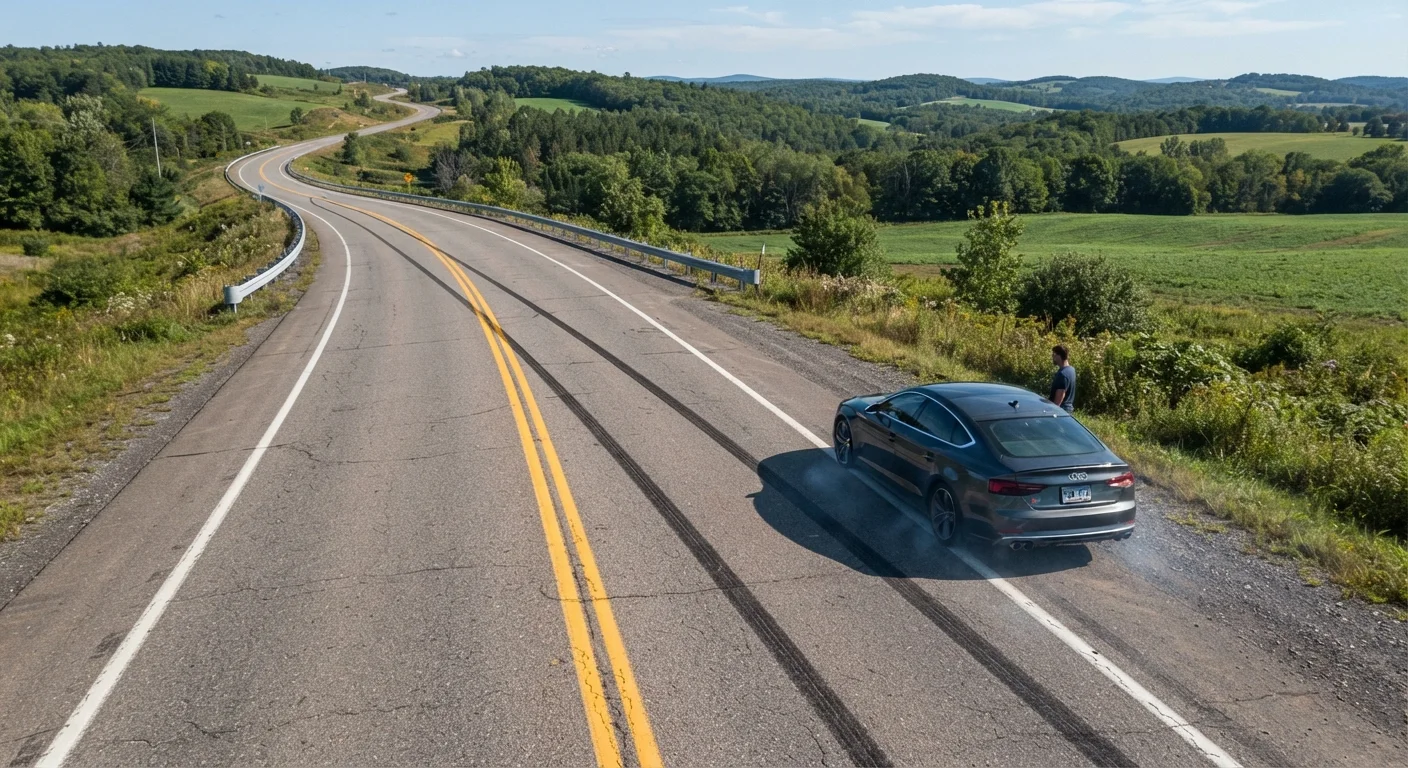
Two Forces Working Against You: Reaction Time and Braking Physics
Every stop your vehicle makes involves two distinct phases. The first is your reaction distance - the road you cover from the instant you register a threat to the moment your foot makes contact with the brake pedal. The second is your braking distance - the distance your vehicle slides while the brakes work to overcome the kinetic energy keeping it in motion.
An alert, undistracted driver typically reacts in about 1.5 seconds. At 60 mph, that reaction time alone translates to roughly 132 feet of travel before braking even starts. Add the braking distance and the total stopping distance at highway speed is often greater than half a football field under ideal dry-road conditions.
Anything that slows your reaction - fatigue, distraction, impairment, or simply not scanning the road ahead - extends that first phase further. The brakes can only work on the portion of the stop that begins after they're engaged.
Check Your Reaction Readiness
Keep your eyes scanning 10-15 seconds ahead on the road, not just at the bumper in front of you. Anticipating slowdowns before they happen gives you the maximum available time to react - effectively extending your stopping margin without changing your speed at all.
The Square Law: Why Doubling Speed Is Never Just Twice the Risk
This is the physics most drivers underestimate. Kinetic energy - the energy a moving vehicle must shed to stop - is calculated using the formula ½ × mass × velocity². The velocity is squared, which means the relationship between speed and stopping distance is not linear - it is exponential.
Consider a straightforward comparison: a vehicle traveling at 30 mph might need roughly 75 feet to stop on dry pavement once brakes are applied. At 60 mph - double the speed - braking distance grows to approximately 300 feet. That is four times longer, not twice. At 90 mph, braking distance climbs to around 675 feet - nine times the 30 mph figure.
This squared relationship is why traffic safety professionals consistently emphasize that even small reductions in speed have an outsized effect on crash survival. Arriving five minutes later is not a meaningful cost when weighed against that physics.
4×
Braking distance increase when doubling speed
Due to the squared relationship in kinetic energy, braking distance quadruples when speed doubles - a core principle in traffic safety physics education.
132 ft
Road covered during reaction time at 60 mph
Assuming a 1.5-second reaction time, a vehicle traveling at 60 mph covers approximately 132 feet before the driver's foot even reaches the brake pedal.
2×
Stopping distance increase on wet roads
Wet pavement can approximately double stopping distance compared to dry conditions, according to general traffic safety guidelines used in driver education programs.
How Road Conditions Multiply the Problem
The stopping distances described above assume dry pavement, functional tires, and a properly maintained braking system. Real-world conditions frequently depart from this baseline - sometimes dramatically.
On wet roads, stopping distances can roughly double compared to dry pavement. On packed snow or ice, stopping distances can be five to ten times longer than dry-road figures, depending on tire type and speed. The friction between tire and road surface - the technical term is the coefficient of friction - drops sharply as surface conditions deteriorate, and your brakes simply have less grip to work with.
Tire condition matters independently of road surface. Worn tread reduces the tire's ability to channel water away from the contact patch, meaning even moderate rain on tires with shallow tread can approximate icy-road braking distances. For a deeper look at technique adjustments in bad weather, see our guide on driving in rain, snow, and ice.
ABS Does Not Shorten Stopping Distance on All Surfaces
Anti-lock braking systems (ABS) help drivers maintain steering control during hard braking by preventing wheel lockup, but on loose surfaces like gravel or deep snow, ABS can actually result in longer stopping distances than threshold braking by a skilled driver. Understanding what ABS does - and does not - do helps you use it more effectively.
Following Distance: Translating Physics Into a Daily Habit
Understanding stopping distance physics makes the three-second rule feel less like an arbitrary guideline and more like a calculated minimum. To check your gap, pick a fixed reference point - a sign, overpass, or road marking - and count the seconds between when the vehicle ahead passes it and when your front bumper reaches the same point. Under three seconds means you're too close.
At highway speeds or in poor conditions, extend that gap to four or five seconds. Heavy vehicles need even more space. A loaded pickup truck or SUV carries more mass, which directly increases the kinetic energy the brakes must overcome.
The same awareness that governs safe following distance also supports fuel efficiency: reading traffic ahead and coasting toward slowdowns rather than braking hard saves fuel and reduces brake wear simultaneously. Smooth driving habits that extend stopping distance awareness into everyday driving pay dividends at both the pump and the service center.
Speed limits set by traffic engineers incorporate stopping distance data, but posted limits represent general maximums - not guarantees of safety in every condition. Understanding the gap between posted limits and safe speeds is the next layer of defensive-driving knowledge worth developing.
This article provides general driver education and is not a substitute for professional driving instruction or official traffic safety guidance.
Frequently Asked Questions
Because kinetic energy increases with the square of speed, doubling your speed roughly quadruples the distance your brakes need to bring you to a stop. At 60 mph you are not simply traveling twice as far as at 30 mph before stopping - the increase is far greater. This is why even modest speed reductions meaningfully improve safety margins.
Most traffic safety guidance recommends a minimum three-second gap between your vehicle and the one ahead under normal conditions. At highway speeds, extend this to four or more seconds to account for higher braking distances, and increase it further in rain, fog, or on slippery roads.
Reaction distance is the road covered between a driver perceiving a hazard and the moment the brakes engage. An alert, unimpaired driver typically takes about 1.5 seconds to react. At 60 mph, that alone amounts to roughly 132 feet traveled before braking even begins.
Yes, significantly. Tires with worn tread cannot channel water away effectively or grip the road surface as well as properly inflated, tread-healthy tires. This can extend stopping distances substantially, particularly on wet roads. Regular tire inspection and maintaining correct pressure are straightforward ways to preserve braking performance.
On wet surfaces, stopping distances can be roughly double those on dry pavement, depending on tire condition and vehicle. On snow or ice, the increase is even more dramatic. This is why speed adjustments in bad weather are essential, not optional.
The content provided on our blog site traverses numerous categories, offering readers valuable and practical information. Readers can use the editorial team’s research and data to gain more insights into their topics of interest. However, they are requested not to treat the articles as conclusive. The website team cannot be held responsible for differences in data or inaccuracies found across other platforms. Please also note that the site might also miss out on various schemes and offers available that the readers may find more beneficial than the ones we cover.