

Start here
Why Traffic Jams Form Out of Nowhere
Build understanding
The Science Behind Traffic Flow
Apply it
How Your Driving Behavior Affects Everyone Around You
Take action
Practical Habits That Improve Flow and Fuel Efficiency
Why Traffic Jams Form Out of Nowhere
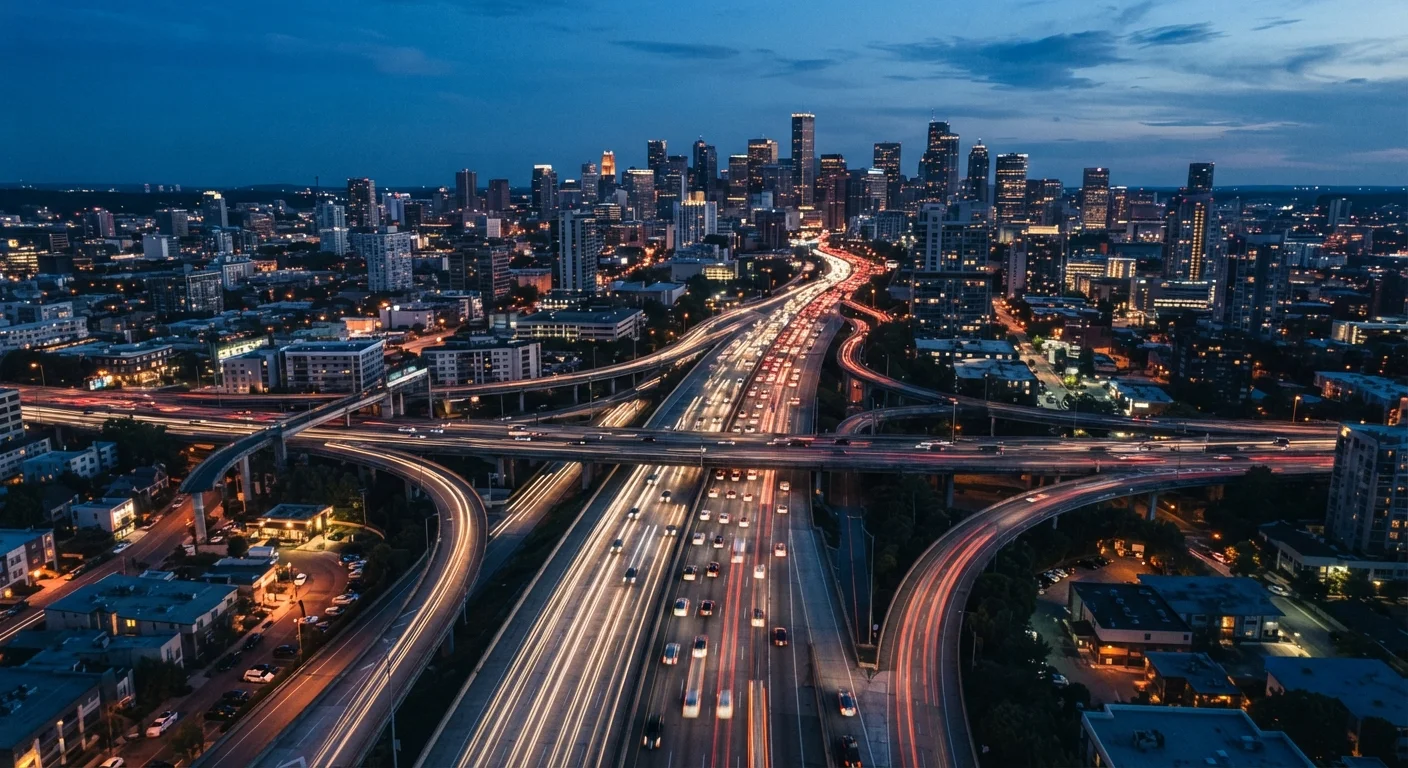
You are cruising on a clear highway when, for no apparent reason, traffic slows to a crawl. A few minutes later, the road opens up again - and there is no accident, no construction zone, nothing. This is called a phantom traffic jam, and it is one of the most common and frustrating phenomena on American roads.
Phantom jams begin with a single overreaction. One driver taps the brakes a little too hard. The driver behind sees the brake lights and reacts, braking slightly harder still. This wave of amplifying braking travels backward through traffic - a process researchers call a stop-and-go wave - until cars far behind have come to a complete stop, even though the original trigger was minor and has long since passed.
Bottlenecks can also emerge where roads narrow, lanes merge, or traffic signals are poorly timed. In each case, the underlying mechanism is the same: the road is temporarily processing more vehicles than its capacity allows, and the mismatch creates a queue that grows upstream.
Traffic Flow Is a Shared Resource
Road capacity is a shared, finite resource - every driver's choices affect it. While individual drivers cannot control congestion on a large scale, the collective behavior of a group of drivers who maintain spacing and drive smoothly has been shown in traffic flow studies to noticeably reduce the frequency and severity of stop-and-go waves. Small changes, applied consistently, matter.
The Science Behind Traffic Flow
Traffic engineers study road capacity using concepts borrowed from fluid dynamics. A highway lane has a theoretical throughput - a maximum number of vehicles per hour it can move at a given speed. Counterintuitively, throughput often drops when speeds drop. Slow, closely packed traffic moves fewer cars per hour than traffic flowing steadily at moderate speed with adequate spacing.
This is why dense, slow traffic is self-defeating. Vehicles packed tightly together leave no room for minor speed adjustments, so every small disturbance ripples backward as a braking wave rather than being absorbed quietly by available space.
Phantom traffic jam
A traffic slowdown or standstill that forms with no physical obstruction, caused entirely by a cascading chain of overreactions from driver to driver.
Stop-and-go wave
A pattern where braking by one driver triggers progressively harder braking in drivers behind, sending a wave of slowdowns backward through traffic.
Road capacity
The maximum number of vehicles a stretch of road can move efficiently in a given time period under normal conditions.
Throughput
The actual number of vehicles passing a point on the road per hour; throughput can drop sharply when traffic becomes dense and slow.
Zipper merge
A merging technique where drivers in both lanes use all available road space and take turns merging one-for-one at the point where lanes combine.
Following distance
The space maintained between your vehicle and the one directly ahead, typically measured in seconds of travel time rather than fixed car lengths.
Lane changes also play a larger role than most drivers realize. Each merge cuts into another driver's following distance, triggering a small braking event. On a congested road, enough of these small events add up to measurable slowdowns. Understanding this helps explain why high-merge-frequency zones near on-ramps are disproportionately prone to congestion.
How Your Driving Behavior Affects Everyone Around You
Most drivers think of their behavior as affecting only their own trip. In reality, every action you take sends a signal to the drivers around you - through brake lights, turn signals, and the gap you leave ahead.
The three-second following rule - maintaining at least three seconds of space between you and the vehicle ahead - is commonly taught for safety reasons, but it is equally valuable for traffic flow. A larger gap gives you time to ease off the accelerator rather than brake, so the driver behind you sees no brake lights at all. Your smoothness becomes their smoothness.
Similarly, aggressive lane changes force nearby drivers to adjust. Cutting into a tight gap means the driver you merged in front of must brake to re-establish a safe distance, sending a braking signal backward. Smooth, predictable driving benefits the entire road - not just your fuel gauge.
Use Cruise Control on Open Highways
On clear stretches of highway, cruise control maintains a perfectly steady speed without the micro-fluctuations that happen when you manage throttle manually. This reduces the small speed variations that can trigger braking waves behind you, and it typically improves fuel efficiency at the same time.
Practical Habits That Improve Flow and Fuel Efficiency
Knowing the theory is useful; changing your habits is what matters. The following practices are straightforward to apply and have a measurable impact on both traffic flow and fuel consumption.
- Increase your following distance. Aim for at least three seconds on surface roads and four or more seconds on highways. The extra buffer lets you absorb speed fluctuations without braking.
- Scan further ahead. Look beyond the car directly in front of you. Watching three to five vehicles ahead gives you earlier warning of slowdowns, so your response is gradual rather than reactive.
- Accelerate gently after stops. Rapid acceleration after a red light burns extra fuel and often delivers you to the next red light faster than a smooth build-up would. Gradual acceleration keeps traffic behind you moving more evenly.
- Avoid unnecessary lane changes. Each merge introduces a braking event for another driver. Stay in your lane when your current lane is moving reasonably well.
- Use the zipper merge correctly. In a lane closure, use the full length of the closing lane before merging, and let one car from each lane take turns. This approach is more efficient than early merging when traffic is heavy.
These habits connect directly to fuel savings. Stop-and-go driving is a significant drain on fuel efficiency, and smoothing out your behavior in congestion reduces how often you cycle between hard acceleration and braking. Consistent, gentle inputs keep your engine operating more efficiently across the board.
Well-maintained tires also play a role - under-inflated tires increase rolling resistance, which raises fuel consumption and makes your car slightly less responsive. See our tire pressure and tread guide for a practical maintenance checklist. For a broader look at keeping your vehicle road-ready, the car maintenance hub covers essential upkeep tasks every driver should know.
Frequently Asked Questions
Phantom jams form when one driver brakes slightly harder than necessary, causing the driver behind to brake more, and so on down the line. This wave of braking amplifies backward through traffic until cars far behind must stop completely. No accident or bottleneck is required - overreaction alone is the trigger.
Yes, significantly. A larger gap between you and the car ahead gives you more time to respond to slowdowns gently rather than braking hard. This gentler response reduces how much those behind you must brake, dampening the ripple effect before it can grow into a jam.
Frequent hard braking wastes the kinetic energy your engine worked to build, and rapid re-acceleration demands a burst of fuel to rebuild speed. Gentle, consistent speed management preserves momentum and reduces how hard the engine must work.
Traffic engineers generally recommend using the full length of a merging lane before combining - often called a zipper merge. Early merging can create uneven lane loading that worsens congestion upstream, while a coordinated late merge uses available road space more efficiently.
Research in traffic flow theory suggests that a single driver maintaining steady speed and appropriate following distance can buffer instabilities that would otherwise escalate. While one driver cannot fix heavy congestion, they can prevent minor slowdowns from compounding into larger jams.
The content provided on our blog site traverses numerous categories, offering readers valuable and practical information. Readers can use the editorial team’s research and data to gain more insights into their topics of interest. However, they are requested not to treat the articles as conclusive. The website team cannot be held responsible for differences in data or inaccuracies found across other platforms. Please also note that the site might also miss out on various schemes and offers available that the readers may find more beneficial than the ones we cover.