

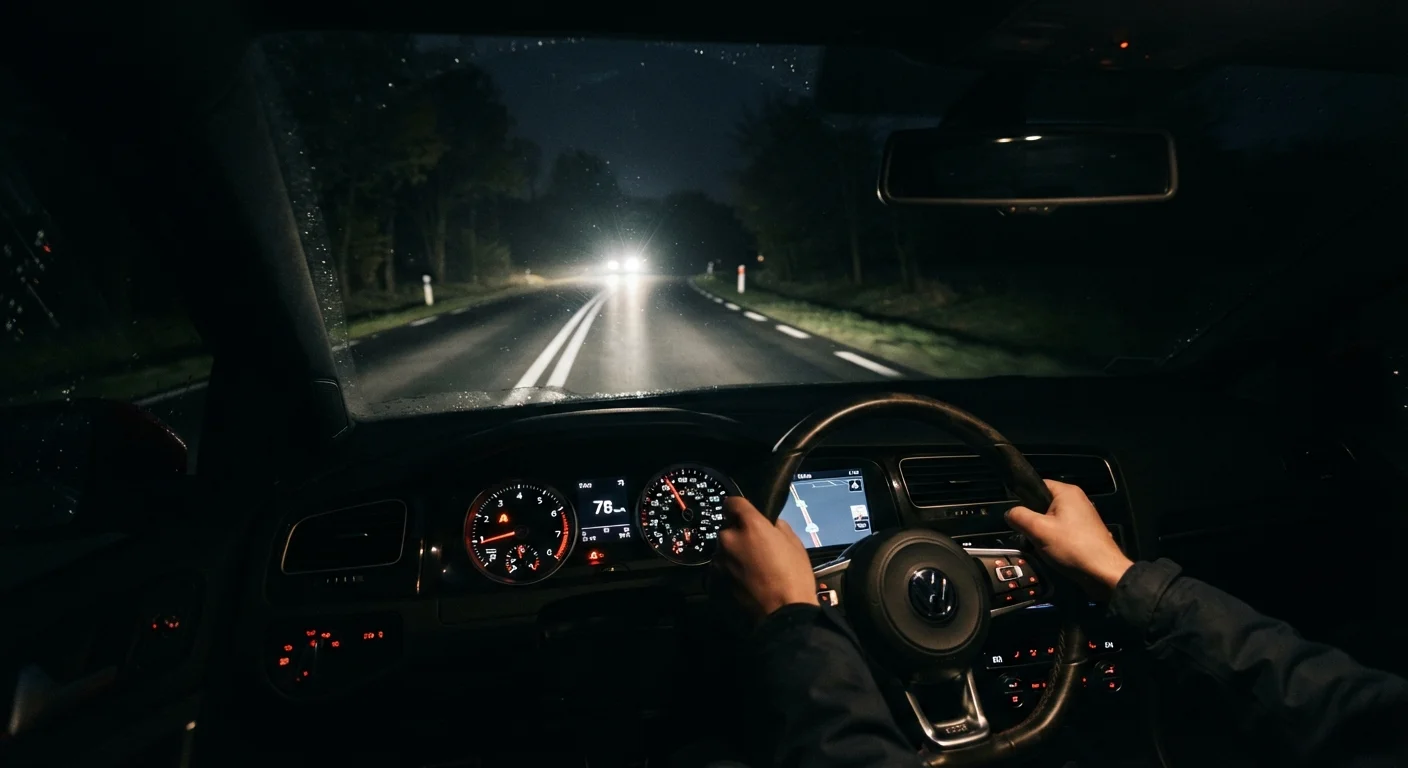
What Happens to Your Vision After Dark
Daylight driving relies on cone cells in the eye - the receptors that resolve fine detail and color. Once the sun sets and ambient light drops, the eye shifts to rod cells, which are more sensitive to dim light but far worse at resolving edges, shapes, and colors accurately. The transition is slow: full dark adaptation can take 20-30 minutes, meaning the first stretch of any night drive is the period of greatest visual vulnerability.
Even after adaptation, the effective visual field narrows. Peripheral vision, which is crucial for detecting movement like a pedestrian stepping off a curb, becomes less reliable. Depth perception also degrades without strong ambient light cues, making it harder to judge the distance to other vehicles or obstacles accurately.
Headlights compensate partially, but they create their own limitations. Standard low-beam headlights typically illuminate only 160-200 feet ahead. At 60 mph, a vehicle covers that distance in roughly 1.8 seconds - leaving almost no margin if a hazard appears at the edge of the light cone. This is why the concept of overdriving your headlights - traveling faster than your ability to stop within the illuminated distance - is a recognized and preventable risk factor.
Glare, Contrast Loss, and the Hidden Hazard Zone
Oncoming headlights introduce a repeating cycle of temporary blindness. When bright light hits the dark-adapted eye, the pupil constricts and rod sensitivity resets momentarily. Recovery takes several seconds - and during that window, low-contrast hazards like dark-clothed pedestrians, deer, or road debris effectively disappear from view.
Modern LED and high-intensity headlights, while superior for the driver using them, can intensify glare for oncoming traffic. Looking toward the right edge lane marking rather than directly at oncoming lights is the standard guidance for managing this - it keeps you on course without directing your gaze into the brightest point of the beam.
3×
Higher fatal crash rate at night vs. daytime
According to the National Highway Traffic Safety Administration (NHTSA), fatal crash rates per mile traveled are approximately three times higher at night than during daylight hours.
~160-200 ft
Typical low-beam headlight range
Most standard low-beam headlights illuminate the road approximately 160 to 200 feet ahead, limiting safe stopping distances at highway speeds.
30 min
Time for full dark adaptation
Vision researchers generally estimate that the human eye requires up to 30 minutes to reach full dark adaptation after exposure to bright light.
Contrast loss is a related and underappreciated problem. During the day, your brain reads the road partly through color contrast and shadow detail. At night those cues are stripped away, making it harder to detect pavement changes, potholes, debris, or the subtle shift that signals a curve. Good anticipatory scanning - looking further down the road and reading lane lines, guardrails, and reflectors as navigation aids - partially compensates. For a deeper look at how scanning technique improves safety, see how anticipation reduces risk on the road.
Fatigue: The Cognitive Multiplier
Visual limitations alone do not account for night driving's elevated risk. Fatigue is a major co-factor, and it tends to peak during the same hours most people drive after dark - particularly between midnight and 6 a.m., when the body's circadian rhythm signals it is time to sleep.
Fatigued driving impairs reaction time, narrows attention, and degrades the quality of decisions in ways that closely mirror mild alcohol impairment. Critically, drivers are poor self-judges of their own fatigue - the cognitive decline tends to arrive before the subjective feeling of sleepiness catches up. For a thorough explanation of that gap, understanding how fatigue sneaks up on drivers is worth reading before any long after-dark journey.
Increase Your Following Distance at Night
During daylight, a two-to-three-second following gap is generally considered adequate. After dark, extending that to at least four seconds provides meaningful additional reaction time to account for slower processing speed and reduced visibility. On rural or unlit roads, extending it further is a reasonable precaution.
Beyond biological fatigue, the monotony of night driving - reduced visual stimulation, less traffic, quieter roads - accelerates attentional drift. Drivers may remain technically awake while their ability to process hazards slips substantially. Increasing following distance to at least four seconds at night (versus the standard two to three during the day) builds in reaction time that compensates for this effect.
Practical Habits and Vehicle Checks That Make a Difference
Several straightforward habits meaningfully reduce night-driving risk without requiring new equipment:
- Clean your windshield inside and out. Interior film and streaks scatter headlight beams from oncoming vehicles and amplify glare. Using a glass-specific cleaner on the inside surface is one of the most overlooked and effective adjustments.
- Verify headlight aim. Misaligned headlights - a common result of minor front-end impacts - illuminate the wrong part of the road. Most service centers can check and adjust aim during routine maintenance visits.
- Dim dashboard and interior lights. A bright infotainment screen or overly lit instrument cluster reduces the contrast between the interior and exterior, slowing your eyes' ability to read the dark road ahead.
- Allow more following distance. Stopping distances do not change at night, but reaction time often does - give yourself more space to use it.
- Schedule night drives strategically. When you have control over departure time, avoiding the highest-fatigue windows (midnight to 6 a.m.) is the single most effective fatigue-management choice.
Before any extended night journey, a quick vehicle check is worth the time. The pre-trip inspection checklist covers lights, tires, and fluid levels that all affect how your vehicle performs in low-visibility conditions. Tire condition in particular matters - wet or poorly maintained roads at night compound the already limited reaction time you have. See the driver's field guide to tire pressure and tread depth for specifics.
Night driving also demands a reassessment of speed. Posted limits are engineered for good conditions, but darkness rarely qualifies. Understanding the difference between posted and safe speeds explains why the gap between those two numbers widens significantly after dark.
Frequently Asked Questions
Reduced light limits how far you can see, slowing your ability to identify and react to hazards. Fatigue is also more common at night, and glare from other vehicles adds a recurring, temporary blindness effect. Fatal crash rates per mile are significantly higher at night than during daylight hours.
Look toward the right edge of the road rather than directly at oncoming lights - this keeps you oriented without staring into the glare. Keeping your windshield clean on both sides also reduces light scatter. If your vehicle has an auto-dimming mirror, verify it is functioning correctly.
A general principle is to drive at a speed from which you could fully stop within the distance your headlights illuminate - often called 'driving within your headlights.' Standard low-beam headlights illuminate roughly 160-200 feet ahead, which limits safe reaction speeds considerably below posted limits on dark roads.
Fatigue slows reaction time, narrows attention, and impairs judgment - effects that overlap significantly with mild alcohol impairment. At night, the body's circadian rhythm also promotes drowsiness, making it harder to self-assess how impaired you actually are.
Yes. The pupil's ability to dilate in low light diminishes with age, reducing the amount of light reaching the retina. Older drivers also tend to experience more sensitivity to glare and take longer to recover from bright light exposure, making nighttime driving progressively more demanding.
Significantly. A hazy or streaked windshield scatters incoming light, amplifying glare and reducing contrast. Cleaning the interior surface of the windshield - often neglected - and replacing worn wiper blades can meaningfully improve nighttime clarity.
The content provided on our blog site traverses numerous categories, offering readers valuable and practical information. Readers can use the editorial team’s research and data to gain more insights into their topics of interest. However, they are requested not to treat the articles as conclusive. The website team cannot be held responsible for differences in data or inaccuracies found across other platforms. Please also note that the site might also miss out on various schemes and offers available that the readers may find more beneficial than the ones we cover.