

Why Lenders Rely on a Single Number
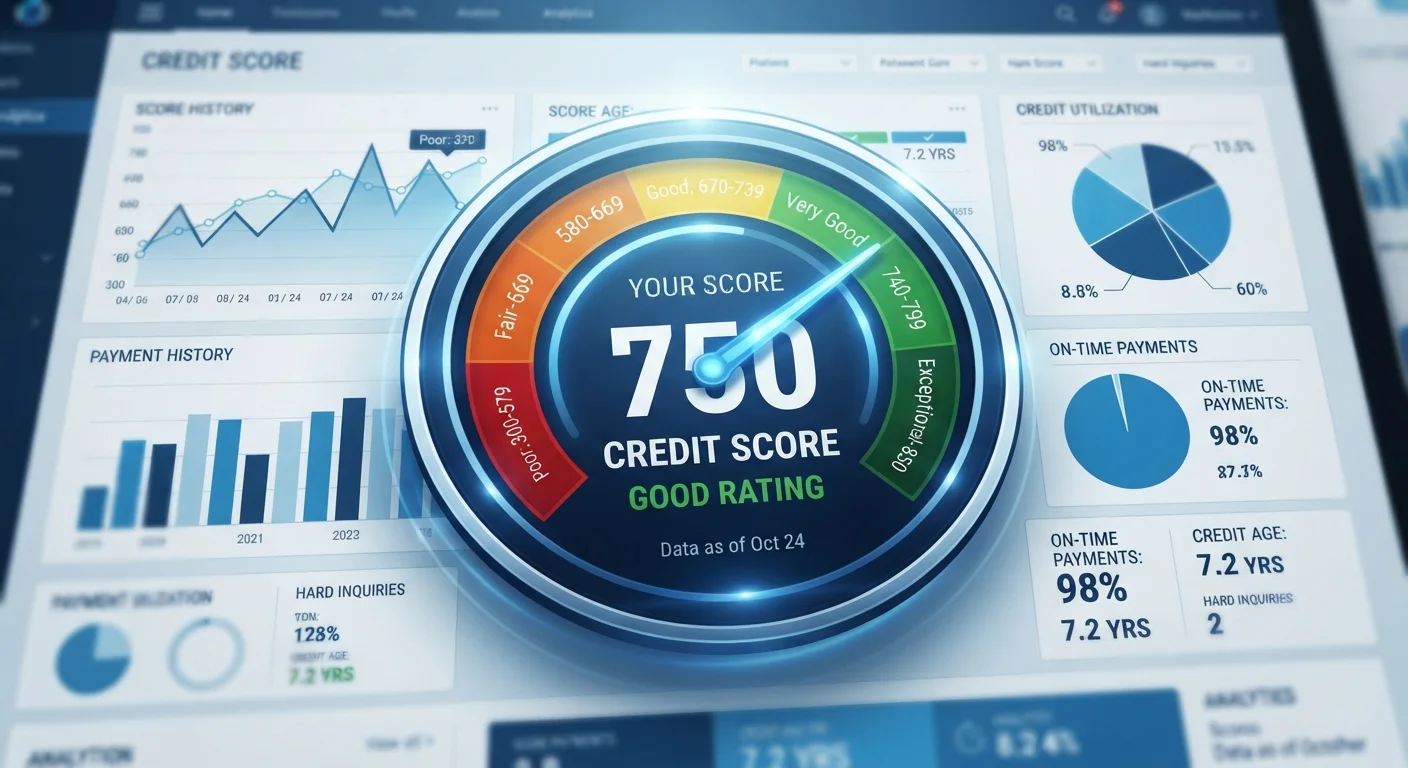
When a lender receives a loan application, they need to make a fast, data-driven judgment about risk. Reviewing years of financial behavior manually for every applicant isn't practical at scale. A credit score solves that problem by compressing your entire borrowing history into a single, comparable number.
It's worth understanding that the score doesn't measure your wealth, income, or financial intelligence. Two people with identical salaries can have dramatically different scores based purely on how they've managed credit accounts. The number is a risk signal - a statistical estimate of the likelihood that you'll fall 90 or more days behind on a payment in the next 24 months. That framing helps explain why certain behaviors move the needle and others don't.
For a deeper look at how scores relate to the underlying data, see Credit Reports and Credit Scores: Not the Same Thing.
The Five Factors - and How Much Each One Counts
The FICO model breaks your score into five weighted categories. Understanding what each one measures - and how much it matters - is the most actionable thing you can take from this article.
35%
Weight of payment history in FICO scoring
Per the FICO scoring model breakdown published by Fair Isaac Corporation, payment history is the single heaviest factor in your score.
300-850
Standard FICO score range
The FICO Score scale runs from 300 to 850; most lenders consider scores above 670 to be in the 'good' range or better.
7 years
How long most negative marks stay on your report
Under the Fair Credit Reporting Act, most derogatory items - including late payments and collections - can remain on your credit report for up to seven years.
1. Payment History (≈35%)
This is the biggest lever. Every on-time payment reinforces your score; every missed or late payment damages it. A single 30-day-late mark can drop a strong score by 60-110 points, and the damage lingers on your report for up to seven years. Consistent, on-time payments are the foundation of a healthy score.
2. Credit Utilization (≈30%)
This measures how much of your available revolving credit you're currently using. If your combined credit card limits total $10,000 and your balances total $3,000, your utilization rate is 30%. Most credit guidance suggests keeping this below 30%, though lower is generally better. How Credit Utilization Works - and Why Most People Mismanage It explores this factor in detail.
3. Length of Credit History (≈15%)
The model rewards longevity. It considers the age of your oldest account, your newest account, and the average age of all your accounts. This is why abruptly closing old credit cards can sometimes hurt your score even if you're not using them.
4. Credit Mix (≈10%)
Lenders view borrowers who can responsibly manage different types of credit - revolving accounts like credit cards and installment loans like auto or student loans - as lower risk. You don't need every type of credit, but some variety does help.
5. New Credit Inquiries (≈10%)
When you apply for new credit, lenders run a hard inquiry on your report. Multiple hard inquiries in a short period can signal financial stress. The impact is small and temporary, typically fading within 12 months, and rate-shopping for mortgages or auto loans within a short window is usually treated as a single inquiry by scoring models.
What Your Score Doesn't Capture
Your credit score is a narrow measure. It doesn't account for your income, savings, assets, employment stability, or net worth. It also doesn't factor in utility payments, rent, or most subscription accounts unless those providers explicitly report to a bureau.
This matters because a score can look strong while someone is financially stretched - or look thin while someone is financially solid but hasn't used much credit. Understanding those limits helps you interpret the number more honestly and avoid over-optimizing for a score at the expense of broader financial health.
Common misconceptions about what behaviors help or hurt your score are covered in Credit Score Myths That Lead People into Poor Financial Decisions.
This article is for general informational and educational purposes only and does not constitute personalized financial or legal advice. Consult a qualified financial professional for guidance specific to your situation.
Frequently Asked Questions
Under the FICO model, scores of 670-739 are generally considered 'good,' while 740-799 is 'very good' and 800 and above is 'exceptional.' However, lenders set their own thresholds, so what qualifies you for the best terms depends on the specific institution and loan product.
Your score can change whenever new information is reported to the credit bureaus, which typically happens monthly as lenders send updated account data. A single late payment or a significant drop in your credit utilization can shift your score within a billing cycle.
No. Checking your own score is called a 'soft inquiry' and has no impact on your credit score. Only 'hard inquiries' - which occur when a lender checks your credit as part of a formal application - can cause a small, temporary dip.
Generally, no. Credit scores are generated from credit report data, and if you have no credit accounts, you likely have no scorable file. This is sometimes called being 'credit invisible.' Secured cards and credit-builder loans are common starting points for establishing a credit history.
Not all lenders report to all three major bureaus - Equifax, Experian, and TransUnion. If one bureau has different account data than another, the score it generates will differ. The scoring model version used can also cause variation.
The content provided on our blog site traverses numerous categories, offering readers valuable and practical information. Readers can use the editorial team’s research and data to gain more insights into their topics of interest. However, they are requested not to treat the articles as conclusive. The website team cannot be held responsible for differences in data or inaccuracies found across other platforms. Please also note that the site might also miss out on various schemes and offers available that the readers may find more beneficial than the ones we cover.