

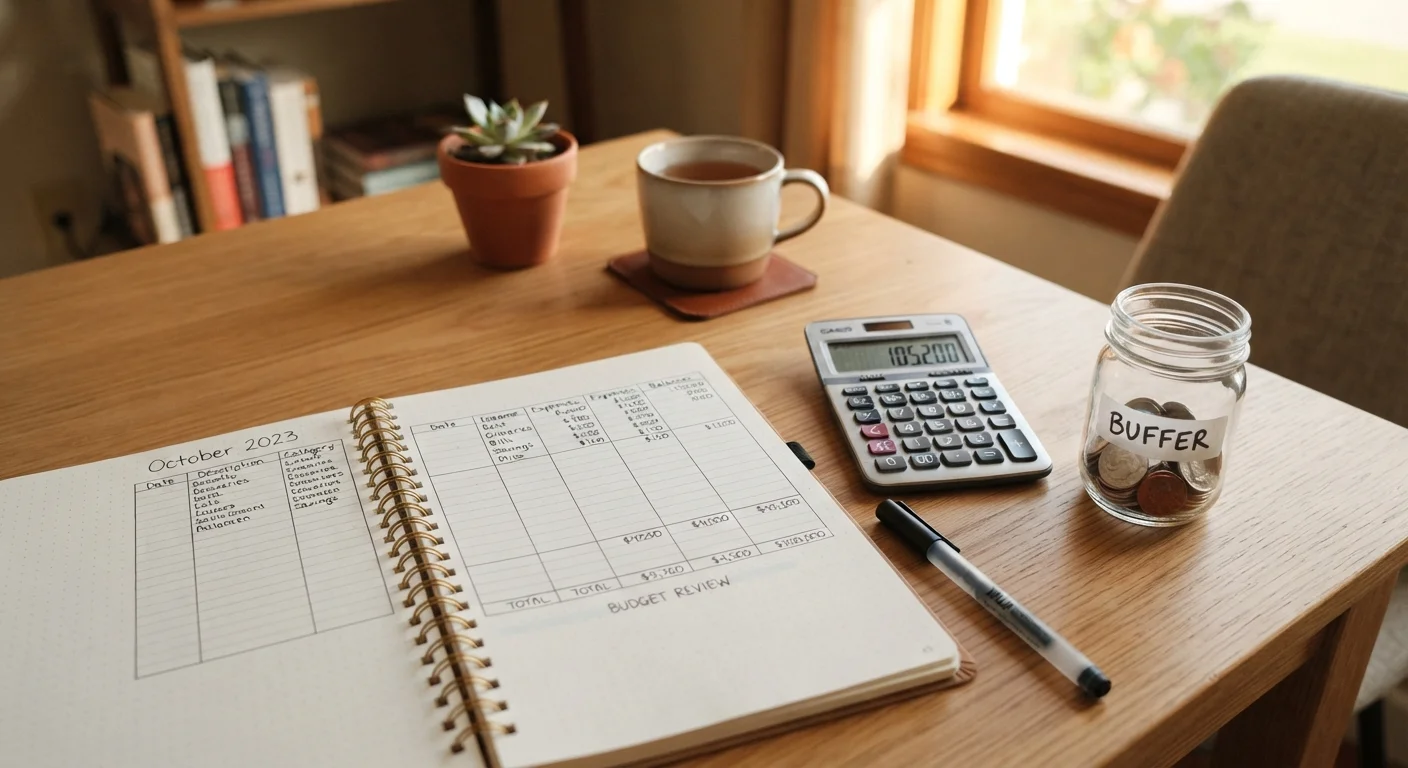
Why Budgets Fail Before the Month Is Over
The most common budgeting complaint isn't overspending on lattes - it's that something always comes up. A $200 vet bill. A co-pay that wasn't expected. A registration renewal that slipped the mind. Each event feels random, but collectively they form a pattern: irregular expenses are regular in the aggregate. They happen every year, in roughly predictable amounts, to virtually everyone.
The problem is that standard budgets are built around recurring, fixed-amount costs - rent, utilities, subscriptions. Variable costs that don't arrive on a schedule get mentally classified as surprises and left unplanned. That gap is where most budgets collapse.
Building a realistic buffer means acknowledging this reality and carving out space for it proactively. It's less about predicting any single expense and more about accepting that something will come up, quantifying what that something typically costs you, and reserving for it deliberately. If you haven't yet established the foundation of a working monthly budget, start there first - a buffer only functions inside a budget that already accounts for your regular spending.
What You'll Need Before You Start
Gathering the right inputs upfront makes every subsequent step faster and more accurate.
What you will need
Bank or credit card statement history
Used to identify irregular expenses from the past 12 months and calculate an accurate annual total.
Spreadsheet or budgeting app
Organizes expense data by category and calculates monthly buffer amounts from annual totals.
Separate savings account
Holds buffer funds in a dedicated account so they aren't accidentally spent before they're needed.
Step-by-Step: Building Your Budget Buffer
Follow these steps in order. Each one builds directly on the last.
Pull 12 months of real spending data
Log into your bank and credit card accounts and export or review your last 12 months of transactions. You're specifically hunting for expenses that didn't occur every single month - things like car registration, a medical co-pay, a home repair, a pet expense, or a quarterly insurance payment. List each one with its date and amount.
Don't try to do this from memory. Memory systematically underestimates irregular costs by 30-50% - the whole point of the exercise is to let your actual history speak.
Categorize and total the irregular expenses
Group the expenses you found into broad categories: auto (repairs, registration, tires), health (co-pays, prescriptions, dental), home (repairs, appliances, supplies), and miscellaneous (gifts, fees, one-off costs). Total each category across the full 12 months.
Add all category totals together to get your annual irregular spending figure. This number is your baseline - the floor of what your budget needs to accommodate.
Convert the annual total into a monthly buffer amount
Divide your annual irregular spending total by 12. That result is the minimum monthly amount you should set aside in a dedicated budget line item labeled something like "Monthly Buffer" or "Irregular Expenses."
For example: if your 12-month total for irregular costs was $1,800, your monthly buffer is $150. That $150 gets budgeted every month whether or not you expect a specific expense that month. Months when it goes unspent, it rolls forward or transfers to savings.
Add a 15-20% padding for the costs you missed
Your 12-month lookback is accurate but incomplete. Cash purchases, shared expenses, or costs paid from a partner's account won't show up in your data. Add 15-20% to your calculated monthly buffer to account for these gaps.
Using the example above: $150 × 1.20 = $180 per month. This adjusted figure is what you enter as your budget line item.
Open a dedicated holding account (optional but recommended)
If your budget buffer funds sit in your main checking account alongside everything else, they will get spent. Consider moving the monthly buffer amount into a separate savings account - ideally one without a debit card - on the same day each month. Transfer back to checking only when an actual irregular expense occurs.
This physical separation does the psychological work of making buffer funds feel off-limits for routine spending.
Review and recalibrate every six months
Your buffer amount isn't permanent. Life circumstances change - a new car, a new pet, aging home systems, or a change in health coverage all shift your irregular expense baseline. Every six months, compare what you've actually spent from your buffer against what you set aside. Adjust the monthly amount up or down accordingly.
A buffer that's consistently underspent by a wide margin means you're over-saving in this category; reallocate that excess to debt paydown or savings goals instead.
Start Small If the Full Amount Feels Tight
If your calculated buffer would strain your current cash flow, start with half the target amount and increase it by $10-$25 each month. An imperfect buffer that you can actually maintain is far more valuable than a correct number you abandon after 60 days. Progress over perfection is the practical standard here.
Buffer vs. Emergency Fund vs. Sinking Fund
These three tools are often confused, but they serve distinct purposes and work best together rather than as substitutes for each other.
| Tool | Purpose | Access Timing |
|---|---|---|
| Budget buffer | Absorbs irregular but foreseeable monthly variation | Current month |
| Emergency fund | Covers true financial shocks - job loss, major medical event | When crisis hits |
| Sinking fund | Pre-saves for a known future cost (car insurance annual payment, holiday gifts) | When the expense arrives |
Your buffer sits inside your monthly spending plan. Your emergency fund sits outside it - in a separate, accessible savings account you don't touch for ordinary variation. For recurring but infrequent costs with a known amount, a sinking fund is a sharper tool than a general buffer. If a major event has already depleted your cushion, the path to rebuilding follows a different playbook.
Don't Raid Your Emergency Fund for Irregular Expenses
Using your emergency fund to cover a car repair or an annual insurance premium isn't a financial emergency - it's a planning gap. Repeatedly dipping into emergency savings for foreseeable irregular costs leaves you exposed when a genuine crisis hits. Your buffer exists precisely so your emergency fund can stay untouched for true emergencies like job loss or a major unexpected medical event.
Understanding the difference between fixed and variable expenses also sharpens how you size each of these categories - fixed costs need no buffer, variable costs often do.
This article provides general financial education and is not personalized financial advice. For guidance tailored to your specific situation, consider consulting a licensed financial professional.
The content provided on our blog site traverses numerous categories, offering readers valuable and practical information. Readers can use the editorial team’s research and data to gain more insights into their topics of interest. However, they are requested not to treat the articles as conclusive. The website team cannot be held responsible for differences in data or inaccuracies found across other platforms. Please also note that the site might also miss out on various schemes and offers available that the readers may find more beneficial than the ones we cover.