

Why Most Budgets Break Down Before Month Two
Most people who try budgeting once and quit aren't failing at math - they're working with a plan that was never realistic in the first place. A budget built on rounded guesses and optimistic estimates will collide with actual life almost immediately. The result is frustration, abandonment, and the conclusion that budgeting 'doesn't work for me.'
The fix isn't more discipline. It's building the budget on accurate numbers from the start, then giving yourself permission to revise it as you learn more about your own spending patterns. If you're starting from absolute zero, our foundational guide covers every step before this one. For a deep dive into why second-month failure is so common - and how to design around it - see why budgets fail in month two.
Use Take-Home Pay, Not Gross Income
A common early mistake is building a budget around your pre-tax salary. Taxes, health insurance premiums, and retirement contributions come out before you see a dollar. Always base your budget on the net amount deposited into your bank account - that's the money you actually have to allocate.
The goal of this guide is a budget you'll still be using in three months, not one that looks perfect on day one.
What You'll Need Before You Start
Gathering the right inputs before you build saves time and produces a more accurate first draft. You don't need specialized software - a notebook works fine - but you do need real data.
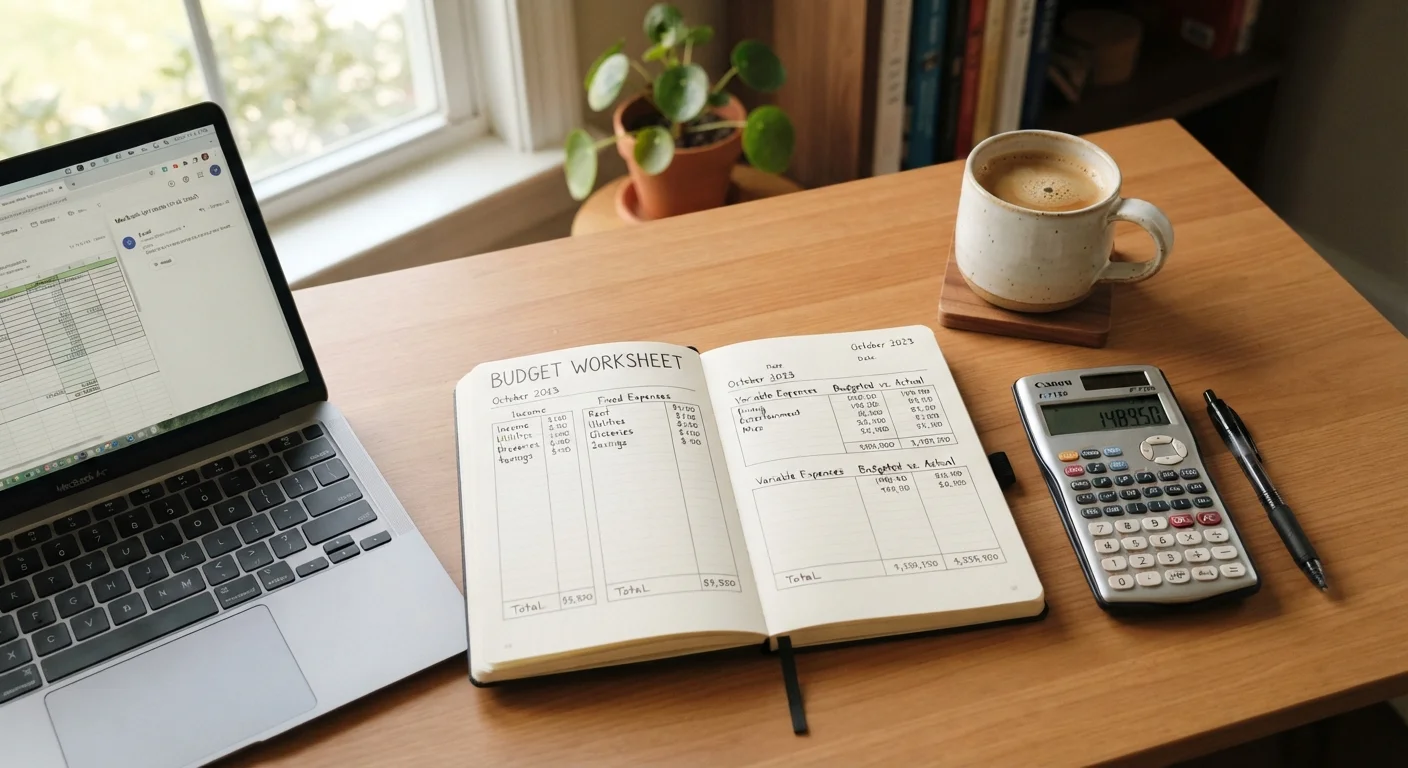
What you will need
Bank or Credit Card Statements
Provides an accurate record of actual spending across categories over recent months.
Spreadsheet or Budgeting App
Used to record income, list spending categories, and track budget vs. actual each month.
Pay Stubs or Income Records
Confirms your exact take-home pay - the foundation of any realistic budget.
Calculator
Helps total up category spending and verify that allocations match available income.
Once you have these materials in hand, the steps below walk you through the full build process from income calculation to your first monthly review.
Step-by-Step: Building Your Monthly Budget
Follow these steps in order. Each one builds on the previous, so skipping ahead tends to produce gaps that cause problems later.
Calculate Your True Monthly Take-Home Income
Add up every reliable source of after-tax income: wages, freelance payments, side income, child support, or any other regular deposits. If your income varies - for example, if you work hourly or on commission - use a conservative estimate based on your lowest recent months rather than your best. For more on handling income variability, see budgeting on an irregular income.
List All Fixed Expenses First
Fixed expenses are obligations that stay the same every month: rent or mortgage, car payments, minimum loan payments, insurance premiums, and recurring subscriptions. List each one with its exact amount. These are non-negotiable in the short term, so place them at the top of your allocation list before anything else is assigned.
Estimate Variable Spending by Category
Pull out two to three months of statements and categorize every transaction: groceries, dining out, gas, utilities, clothing, personal care, entertainment, and anything else that appears. Average each category across those months to get a realistic baseline. This step reveals where money actually goes - not where you assume it goes.
Assign Every Dollar a Category
Subtract your fixed expenses from take-home income. What remains is your discretionary pool - the money available for variable spending, savings, and debt repayment beyond minimums. Allocate specific dollar amounts to each category until you reach zero. This is the core of zero-based budgeting: income minus all allocations equals zero. If you'd prefer a simpler framework, the 50/30/20 rule divides income into needs, wants, and savings without requiring granular category tracking.
Build In a Buffer for Irregular Costs
Even a well-crafted budget meets unexpected costs - a co-pay, a car repair, a birthday gift. Reserve a small monthly buffer (often called a 'miscellaneous' or 'buffer' line) within your budget rather than letting surprises blow up the whole plan. Our article on building a realistic buffer explains how to size this amount based on your actual financial history.
Review and Adjust at Month's End
At the end of each month, compare what you budgeted against what you actually spent in each category. Categories that consistently run over need a higher allocation or a behavioural change - not willpower alone. Categories that consistently come in under can redirect funds elsewhere. This monthly review is what turns a budget from a static document into a useful tool. For a structured checklist to guide this review, see our spending audit guide.
Don't Underestimate Variable Spending
Groceries, gas, dining out, and personal care costs fluctuate month to month. Reviewing at least two to three months of actual bank or credit card statements before you set category limits gives you a realistic baseline. Guessing low here is one of the most common reasons first budgets fall apart. See our spending audit guide for a structured approach to uncovering these numbers.
After your first full month on the budget, you'll likely find two or three categories that need recalibration. That's normal - and expected. The complete budgeting reference guide covers advanced adjustments once you've got the basics dialed in.
Keeping Your Budget Alive Long-Term
A budget that works is one you return to. That requires two things: a system simple enough to maintain without significant effort, and flexibility built in from the start. Rigid category limits with no room for error tend to produce guilt and abandonment rather than behaviour change.
Automate the Easy Wins Early
Once you've built your budget, consider setting up automatic transfers for savings and fixed bills on payday. Removing the decision from the equation dramatically improves follow-through. Our guide on automating your savings walks through exactly how to set this up.
As your budget matures, you'll naturally begin thinking about what to do with any surplus you generate. The saving and emergency funds hub is a logical next destination - it covers how to build a financial cushion that keeps your budget intact when life gets unpredictable.
If you share finances with a partner, budgeting as a couple addresses the added complexity that comes with aligning two sets of habits and priorities.
This article is for general informational and educational purposes only and does not constitute personalized financial advice. Consult a qualified financial professional for guidance specific to your situation.
The content provided on our blog site traverses numerous categories, offering readers valuable and practical information. Readers can use the editorial team’s research and data to gain more insights into their topics of interest. However, they are requested not to treat the articles as conclusive. The website team cannot be held responsible for differences in data or inaccuracies found across other platforms. Please also note that the site might also miss out on various schemes and offers available that the readers may find more beneficial than the ones we cover.