

Start here
What a Budget Actually Is (and Isn't)
Next
Step 1: Know Your Real Take-Home Income
Then
Step 2: Map Out Where Your Money Goes
Apply it
Step 3: Set Spending Limits That Match Your Life
Stay consistent
Step 4: Track, Review, and Adjust
Keep going
Where to Go From Here
What a Budget Actually Is (and Isn't)
A budget is a spending plan - a written decision about where your money goes before you spend it. That's the whole concept. It isn't a punishment, a sign of financial struggle, or a rigid cage that eliminates all fun. If you've been avoiding budgets because they feel restrictive, you may be working from some common misconceptions. The most persistent budgeting myths tend to stop people before they even start.
The practical value of a budget is straightforward: when you tell your money where to go, you're less likely to run out of it before the month ends. You also get visibility - you can see trade-offs clearly, make deliberate choices, and work toward goals instead of reacting to shortfalls.
Net income
The money you actually receive after taxes and deductions are taken out of your paycheck - the real number your budget must be built around.
Fixed expense
A recurring cost that stays the same amount each month, such as rent or a car loan payment.
Variable expense
A recurring cost whose amount changes month to month, like groceries, gas, or utility bills.
Periodic expense
A cost that doesn't occur every month but is predictable, such as an annual insurance renewal or holiday spending.
50/30/20 guideline
A simple budgeting framework that suggests allocating about 50% of take-home pay to needs, 30% to wants, and 20% to savings and debt repayment.
Zero-based budget
A budgeting approach where you assign every dollar of income to a specific category so that income minus all assigned amounts equals zero - nothing is left unaccounted for.
Step 1: Know Your Real Take-Home Income
Your budget starts with one number: what actually hits your bank account each month. This is your net income - pay after taxes, Social Security, Medicare, and any other payroll deductions. Don't use your gross (pre-tax) salary. Budgeting from gross income is one of the fastest ways to create a plan that doesn't work in practice.
Add up all consistent income sources: your primary job, a part-time role, freelance work if it's regular, or other reliable inflows. If your income varies month to month, use a conservative baseline - the lower end of what you typically bring in. For more on handling variable pay, see the guide on budgeting on an irregular income.
Write this number down. It's the ceiling your entire plan must fit under.
Step 2: Map Out Where Your Money Goes
Before you set limits, you need an honest picture of current spending. Pull three months of bank and credit card statements and categorize every transaction. Group expenses into three buckets:
- Fixed expenses - same amount every month (rent, loan payments, insurance premiums)
- Variable expenses - fluctuate but are recurring (groceries, gas, utilities)
- Periodic expenses - infrequent but predictable (car registration, annual subscriptions, holiday gifts)
Most people are surprised by their variable spending. Subscriptions accumulate quietly, dining out adds up faster than expected, and small convenience purchases compound over a month. The point here isn't judgment - it's accuracy. You can't build a realistic plan from guesses.
A Simpler Way to Categorize Spending
If combing through months of statements feels overwhelming, start with just the last 30 days. Use your bank's built-in transaction history or export a CSV to a spreadsheet. Even a rough grouping into five to eight categories gives you enough clarity to build a first budget without getting lost in the detail.
Step 3: Set Spending Limits That Match Your Life
Once you know your income and your actual spending patterns, assign a dollar limit to each category. A widely used starting point is the 50/30/20 guideline: roughly 50% of take-home pay toward needs, 30% toward wants, and 20% toward savings and debt repayment. Think of it as a framework to react to, not a rule to follow blindly - your housing costs, debt load, and income level may make those percentages unrealistic in your situation.
The goal is a plan where your category totals don't exceed your take-home income. If they do, you have two levers: reduce spending in discretionary categories, or find ways to grow income over time. Prioritize essential fixed expenses first, then savings (treat it like a bill you pay yourself), then variable and discretionary spending with what remains.
For a more detailed walkthrough of allocating dollars to every category, the step-by-step monthly budget guide covers the process thoroughly.
Step 4: Track, Review, and Adjust
A budget written once and ignored is just a document. The work - and the benefit - comes from comparing your plan to reality each month. Set aside 20-30 minutes at month's end to review: Which categories went over? Which were consistently under? Did any new expenses appear?
Adjustments are normal. Your first budget is essentially an educated guess. By month three, you'll have real data to build on. Common early pitfalls - underestimating groceries, forgetting periodic expenses, not accounting for irregular income - tend to surface and resolve quickly when you're reviewing regularly. If your budget keeps collapsing before month two ends, understanding why that happens can help you design around the pattern.
Where to Go From Here
You now have the foundation: know your income, map your spending, set intentional limits, and review regularly. The next step is choosing a budgeting approach that suits your personality and lifestyle. If you want to compare envelope budgeting, pay-yourself-first, zero-based budgeting, and other methods side by side, the budgeting methods comparison breaks down the trade-offs clearly.
Once your budget is running, your natural next priority is building savings - specifically an emergency fund. The Saving & Emergency Funds hub is the logical continuation of this work. And for a comprehensive reference you can return to as your financial situation evolves, the complete personal budgeting reference guide covers every layer in depth.
This article is for general informational and educational purposes only and does not constitute personalized financial advice. Consider consulting a qualified financial professional for guidance tailored to your specific situation.
Frequently Asked Questions
You can start a budget at any income level. A budget is simply a plan for the money you have - it doesn't require a minimum balance or a specific salary. In fact, lower incomes often benefit the most from budgeting because every dollar must work harder.
The 50/30/20 method - allocating roughly 50% to needs, 30% to wants, and 20% to savings and debt repayment - is widely recommended for its simplicity. It gives structure without requiring you to track dozens of subcategories. That said, your best method depends on your income pattern and habits.
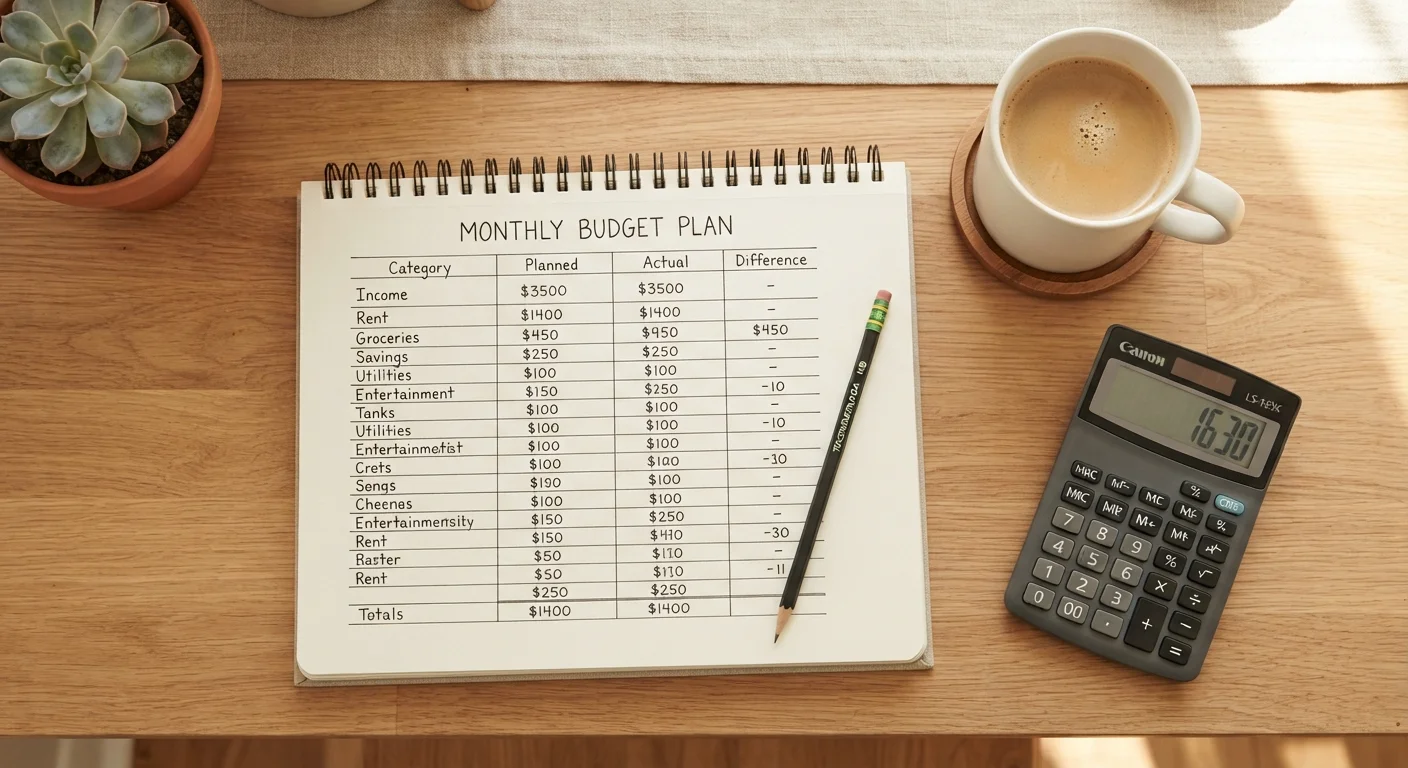
No. A notebook and a pen work just fine, especially when you're starting out. Apps and spreadsheets can help later, but the mechanics of budgeting don't require any specific tool. Choose whatever format you'll actually use consistently.
Going over in one category is normal, especially in the first few months. Pull from a lower-priority category to compensate, and then adjust your limits in the next month to be more realistic. Overspending isn't failure - ignoring it is.
Tracking tells you what happened; a budget tells you what you intend to happen. Both are useful, but a budget adds intentionality - you decide in advance where dollars go rather than observing afterward where they went.
Most people notice clearer financial awareness within the first month, though meaningful behavioral change typically takes two to three months of consistent practice. Budgeting is a skill that improves with repetition, not an instant fix.
The content provided on our blog site traverses numerous categories, offering readers valuable and practical information. Readers can use the editorial team’s research and data to gain more insights into their topics of interest. However, they are requested not to treat the articles as conclusive. The website team cannot be held responsible for differences in data or inaccuracies found across other platforms. Please also note that the site might also miss out on various schemes and offers available that the readers may find more beneficial than the ones we cover.