

Why This Distinction Is the First Step in Any Budget
Before you can decide where to cut, save, or redirect money, you need to know which costs are truly in your control each month and which are already spoken for. That's the core value of separating fixed from variable expenses - not as a bookkeeping exercise, but as a clarity tool.
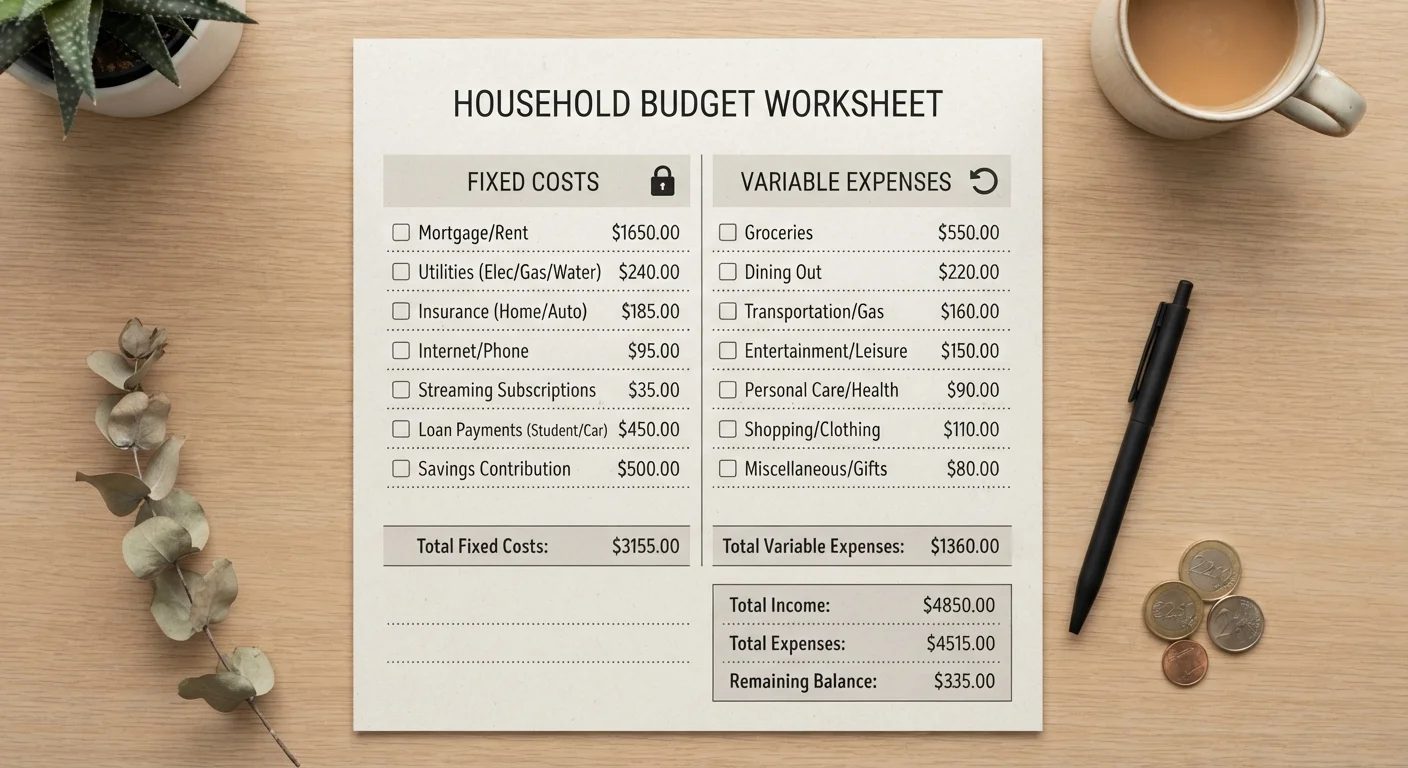
Add up every fixed expense you carry: rent or mortgage, loan payments, insurance premiums, required minimum debt payments. That total is your committed baseline - the amount that leaves your account every month no matter what. Whatever remains after taxes and that committed baseline is where every financial decision you make actually lives.
Most people skip this step and budget against gross income, then wonder why they're perpetually short. Knowing your fixed floor prevents that confusion from the start.
~33%
Average share of income spent on housing alone
The U.S. Bureau of Labor Statistics Consumer Expenditure Survey consistently finds housing represents the single largest fixed cost category for American households.
20-30%
Typical underestimation of variable spending
Financial planners commonly observe that consumers underestimate their discretionary variable spending by this margin when relying on memory rather than tracked actuals.
Fixed Expenses: Predictable, Contractual, and Harder to Change
Fixed expenses are governed by agreements: a lease, a loan contract, an insurance policy, a subscription billing cycle. Because they don't respond to your behavior in a given month, they offer planning certainty - but they also require real effort to reduce. You can't simply spend less on your mortgage payment the way you can order a cheaper meal.
That doesn't mean fixed costs are untouchable forever. Refinancing a mortgage at a lower rate, negotiating a better insurance premium at renewal, canceling subscriptions you've drifted from - these are strategies that reduce your fixed baseline, but they take time and sometimes upfront cost. Think of managing fixed expenses as a quarterly or annual review project rather than a monthly adjustment.
Audit Fixed Expenses Annually
Set a calendar reminder once a year to review every fixed expense line by line. Insurance premiums, subscription services, and loan terms can all shift - and so can your needs. Annual review is one of the highest-leverage, lowest-effort ways to free up meaningful cash each month without changing daily habits.
Variable Expenses: Where Behavioral Change Actually Shows Up
Variable expenses are sensitive to your choices. Groceries, gas, clothing, dining out, entertainment, and personal care all fluctuate month to month depending on your habits. This is where the bulk of day-to-day budgeting happens - and where most spending reductions are realistically achievable without breaking contracts or upending your life.
The challenge with variable expenses is that they require ongoing attention. Unlike a fixed cost you enter once and forget, variable costs need to be tracked actively. Many people underestimate their variable spending by 20-30% simply because small purchases don't feel significant in the moment. Tracking actuals for two to three months often surfaces patterns that estimates miss entirely.
Variable costs also make budgeting as a household more complex. Two people with different spending habits on groceries or entertainment will need an explicit framework for how decisions get made. See our guide to budgeting as a couple for approaches that reduce friction around shared variable spending.
How the Split Shapes Your Budgeting Strategy
Once you know how your income divides between fixed and variable categories, you can make a more informed choice about which budgeting method actually fits your life. Someone with high fixed obligations - say, 65% of take-home pay committed before any discretionary spending - faces a very different challenge than someone at 40%.
If your fixed costs are high relative to income, you need a system that starts from actuals, not idealized percentages. Zero-based budgeting - where you assign every dollar a job from scratch each month - tends to work better in that situation than a percentage-based approach. Our comparison of zero-based budgeting and the envelope method breaks down when each makes sense. For a broader view of available frameworks, see our side-by-side comparison of common budgeting approaches.
The fixed/variable distinction also matters when planning for irregular costs. Car repairs, medical copays, and seasonal expenses technically vary - but they are predictable in aggregate. Setting aside a monthly buffer for these is a natural extension of variable-expense planning. Our guide to building a realistic budget buffer covers how to size that reserve without overcomplicating your plan.
Frequently Asked Questions
Fixed expenses are set costs that recur at the same amount each month, such as rent or a loan payment. Variable expenses fluctuate based on consumption or choices, like groceries or entertainment. The key difference is predictability - fixed costs are easy to plan around, while variable costs require ongoing tracking.
Variable expenses are usually the easier starting point because they change based on behavior rather than binding contracts. Reducing discretionary spending on dining, subscriptions you rarely use, or impulse purchases typically shows results quickly. Fixed expenses often require more effort to reduce - such as refinancing a loan or moving - but can yield larger long-term savings.
Most subscription services - streaming platforms, gym memberships, software - are fixed expenses because they bill the same amount every period regardless of how much you use them. However, usage-based subscriptions that charge by consumption would be variable. When auditing your budget, list all subscriptions together so you can see the combined fixed commitment clearly.
Semi-variable expenses, like electricity or a cell phone plan with overages, have both a predictable floor and a usage-based top. Budget for the minimum guaranteed cost as a fixed line item, then set an estimated cap for the variable portion. Track actuals monthly to see if your estimate holds.
Yes. If your fixed expenses consume most of your income, a percentage-based method like 50/30/20 may not map cleanly to your reality, and a zero-based approach might suit you better. Understanding your fixed obligations first helps you choose a framework that reflects your actual constraints rather than an idealized ratio.
The content provided on our blog site traverses numerous categories, offering readers valuable and practical information. Readers can use the editorial team’s research and data to gain more insights into their topics of interest. However, they are requested not to treat the articles as conclusive. The website team cannot be held responsible for differences in data or inaccuracies found across other platforms. Please also note that the site might also miss out on various schemes and offers available that the readers may find more beneficial than the ones we cover.