

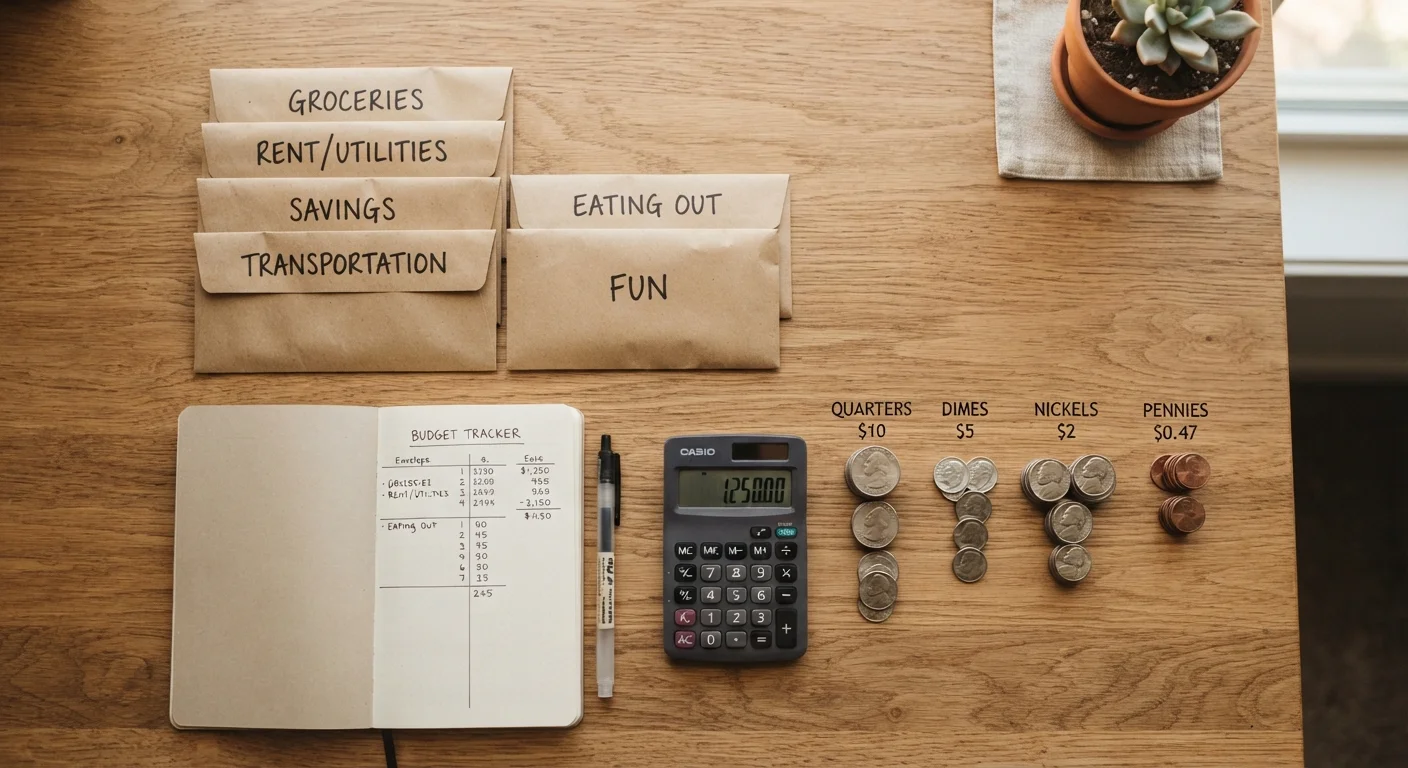
Option A
Zero-Based Budgeting
The meticulous, every-dollar-has-a-job approach.
Best for: People who want total control over their finances and don't mind a monthly planning session.
Option B
The Envelope Method
The tactile, cash-in-hand system that makes limits concrete.
Best for: People who overspend on discretionary categories and benefit from a physical spending boundary.
How Each System Works
Both methods share a foundational premise: allocate money with intention before you spend it. But their mechanics differ significantly.
Zero-based budgeting (ZBB) starts with your total monthly income and assigns every dollar to a category - rent, groceries, savings, insurance, entertainment - until income minus allocations equals zero. Nothing is left unassigned. Each month, you rebuild the budget from scratch, which forces a fresh look at priorities. This approach is especially useful for spotting subscriptions or habits you've stopped noticing.
The envelope method takes a more tactile route. You divide your spending categories - typically discretionary ones like groceries, dining, and personal care - into labeled envelopes and fill each with its cash allocation. When an envelope is empty, spending in that category stops. The method works with physical cash or, increasingly, digital apps that mimic the same constraint.
If you've never built a budget before, our Personal Budgeting From the Ground Up walks through the income-tracking groundwork both systems depend on.
| Criterion | Zero-Based Budgeting | The Envelope Method |
|---|---|---|
| Core mechanic | Assign every dollar a category | Cap spending with labeled cash envelopes |
| Setup time | 30-60 min per month | Once per pay period, envelope fill |
| Ongoing effort | Moderate - requires check-ins | Low - envelope balance is self-evident |
| Works for irregular income | Yes - rebuilt monthly | Less flexible, requires adjustment |
| Handles fixed bills (rent, utilities) | Yes, fully integrated | Less suited - works best for discretionary |
| Impulse-spending control | Moderate - relies on self-monitoring | Strong - empty envelope = hard stop |
| Digital-friendly | Yes - spreadsheets and apps | Partially - requires workarounds or apps |
| Savings integration | Built in as a budget category | Requires a separate savings envelope |
Practical Trade-Offs to Consider
Choosing between these systems isn't about which one is objectively better - it's about which friction you're more willing to tolerate.
Zero-based budgeting demands more upfront time. Building the monthly plan - categorizing every expected expense, adjusting when life shifts - can take 30 to 60 minutes. On the upside, you get a complete picture of your finances, including savings contributions, debt payments, and irregular bills. That completeness makes it easier to align spending with longer-term goals. The main risk: if the plan isn't revisited during the month, overspending in one category can quietly ripple through others.
The envelope method imposes its discipline automatically through cash limits. There's little ongoing analysis required - when the grocery envelope is empty by week three, the feedback is immediate and visceral. The downside is that cash is inconvenient in many modern contexts: online purchases, automatic bills, and subscription services don't work with physical envelopes. Digital envelope apps can bridge this gap, though they require the same behavioral discipline as any app-based tracking tool.
A Note on Cash and Modern Spending
The traditional envelope method was designed around physical cash at a time when most purchases were made in person. Today, many Americans rarely carry cash, which makes pure envelope budgeting impractical for day-to-day use. Several budgeting apps replicate the envelope structure digitally, allowing you to set category caps and track card spending against them. The behavioral logic is the same; only the medium changes.
For a broader look at how these methods fit alongside other approaches like pay-yourself-first or the 50/30/20 rule, see our Budgeting Methods Compared.
Can You Use Both at Once?
Yes - and many people do. A common hybrid approach uses zero-based budgeting for the full monthly plan, then deploys envelopes (physical or digital) for the two or three categories where overspending is most likely. This gives you the strategic clarity of ZBB with the behavioral guardrails of the envelope method where you actually need them.
For example, someone might zero-base their entire budget each month, earmarking amounts for rent, utilities, savings, and debt payments - then use cash envelopes only for grocery and dining spending, since those categories tend to creep.
If you're curious how envelope budgeting stacks up against a pay-yourself-first approach on the savings side, the Saving Strategies Worth Comparing article breaks that down in detail.
Whichever system you adopt, the most important step is starting. The Budgeting Myths That Keep People From Starting addresses common hesitations that prevent people from ever picking up a method at all.
This article is for general informational and educational purposes only and does not constitute personalized financial advice. Consider consulting a qualified financial professional for guidance specific to your situation.
The content provided on our blog site traverses numerous categories, offering readers valuable and practical information. Readers can use the editorial team’s research and data to gain more insights into their topics of interest. However, they are requested not to treat the articles as conclusive. The website team cannot be held responsible for differences in data or inaccuracies found across other platforms. Please also note that the site might also miss out on various schemes and offers available that the readers may find more beneficial than the ones we cover.