

Our Verdict
No single saving framework is objectively superior - the right one is whichever you'll actually stick with. Pay-yourself-first wins on simplicity and automation; envelope budgeting wins on spending control for cash-heavy spenders; zero-based budgeting wins on precision for detail-oriented planners. Consider starting with one method for 60-90 days before deciding whether to switch or adapt.
| Best for | Recommended |
|---|---|
| People who struggle to save consistently | Pay-Yourself-First |
| Those who overspend in specific categories | Envelope Budgeting |
| Detail-oriented planners who want full income allocation | Zero-Based Budgeting |
| Freelancers or those with variable income | Pay-Yourself-First with a percentage-based rule |
Why Your Saving Method Matters as Much as Your Saving Rate
Most people know they should save more. The harder question is how to structure that saving so it actually happens each month without requiring heroic willpower. That's where a budgeting framework earns its keep - not just as a spending tracker, but as a system that makes saving the default rather than an afterthought.
The three methods compared here - envelope budgeting, pay-yourself-first, and zero-based budgeting - are among the most widely discussed in personal finance. Each has a different philosophy about where saving fits into your monthly cash flow. Understanding the mechanics helps you pick the one that matches how you actually think about money. For a broader look at how these and other approaches stack up, see this side-by-side comparison of six budgeting frameworks.
| Envelope Budgeting | Pay-Yourself-First | Zero-Based Budgeting | |
|---|---|---|---|
| Core idea | Spend only what's in each envelope | Save first, live on the rest | Assign every dollar a purpose |
| Monthly time commitment | Medium - refill and track envelopes | Low - automate and monitor | High - rebuild budget each month |
| Best for spending control | Strong - hard limits per category | Moderate - unallocated spending is flexible | Strong - all spending is deliberate |
| Emergency fund integration | Dedicated envelope, requires discipline | First allocation before spending | Explicit monthly line item |
| Works with variable income | Harder - amounts change each period | Yes - use percentage-based rule | Workable - rebuild each month anyway |
| Automation-friendly | Partially - digital apps help | Very - designed for automation | Less so - requires monthly rebuilding |
| Beginner-friendliness | Moderate - concrete but manual | High - simple concept, easy to start | Lower - steeper learning curve |
Envelope Budgeting: Spending Control Through Physical (or Digital) Limits
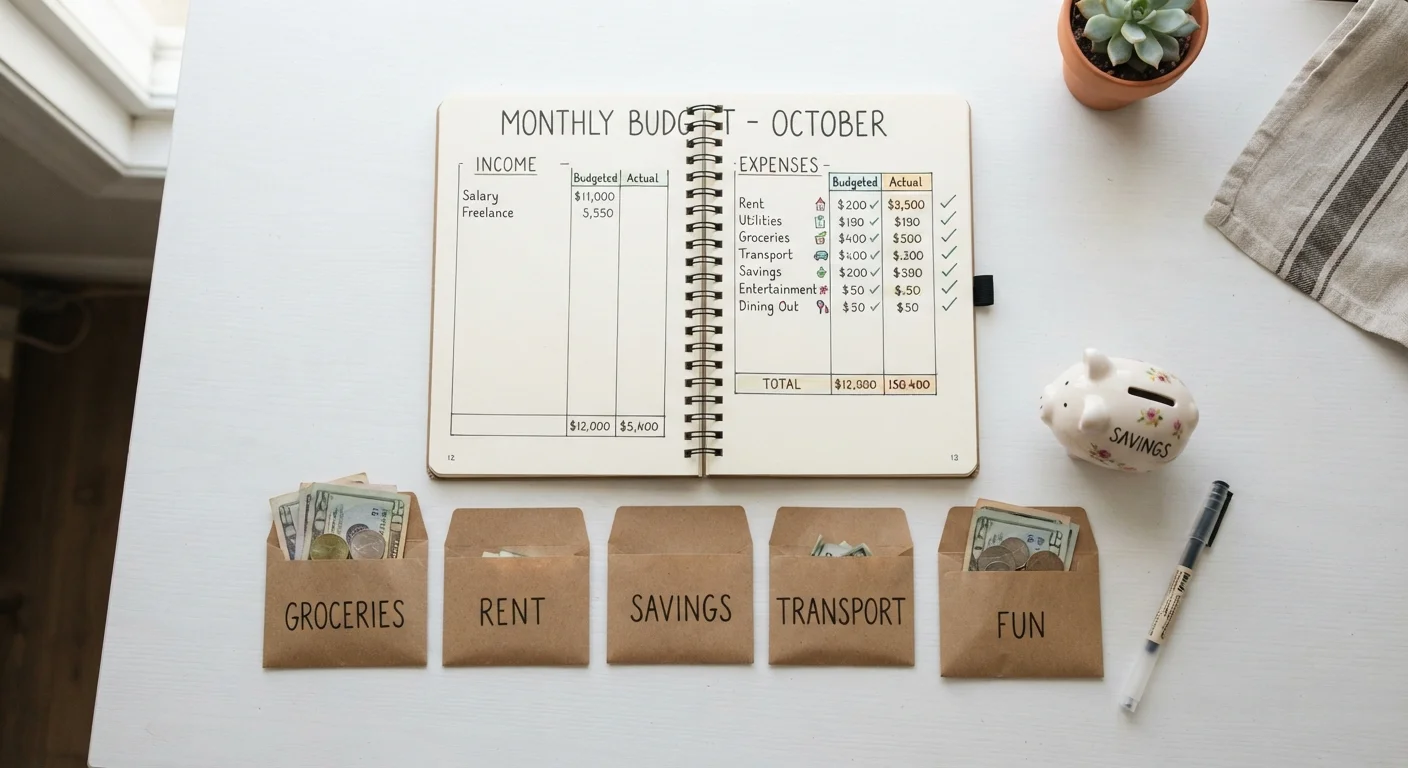
The envelope method divides your take-home pay into labelled spending categories - groceries, gas, dining out, utilities - and allocates a fixed cash amount to each. When an envelope is empty, that category is done for the month. Traditionally this meant physical cash; today most people use digital envelope apps that mimic the same constraint.
Its strength is behavioural: the limit is tangible, not abstract. For people who find that debit cards encourage overspending because nothing feels finite, envelope budgeting creates a hard stop. Its weakness is administration - you need to fill envelopes at the start of each pay period and track them throughout the month.
Emergency fund fit: You create a dedicated "savings" or "emergency fund" envelope and treat it like any other spending category - except you don't spend it. The discipline required to keep that envelope untouched is the main challenge. If you want to go deeper on building that fund from scratch, this walkthrough for starting an emergency fund from zero offers a practical starting point.
Start With One Category, Not Your Whole Budget
If envelope budgeting feels overwhelming, you don't have to categorise every dollar on day one. Pick the two or three categories where you most often overspend - say, dining and groceries - and apply envelopes there first. Once those limits feel natural, expand to other categories. Gradual adoption tends to stick better than an all-or-nothing launch.
Pay-Yourself-First: Saving Before You Have a Chance to Spend
Pay-yourself-first (PYF) reverses the typical order of operations. Instead of spending first and saving whatever's left, you move a set amount to savings the moment your paycheck lands - then live on the rest. The logic is simple: most people find it easier to adjust their spending to fit a smaller number than to consistently resist spending a larger one.
PYF works especially well when paired with automation. Setting up an automatic transfer to a separate savings account on payday removes the decision entirely. Automating that transfer is one of the most reliable ways to make consistent saving the default rather than a monthly act of discipline.
Emergency fund fit: PYF is arguably the most direct path to building an emergency fund because the fund is the first allocation, not a category competing with other expenses. If your income is irregular, a percentage-based rule (saving a fixed share of each deposit rather than a fixed dollar amount) makes PYF adaptable. See saving strategies for variable-income earners for how to adjust.
Zero-Based Budgeting: Assigning Every Dollar a Job
Zero-based budgeting (ZBB) means your income minus your planned expenses and savings equals zero at the end of the allocation process. Every dollar is assigned a purpose before the month begins - whether that's rent, groceries, entertainment, debt repayment, or an emergency fund contribution. Nothing is left unassigned.
ZBB demands the most upfront work: you rebuild your budget from scratch each month, which forces you to make deliberate choices rather than running on autopilot. That's both its power and its friction. It's well-suited to people who find motivation in seeing exactly where their money goes and who have the patience to do the monthly planning. For a direct head-to-head of ZBB versus the envelope method, this detailed comparison is worth reading alongside this article.
Emergency fund fit: Because every dollar is allocated, your emergency fund contribution appears as an explicit line item each month. That visibility is useful - but it also means that in a tight month, that line item faces direct competition from other needs. ZBB practitioners often address this by treating the savings line as non-negotiable, similar to rent.
~57%
Americans with less than 3 months' expenses saved
Federal Reserve survey data has consistently shown that a large share of U.S. households would struggle to cover several months of expenses from savings alone.
1 in 4
Adults who have no dedicated savings method
Consumer finance surveys indicate a significant portion of adults save sporadically rather than using a structured, repeatable approach.
Choosing the Right Framework for Your Situation
The best budgeting method is the one you'll sustain. A few questions help narrow it down:
- How much time can you give it? ZBB requires the most monthly maintenance; PYF the least once it's automated.
- Do you overspend in specific categories? Envelope budgeting directly addresses category-level overspending in a way the other two don't.
- Is your income predictable? Fixed-dollar PYF and ZBB work more naturally with steady paychecks. Variable earners often do better with percentage-based rules within any of these frameworks.
- Are you starting from zero? If you have no emergency fund yet, PYF offers the clearest on-ramp because saving is the first action, not one allocation among many.
Once you have a framework and a growing emergency fund, the next question becomes where to keep that money. Understanding the trade-off between liquid and invested savings can help you think through whether a high-yield savings account, money market account, or another vehicle makes the most sense for your situation.
This article is for general informational purposes only and does not constitute personalised financial advice. Consider consulting a qualified financial professional about decisions specific to your circumstances.
The content provided on our blog site traverses numerous categories, offering readers valuable and practical information. Readers can use the editorial team’s research and data to gain more insights into their topics of interest. However, they are requested not to treat the articles as conclusive. The website team cannot be held responsible for differences in data or inaccuracies found across other platforms. Please also note that the site might also miss out on various schemes and offers available that the readers may find more beneficial than the ones we cover.