

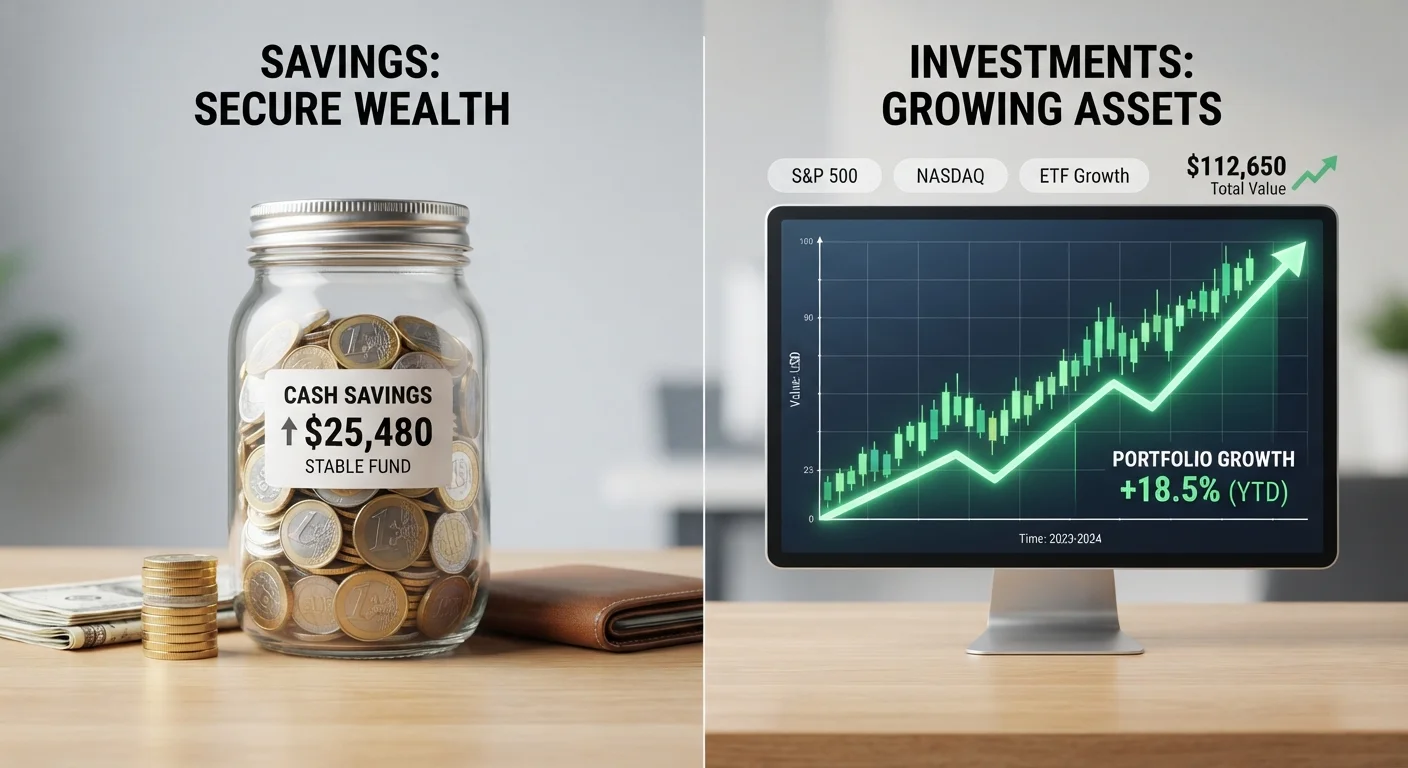
Option A
Liquid Savings
The immediately accessible financial safety net.
Best for: Covering emergencies, short-term goals, and predictable near-term expenses without any risk of loss.
Option B
Invested Savings
The long-horizon wealth-building engine.
Best for: Growing wealth over years or decades for goals like retirement or a child's education, accepting short-term volatility for long-term gain.
What Each Term Actually Means
Liquid savings refers to money you can convert to spendable cash quickly - typically within one to two business days - without penalty or loss of principal. High-yield savings accounts, money market accounts, and standard checking accounts are the most common vehicles. The defining feature is certainty: you put in $5,000, you can withdraw $5,000 (plus any interest earned). For a plain-language breakdown of terms like liquidity and APY, see the Key Terms Every Saver Should Know.
Invested savings refers to money placed into assets - stocks, bonds, mutual funds, ETFs, or similar instruments - with the goal of earning returns that outpace inflation over time. These assets trade in markets, so their value fluctuates. You might deposit $5,000 and find it worth $4,200 a year later, or $6,800. Time is the critical variable: volatility smooths out over long periods, but short-term access comes with real risk.
The core tension is simple: liquidity and growth pull in opposite directions. Accounts that keep your money perfectly safe and instantly accessible generally earn less. Accounts or vehicles that produce meaningful long-term growth require you to tolerate short-term uncertainty and reduced access.
| Criterion | Liquid Savings | Invested Savings |
|---|---|---|
| Access speed | 1-2 business days, no penalty | Days to weeks; selling may trigger losses |
| Principal risk | None (FDIC-insured up to limits) | Yes - value can fall below amount deposited |
| Inflation protection | Limited - low yields often lag inflation | Stronger long-term real return potential |
| Best time horizon | Immediate to 3 years | 5 years or longer |
| Tax considerations | Interest taxed as ordinary income | Capital gains, dividends; tax-advantaged options available |
| Ideal purpose | Emergencies, near-term goals | Retirement, long-term wealth building |
The Risk That Goes Unnoticed on Each Side
Most people instinctively fear the risk of invested savings - and market volatility is real. But liquid savings carry their own underappreciated risk: inflation erosion. If your savings account earns 1% annually while inflation runs at 3%, your money's purchasing power is quietly shrinking. Over a decade, that gap compounds into a meaningful real-dollar loss.
On the invested side, the risk that catches people off guard is sequence of returns risk - the danger of needing to withdraw money during a market downturn. If you've kept your emergency fund inside an investment account and the market drops 25% the month your furnace fails, you're either forced to sell at a loss or take on debt. That's not a hypothetical; it's a predictable consequence of mismatching the purpose of money with its vehicle.
FDIC Insurance Has Limits
The FDIC insures deposits at member banks up to $250,000 per depositor, per institution, per ownership category. If your liquid savings across accounts at a single bank exceed that threshold, the excess is not federally insured. Spreading funds across institutions or account types is one way to extend coverage - verify current rules at FDIC.gov.
Understanding this dynamic is also relevant when you're weighing large purchases. The Financing vs. Paying Cash for a Car illustrates how liquid reserves factor into big spending decisions.
Building a Framework That Accounts for Both
Rather than choosing one over the other, most financial guidance treats these as complementary layers of a savings structure:
- Tier 1 - Liquid buffer: One month of essential expenses in a checking or savings account for immediate access.
- Tier 2 - Emergency fund: Three to six months of expenses in a high-yield savings or money market account. For help choosing between those two vehicles, see High-Yield Savings vs. Money Market Accounts.
- Tier 3 - Near-term goals: Sinking funds for known expenses (car replacement, home repairs, travel) held in liquid accounts with a clear timeline.
- Tier 4 - Long-term invested savings: Retirement accounts, brokerage accounts, and other invested vehicles for goals five or more years away.
The proportion you allocate to each tier isn't fixed - it shifts with your income stability, life stage, and existing obligations. What matters is that every dollar has a defined job. If you're still working out how to direct savings consistently, saving strategies like pay-yourself-first can provide a useful structural framework alongside your household budget.
One common misconception is that a modest amount of savings isn't worth the effort. That thinking tends to stall progress entirely - and savings myths like this one are worth examining directly.
~56%
Americans without 3 months' emergency savings
Federal Reserve surveys have consistently found that a substantial share of U.S. adults could not cover three months of expenses with savings alone, underscoring the gap between recommended and actual liquid reserves.
7%+
Historical average annual stock market return (inflation-adjusted)
Long-run U.S. equity market data, often cited by financial researchers, suggests inflation-adjusted average annual returns in the range of 6-7%, though past performance does not guarantee future results.
This article is for general informational and educational purposes only. It does not constitute personalized financial or investment advice. Consult a qualified financial professional before making decisions based on your specific circumstances.
The content provided on our blog site traverses numerous categories, offering readers valuable and practical information. Readers can use the editorial team’s research and data to gain more insights into their topics of interest. However, they are requested not to treat the articles as conclusive. The website team cannot be held responsible for differences in data or inaccuracies found across other platforms. Please also note that the site might also miss out on various schemes and offers available that the readers may find more beneficial than the ones we cover.