

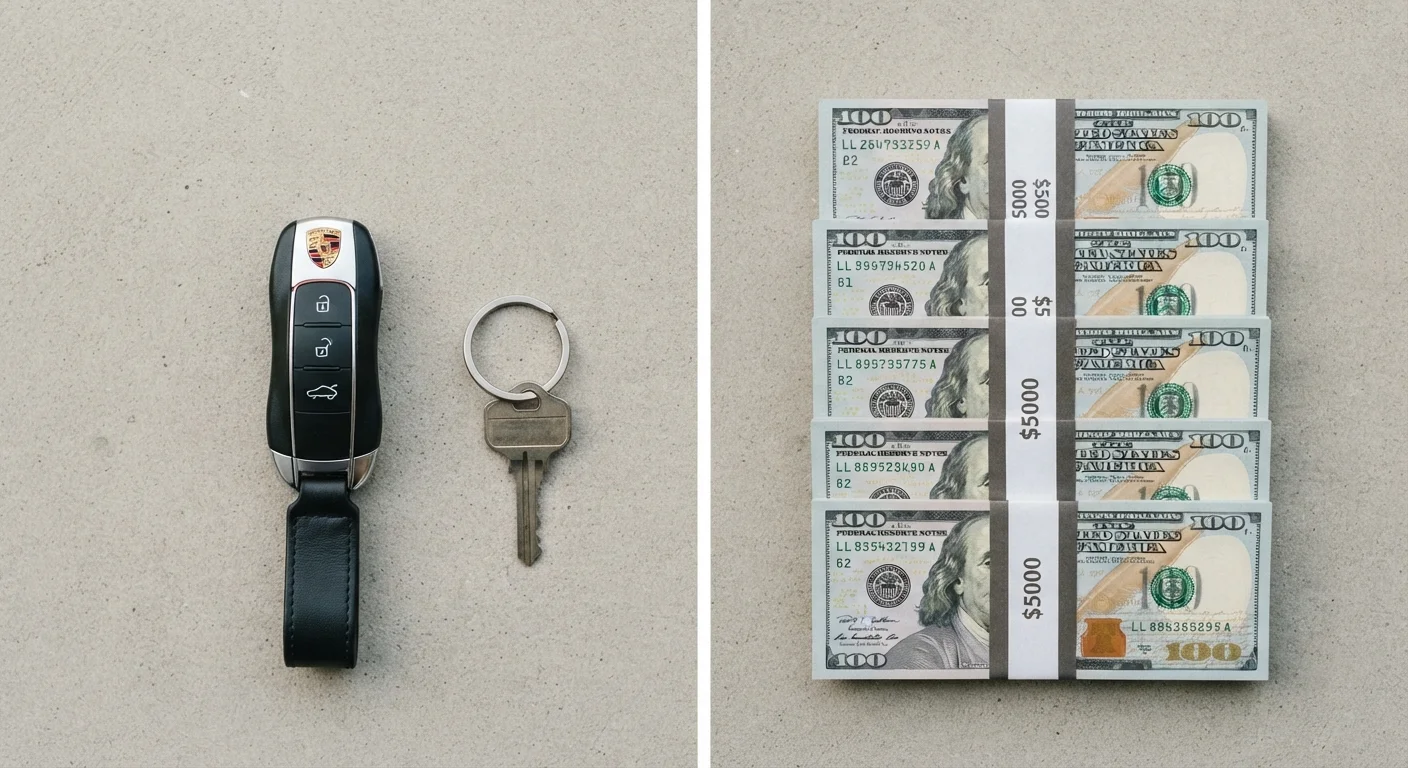
Option A
Auto Loan Financing
The monthly-payment approach that preserves liquidity.
Best for: Buyers who want to keep cash accessible, build credit history, or take advantage of low promotional interest rates.
Option B
Cash Purchase
The debt-free route that minimizes total cost.
Best for: Buyers with sufficient savings who want to eliminate interest costs and simplify long-term vehicle ownership.
What You're Really Choosing Between
When you buy a car, the purchase price is only part of the equation. How you pay changes what you ultimately spend, what obligations you carry, and how your broader financial picture holds up afterward. Understanding the mechanics of each approach - before you walk onto any lot - gives you the leverage to make a genuinely informed call.
Auto loan financing means a lender (a bank, credit union, or dealer-arranged lender) pays the seller, and you repay the lender in monthly installments over an agreed term, typically 36 to 72 months. In exchange for that convenience, you pay interest - the lender's cost for fronting the money. The interest rate you receive, expressed as an APR, depends heavily on your credit score, loan term, and market conditions at the time of purchase.
A cash purchase means you transfer the full purchase price directly, the title is yours immediately, and no lender has a claim on the vehicle. The transaction is complete the moment funds clear. See our full breakdown of annual vehicle ownership costs to put either payment method in context of your total spending.
The True Cost Comparison
Interest is the core financial difference between the two paths. On a $30,000 vehicle financed at 7% APR over 60 months, you'd pay roughly $5,560 in interest alone by the end of the term - meaning the car effectively costs you closer to $35,560. The longer the term or the higher the rate, the larger that gap becomes.
| Criterion | Auto Loan Financing | Cash Purchase |
|---|---|---|
| Total cost | Higher (purchase price + interest) | Lower (purchase price only) |
| Monthly obligation | Yes - fixed installment payments | None |
| Liquidity preserved | Yes - savings remain available | No - cash is spent upfront |
| Credit impact | Positive if managed well | No impact on credit |
| Title ownership | Lender holds lien until paid off | Clear title immediately |
| Insurance requirements | Comprehensive & collision required | At owner's discretion |
| Negotiating flexibility | Financing terms add complexity | Simpler, one-step negotiation |
Cash buyers avoid that interest cost entirely, but they also give up liquidity. Spending $30,000 in savings means those dollars are no longer available for emergencies, investment, or other priorities. The opportunity cost of a cash purchase - what that money could have earned elsewhere - is a real, if harder-to-measure, expense. For a deeper look at how liquid versus invested savings behave differently, see our guide to balancing liquidity and growth.
One factor that can shift this math: dealer-offered promotional financing. Manufacturers sometimes offer 0% or sub-2% APR to qualified buyers on select models. At those rates, the interest cost is negligible, and keeping cash in savings or investments may be the stronger move - provided you can maintain the monthly payments comfortably.
~$35,560
True cost of a financed $30,000 vehicle
Illustrative example based on a $30,000 loan at 7% APR over 60 months, resulting in approximately $5,560 in interest charges.
72 months
Common maximum auto loan term
Longer loan terms lower monthly payments but significantly increase total interest paid over the life of the loan.
0%
Promotional APR sometimes offered by manufacturers
Select automakers periodically offer 0% financing to qualified buyers, making financing competitive with cash in total cost terms.
Practical Considerations Beyond the Numbers
Insurance requirements: Lenders typically require comprehensive and collision coverage for the life of the loan, which increases your insurance premium. Cash owners can legally carry only state-minimum liability coverage, though most financial advisers recommend maintaining broader protection regardless. If you're financing a newer vehicle, gap insurance is worth evaluating - it covers the difference between what you owe and what the car is worth if it's totaled early in the loan.
Negotiating position: Cash buyers often have a cleaner negotiating stance because they remove financing-related back-and-forth from the discussion. However, some dealers actually prefer financed transactions because they may earn a fee from the lender - so "cash" doesn't automatically translate to a better deal on the vehicle price itself.
Credit impact: A car loan, managed responsibly, adds a positive installment account to your credit history. For buyers with thin or rebuilding credit profiles, this can be meaningful. Cash purchases have no effect on your credit report. If managing debt feels risky given your current financial habits, review foundational debt and credit principles before committing to a loan.
Title and ownership: With financing, the lender holds a lien on the title until the loan is paid off. This can complicate selling the vehicle mid-loan, though it's a manageable process. Cash buyers hold a clear title immediately and face no such restrictions when selling privately or trading in.
Making the Right Call for Your Situation
The most important variable isn't the interest rate or even the purchase price - it's the state of your personal financial foundation. If paying cash would leave you with little to no emergency fund, financing is likely the more prudent path, even at a higher total cost. An unexpected repair, job disruption, or medical expense can become a crisis when all your liquid savings are tied up in a depreciating asset.
On the other hand, if you have a robust emergency fund, stable income, and the cash to purchase outright without strain, the math generally favors paying cash. The interest savings are real, the simplicity is real, and the peace of not carrying a monthly obligation has genuine value.
If you're carrying high-interest debt elsewhere - credit cards, for example - paying cash for a car and simultaneously servicing expensive revolving debt rarely makes sense. The debt avalanche and debt snowball methods can help you think through which obligations to prioritize. Either way, a car payment is one piece of a larger ownership picture - depreciation, maintenance, fuel, and insurance all contribute to your total cost of ownership.
This article provides general financial education and is not personalized financial advice. Consult a qualified financial professional for guidance tailored to your individual circumstances.
The content provided on our blog site traverses numerous categories, offering readers valuable and practical information. Readers can use the editorial team’s research and data to gain more insights into their topics of interest. However, they are requested not to treat the articles as conclusive. The website team cannot be held responsible for differences in data or inaccuracies found across other platforms. Please also note that the site might also miss out on various schemes and offers available that the readers may find more beneficial than the ones we cover.