

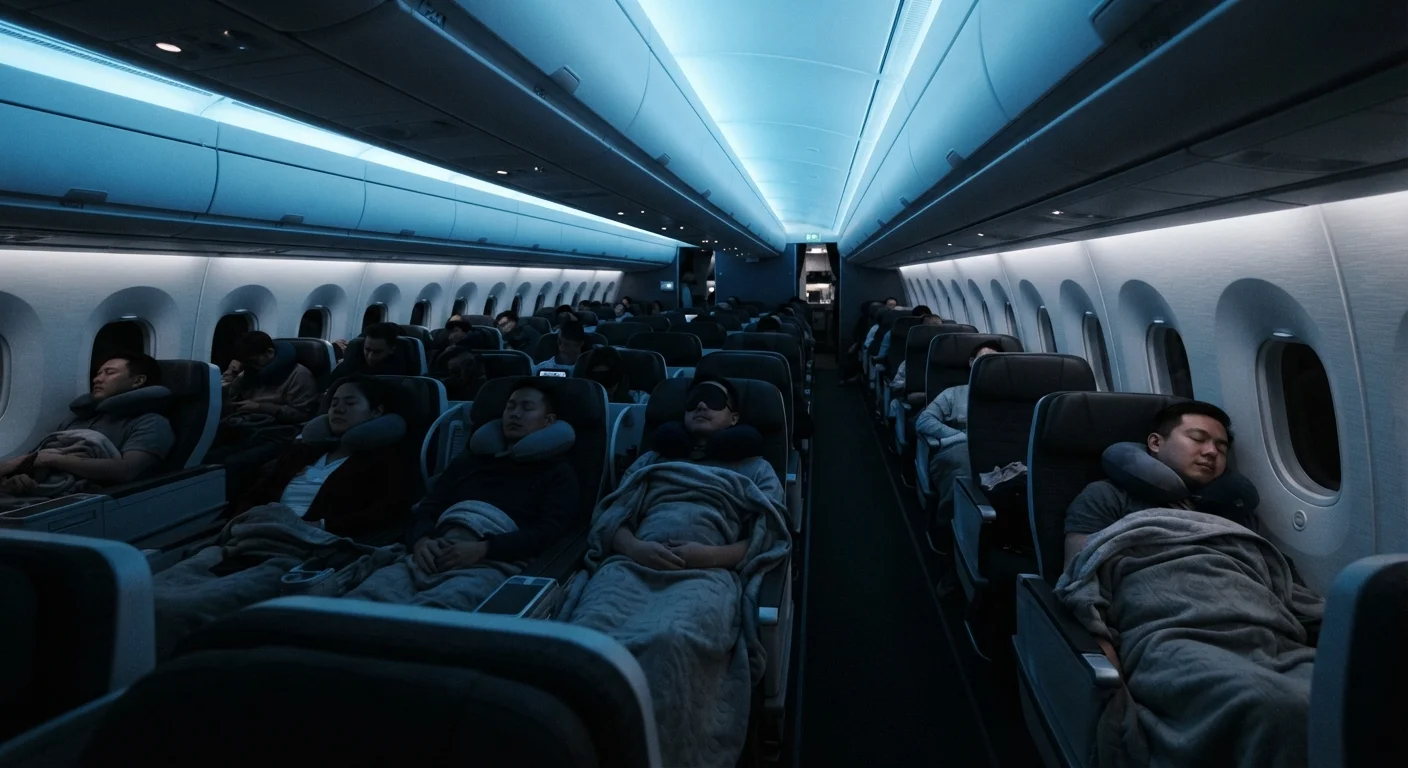
What's Actually Happening to Your Body at 35,000 Feet
Before you can counter the effects of long-haul flight, it helps to understand the real mechanisms behind the discomfort. Cruising altitude cabins are pressurized to the equivalent of roughly 6,000-8,000 feet above sea level - not ground level. That reduced pressure lowers the partial pressure of oxygen in your blood, which can cause mild hypoxia: fatigue, headache, and reduced mental sharpness. Humidity inside the cabin typically drops below 20%, far drier than most desert environments, which accelerates dehydration through respiration alone.
Immobility compounds everything. Sitting in a fixed position for 10 or more hours slows circulation, increases venous pooling in the lower legs, and puts sustained pressure on the lumbar spine. For a deeper look at what these compounding stressors do over time, see what's actually happening to your body in-flight.
Understanding these physiological realities - pressure, humidity, immobility - shapes every worthwhile strategy that follows.
Circulation, Compression, and DVT Risk
Deep vein thrombosis (DVT) - a blood clot forming in a deep vein, typically in the leg - is a recognized though relatively uncommon risk on long-haul flights. Prolonged sitting reduces the muscle contractions that normally pump venous blood back toward the heart. Passengers with additional risk factors (recent surgery, clotting disorders, pregnancy, or prior DVT) face a meaningfully elevated baseline risk and should consult a physician before flying long distances.
For the general traveling population, evidence supports several practical precautions. Graduated compression socks - which apply more pressure at the ankle than the calf - are consistently cited in clinical literature as effective at reducing lower-leg swelling and venous stasis. Aim for a compression level in the 15-30 mmHg range; a healthcare provider can advise on the appropriate level for your individual situation.
Movement matters too. Standing and walking the aisle for a few minutes every hour or two, performing seated calf raises, and flexing your ankles regularly all meaningfully improve blood flow. For a more complete breakdown of DVT risk factors and general precautions, see what passengers should know about DVT and air travel.
Put on graduated compression socks before you board, not mid-flight.
Compression is most effective before swelling begins. Applying socks after hours of sitting provides less benefit and can be difficult when legs are already swollen. Clinical evidence consistently supports their use as a prophylactic measure on flights over four hours.
Stand and walk the aisle for two to three minutes every 60-90 minutes of flight.
Leg muscle contractions during walking actively pump blood back toward the heart, countering venous stasis that builds during prolonged sitting. Even brief bouts of movement interrupt the pooling cycle meaningfully.
Drink water consistently throughout the flight rather than in large amounts at once.
Steady intake maintains hydration against continuous respiratory and skin moisture loss. Large boluses pass through more quickly without adequately compensating for ongoing losses, and can disrupt sleep with frequent bathroom trips.
Limit or avoid alcohol and caffeine on overnight long-haul flights.
Alcohol is a diuretic that worsens dehydration and fragments sleep architecture, increasing next-day fatigue. Caffeine taken in the second half of a long flight can push back sleep onset by hours, making jet lag recovery harder.
Use a supportive neck pillow, eye mask, and hearing protection together as a sleep kit.
These three items address the three biggest barriers to in-flight sleep - postural discomfort, light stimulation, and noise - simultaneously. Each item alone helps; together they compound the benefit.
Set your watch to the destination timezone at the moment of boarding.
Aligning your mental framework with the destination clock immediately - rather than at landing - encourages you to time light exposure, meals, and sleep attempts to your new timezone. This gives your circadian system more lead time to begin shifting.
Hydration, Nutrition, and Alcohol
The dry cabin environment means you're losing water through breathing and skin evaporation even without feeling thirsty. A commonly cited guideline is to drink approximately 8 ounces of water for every hour of flight - though individual needs vary and the evidence base for a specific number is limited. What is well-supported: arriving at the airport already well-hydrated sets a better baseline than trying to catch up mid-flight.
Alcohol accelerates dehydration and disrupts sleep architecture, making it a poor choice for long-haul comfort even if the in-flight experience feels more relaxing in the moment. Caffeine presents a similar trade-off: useful if you need to stay alert on arrival, but counterproductive if your goal is sleeping on the plane. Salty, heavy meals increase bloating at altitude, where intestinal gas expands due to lower cabin pressure - lighter, lower-sodium options tend to serve travelers better.
“The single most underrated intervention for long-haul travelers is simply drinking enough water. Most people arrive chronically dehydrated not because they refused water, but because they never thought to ask for more between service rounds.”
— Aviation Medicine Specialist, Physician specializing in aerospace and travel medicine
Sleep Strategy and Jet Lag Mitigation
Sleep on a long-haul flight is genuinely difficult - the environment is designed for transit, not rest. That said, specific strategies improve outcomes. A supportive neck pillow (one that keeps the head from falling forward) reduces cervical discomfort and makes light sleep more sustainable. An eye mask and earplugs or noise-canceling headphones are the two highest-impact items for blocking the stimuli that interrupt sleep cycles.
Seat selection shapes your options significantly. A window seat lets you lean against the fuselage wall and control your light exposure; an aisle seat offers easier movement but more disturbance. Bulkhead and exit-row seats provide additional legroom but often lack under-seat storage and may have fixed armrests.
Jet lag is a circadian disruption, not simply tiredness. Setting your watch to the destination timezone at boarding and eating and sleeping according to that clock - even roughly - gives your body a head start. Bright light exposure at the destination is one of the strongest circadian reset signals available. For more on how sleep consistency affects recovery, see why sleep consistency matters for your health.
What to Pack for a More Comfortable Long Haul
Carry-on preparation directly affects your comfort level once you're locked into your seat for the duration. Compression socks should go on before boarding, not after your legs have already swollen. A small personal care kit - lip balm, saline nasal spray, and a basic moisturizer - addresses the specific effects of low cabin humidity on skin and mucous membranes.
Dress in loose, breathable layers; cabin temperature fluctuates and varies by seat location. Slip-on shoes allow easy removal during the flight, reducing foot pressure from swelling. If you plan to sleep, pack your eye mask and earplugs in your personal item, not in the overhead bin.
Packing intelligently for long-haul travel is an extension of a broader skill set. See how to pack light without sacrificing comfort for a structured framework that applies across trip types.
This article provides general travel wellness information. It is not a substitute for personalized medical advice. Travelers with underlying health conditions - including cardiovascular, clotting, or respiratory conditions - should consult a qualified healthcare provider before undertaking long-haul flights.
The content provided on our blog site traverses numerous categories, offering readers valuable and practical information. Readers can use the editorial team’s research and data to gain more insights into their topics of interest. However, they are requested not to treat the articles as conclusive. The website team cannot be held responsible for differences in data or inaccuracies found across other platforms. Please also note that the site might also miss out on various schemes and offers available that the readers may find more beneficial than the ones we cover.