

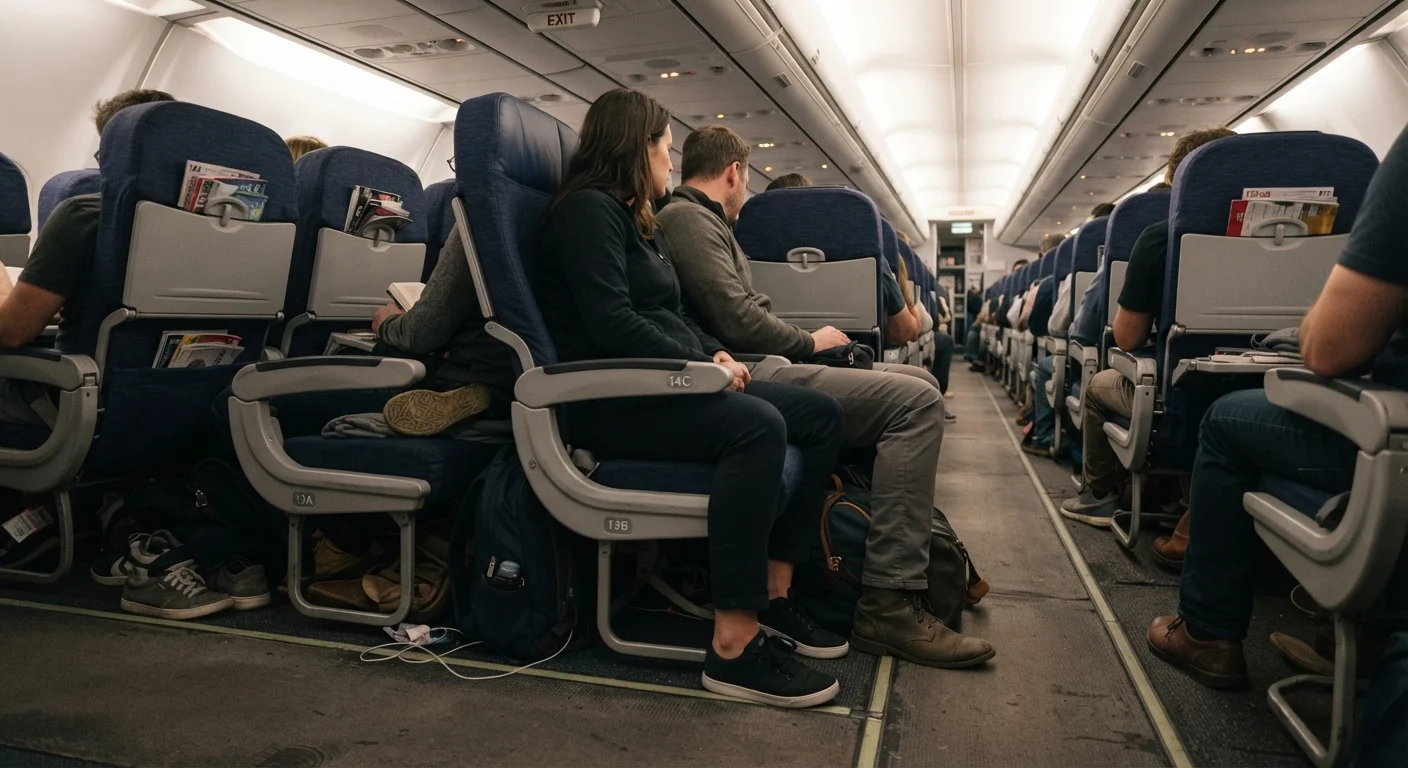
Why Air Travel Creates Conditions for Blood Clots
When you sit still for hours in a pressurized cabin, blood flow through your legs slows significantly. The calf muscles, which normally act as pumps to push blood back toward the heart, become largely inactive. This reduced circulation creates conditions in which blood can pool and, in some individuals, begin to clot in the deep veins of the legs.
Several factors specific to air travel compound this effect. Cabin humidity is typically very low - often below 20% - which can promote mild dehydration. Some evidence suggests that mild hypoxia (lower oxygen levels at cruising altitude) may also affect blood coagulation, though researchers continue to study the precise contribution of each variable. What is well-established is that immobility duration matters: the longer you remain seated without movement, the greater the circulatory impact.
It's worth noting that prolonged immobility in other contexts - long car trips, bus journeys, or extended desk work - carries similar physiological dynamics. Air travel is not uniquely dangerous in kind, but the combination of factors and the difficulty of moving around in a pressurized aircraft cabin makes it a situation worth understanding. For a broader look at how your body responds to the flight environment, see The Hidden Comfort Drains of Air Travel.
Who Faces a Higher Personal Risk
For most healthy adults on a typical flight, the absolute risk of developing a clinically significant DVT is low. However, certain individual characteristics meaningfully elevate that baseline risk. Travelers who fall into one or more of these categories should discuss their itinerary with a healthcare provider before flying:
- Personal or family history of DVT, pulmonary embolism, or inherited clotting disorders (such as Factor V Leiden)
- Recent surgery or trauma, particularly to the lower limbs or pelvis, which can impair normal vascular function
- Pregnancy and the postpartum period, during which the body is in a naturally pro-coagulant state
- Active cancer or recent cancer treatment, both of which are associated with elevated clotting risk
- Use of hormonal contraceptives or hormone replacement therapy, which can affect clotting factor levels
- Obesity, which is associated with reduced venous return from the lower extremities
- Older age combined with reduced mobility or cardiovascular health
Flight duration also interacts with personal risk. Most clinical guidance places increased concern at the four-hour mark and beyond, with risk generally rising with duration. This is particularly relevant for travelers on intercontinental routes. For general health-risk context applicable to international travel, Staying Healthy Abroad addresses common misconceptions worth reviewing before you go.
2-4x
Increased DVT risk on long-haul flights
Research published in medical literature suggests air travel lasting four or more hours approximately doubles to quadruples DVT risk relative to non-travel periods, particularly in those with other risk factors.
~1 in 4,656
Estimated DVT events per long-haul flight
A frequently cited estimate from aviation medicine research suggests roughly one symptomatic DVT event per approximately 4,600 long-haul flights, underscoring that absolute risk for most travelers remains relatively low.
40%
DVT cases that may be asymptomatic
Medical literature notes that a substantial proportion of DVT cases produce no obvious symptoms, making awareness of risk factors and post-travel monitoring important even without apparent signs.
General Precautions Commonly Recommended for Long Flights
While no precaution eliminates DVT risk entirely, several evidence-informed habits are widely recommended to support circulation during long flights. These are general measures - they are not a substitute for personalized medical advice if you have known risk factors.
Make Movement Part of Your Flight Routine
Set a reminder on your phone or watch to stand and walk the aisle at least once every 90 minutes on long flights. If the seatbelt sign is on, perform ankle rotations and calf raises in your seat - even small muscle contractions help maintain venous blood flow in the legs.
- Move regularly: Getting up to walk the aisle every one to two hours, or performing seated leg exercises (ankle circles, heel raises, knee lifts), helps activate the calf muscle pump and keep blood moving.
- Stay hydrated: Drinking water throughout the flight counteracts the dehydrating effect of low cabin humidity. Limiting alcohol and caffeine, which have diuretic effects, is also generally advisable.
- Wear compression socks: Graduated compression hosiery applies gentle pressure to the lower leg, supporting venous return. Some clinical evidence supports their use in reducing superficial clot risk in higher-risk travelers on long hauls. Discuss appropriate compression levels with a healthcare provider if you have circulatory concerns.
- Avoid tight clothing around the knees or hips: Restrictive garments can impede circulation in the seated position.
- Recline thoughtfully: Deep reclining can increase pressure behind the knee and restrict blood flow in the popliteal vein - a common DVT site.
For a detailed, evidence-based review of long-haul comfort strategies including hydration, positioning, and compression, Long-Haul Flight Comfort provides thorough coverage.
Recognizing Symptoms and Knowing When to Seek Help
DVT symptoms can appear during a flight or in the days following travel. The most common presentation involves one leg - typically the calf - becoming swollen, tender, warm to the touch, or discolored (red or bluish). Some people experience a dull ache or cramping that worsens when standing or walking. Notably, DVT can also be asymptomatic, which is one reason it can be difficult to detect without medical assessment.
The most serious concern is pulmonary embolism (PE), which occurs if a clot breaks loose and lodges in the lungs. Symptoms of PE include sudden shortness of breath, chest pain that worsens when breathing, rapid heartbeat, lightheadedness, or coughing up blood. PE is a medical emergency requiring immediate care - call emergency services without delay if these symptoms occur.
If you notice leg swelling, pain, or warmth in the days after a long flight, do not dismiss it as normal fatigue or dehydration. A healthcare provider can evaluate symptoms and order imaging such as a Doppler ultrasound if DVT is suspected. Early diagnosis significantly improves outcomes.
DVT Symptoms Can Appear Days After Landing
Deep vein thrombosis doesn't always manifest during a flight. Symptoms may emerge 24 to 72 hours - or even longer - after travel concludes. If you experience unexplained leg pain, swelling, or warmth in the days following a long journey, report it to a healthcare provider promptly rather than assuming it will resolve on its own.
Travelers planning international trips can find broader safety frameworks in Travel Safety 101, which covers foundational health and safety concepts for those heading abroad.
This article is for general informational and educational purposes only and does not constitute medical advice. Always consult a qualified healthcare professional for guidance specific to your health conditions, medications, and travel plans.
Frequently Asked Questions
DVT from air travel is relatively uncommon for healthy passengers. Research suggests the risk increases meaningfully on flights exceeding four hours, and is substantially higher for people with pre-existing clotting risk factors. Most travelers do not develop DVT, but awareness and basic precautions are still worthwhile.
Common symptoms include swelling, pain, tenderness, or redness in one leg - particularly in the calf. If a clot has traveled to the lungs, symptoms may include chest pain, shortness of breath, or rapid heartbeat. These symptoms require immediate medical attention.
Compression socks are widely recommended as a general precaution to support circulation during long flights. Some clinical evidence suggests they may reduce superficial clot formation in at-risk travelers, but they are not a guarantee of prevention. Consult your doctor about whether they're appropriate for your situation.
While the term 'economy class syndrome' is commonly used, research indicates that immobility - not seat class per se - is the key factor. However, economy seating typically offers less legroom, making it harder to move freely, which may contribute to increased risk on long hauls.
Higher-risk individuals include those with a personal or family history of DVT or clotting disorders, recent surgery or injury, pregnancy, active cancer, use of hormonal contraceptives, obesity, or older age. These travelers should discuss air travel plans with a healthcare professional.
Aspirin is not generally recommended as a preventive measure for flight-related DVT in most travelers. It carries its own risks and is not a substitute for medical-grade precautions. If you are concerned about your personal risk, speak with your doctor before your trip.
The content provided on our blog site traverses numerous categories, offering readers valuable and practical information. Readers can use the editorial team’s research and data to gain more insights into their topics of interest. However, they are requested not to treat the articles as conclusive. The website team cannot be held responsible for differences in data or inaccuracies found across other platforms. Please also note that the site might also miss out on various schemes and offers available that the readers may find more beneficial than the ones we cover.