

Learning Doesn't Stop at the Classroom Door
Most families think of learning as something that happens between school bells. But research in developmental education consistently shows that children absorb and retain knowledge most readily when it's embedded in meaningful, real-life context. The kitchen, the grocery store, the backyard, and even the car ride to practice are all classrooms in disguise.
This isn't about turning every moment into a lesson or adding pressure to already-busy family life. It's about recognizing the educational value already present in the things you're already doing - and occasionally nudging those moments in a richer direction. As part of a broader approach to raising lifelong learners, everyday activities serve as low-stakes, high-impact opportunities to build skills and curiosity together.
Ask Questions, Don't Deliver Lectures
The most effective way to turn a daily activity into a learning moment is through questions rather than explanations. "How much flour do you think we need?" invites thinking; "Flour measures volume, not weight" closes it down. Open-ended prompts keep children engaged and build reasoning skills far more effectively than fact-delivery.
The list below covers six common household activities and the core academic skills each one naturally reinforces. None require special equipment or significant extra time.
Six Everyday Activities Rich With Learning Potential
Cooking and Baking
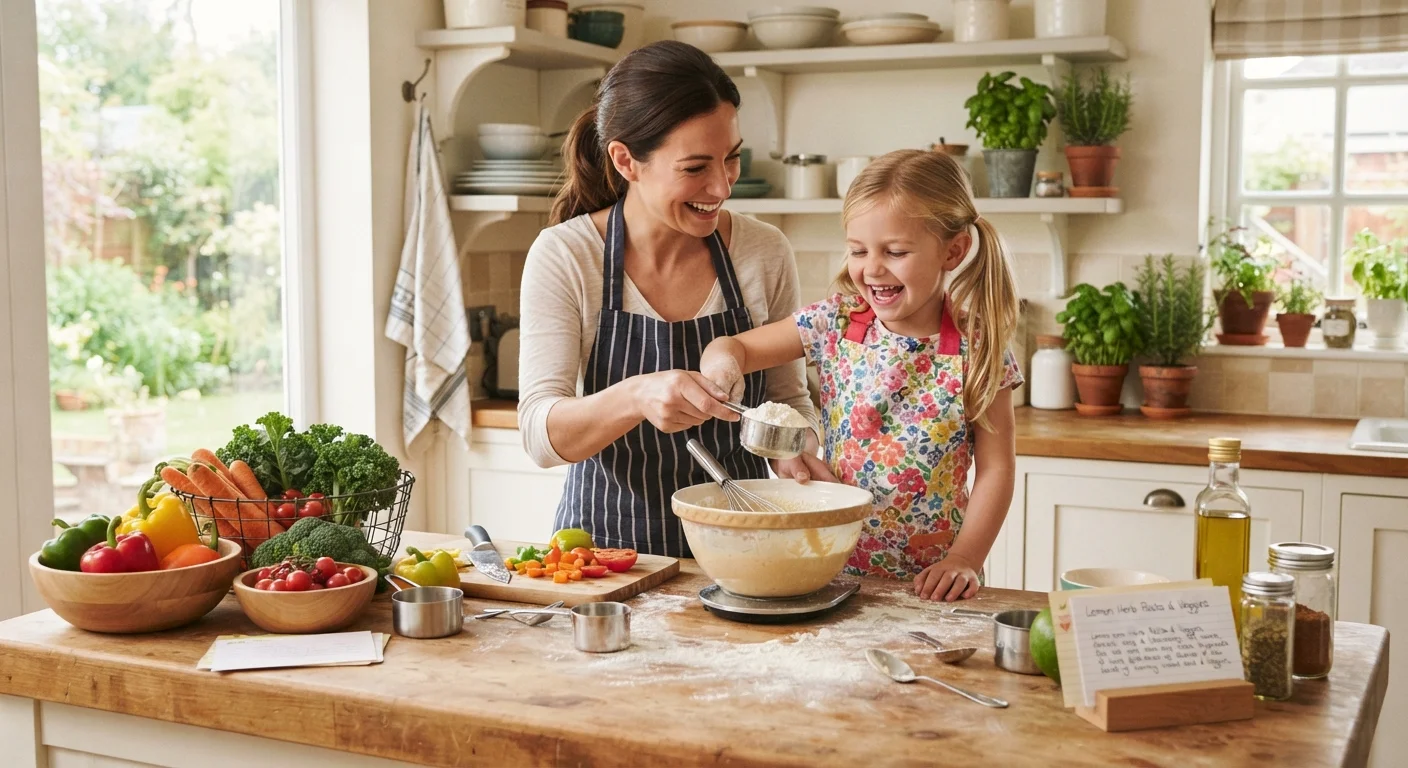
The kitchen is one of the most academically rich rooms in the house. Recipes require reading comprehension and following multi-step instructions. Measuring ingredients builds fractions and proportional reasoning - halving a recipe or doubling a batch connects directly to elementary and middle school math concepts. Observing what happens when heat is applied, or why baking soda causes a reaction, introduces basic chemistry in a concrete, memorable way.
Invite children to read the recipe aloud, estimate quantities before measuring, or predict what the dish will look and smell like before it's done. These small prompts activate higher-order thinking without feeling like a quiz.
Measuring ingredients and adjusting recipes builds real fractions and proportional reasoning skills.
Grocery Shopping
A grocery run is a live exercise in budgeting, comparison, categorization, and planning. Children can help estimate the running total, compare unit prices (price per ounce versus price per item), and sort items by food group or store section. Older children can be given a small budget and tasked with making decisions about what fits within it - an authentic introduction to financial literacy.
Reading food labels together also builds both literacy and health awareness. Asking "Which one has less sodium?" or "What does 'serving size' mean?" draws on reading skills while grounding nutrition concepts in real choices.
Comparing unit prices at the store is an authentic, low-pressure introduction to financial reasoning.
Neighborhood Walks and Nature Observation
Walking through a neighborhood or local park naturally supports science and geography learning. Children can observe seasonal changes in plants, identify animal tracks or birds, notice patterns in architecture, or count specific features (fire hydrants, types of trees, stop signs). These observations build scientific habits of mind: noticing, categorizing, and asking "why."
Bring a small notebook for sketching or listing observations. This practice mirrors what scientists actually do and gives children a sense of ownership over what they discover. It also connects to nurturing curiosity as a household norm - the outdoors becomes an extension of that environment.
Observing and sketching during a neighborhood walk mirrors the habits of real scientific inquiry.
Household Chores and Planning
Chores teach sequencing, responsibility, and cause-and-effect reasoning - all foundational to executive function skills that support academic performance. Sorting laundry involves classification; setting the table uses basic geometry and spatial reasoning (symmetry, placement, counting); organizing a pantry requires categorization and planning ahead.
Involving children in planning the week's tasks - deciding what needs to happen and in what order - builds scheduling and prioritization skills. These are the same organizational capacities that help children manage school projects and long-term assignments. For families working on structured after-school systems, understanding different homework approaches can help align home planning with how your child learns best.
Planning household tasks with children builds the scheduling skills that transfer directly to managing school assignments.
Car Rides and Commutes
Transit time is often underused. Audio books, educational podcasts for kids, or simply talking through the day offer rich language development opportunities. Word games like 20 Questions, storytelling chains, or "I Spy" variations build vocabulary, creative thinking, and verbal reasoning - all without a screen.
Older children can navigate using a map or help estimate arrival time based on distance and speed - an applied math problem most kids find genuinely engaging. Even casual conversation about current events or something observed out the window can spark questions worth exploring further at home.
Word games and map navigation during car rides build language and applied math skills with no extra prep.
Reading Aloud Together
Reading aloud remains one of the most research-supported practices for building literacy across age groups - not just for young children. Shared reading develops vocabulary, listening comprehension, and the ability to follow complex narratives. It also exposes children to sentence structures and writing styles they may not yet read independently.
After reading, ask open-ended questions: "Why do you think the character made that choice?" or "What would you have done differently?" These discussions practice inference, empathy, and analytical thinking. Comprehension and language fluency are often where capable children hit unexpected walls - regular read-alouds are a low-effort way to strengthen both.
Reading aloud together - at any age - remains one of the strongest predictors of long-term literacy development.
Age-Appropriate Involvement Matters
The depth of a learning moment naturally shifts with a child's age and developmental stage. A five-year-old sorting canned goods by color is doing real categorization work; a twelve-year-old comparing cost-per-unit is doing pre-algebra. The same activity can serve different children differently - the key is matching the challenge level to where the child is, not where you'd like them to be.
Making It a Habit Without Making It a Chore
The most important shift is attitude, not schedule. When adults approach daily tasks with genuine curiosity - asking "I wonder why..." or "What do you think would happen if..." - children follow that lead naturally. Learning becomes conversational rather than instructional, which tends to stick far longer.
If you're thinking about how these informal moments fit alongside more structured study time, building a consistent study routine is a useful next step. And for families wanting to go further, shaping the home environment itself can make curiosity a default rather than an occasional event. Small adjustments, repeated daily, add up to a genuinely different educational experience - one that reinforces what school teaches and extends it into lived reality.
The content provided on our blog site traverses numerous categories, offering readers valuable and practical information. Readers can use the editorial team’s research and data to gain more insights into their topics of interest. However, they are requested not to treat the articles as conclusive. The website team cannot be held responsible for differences in data or inaccuracies found across other platforms. Please also note that the site might also miss out on various schemes and offers available that the readers may find more beneficial than the ones we cover.