

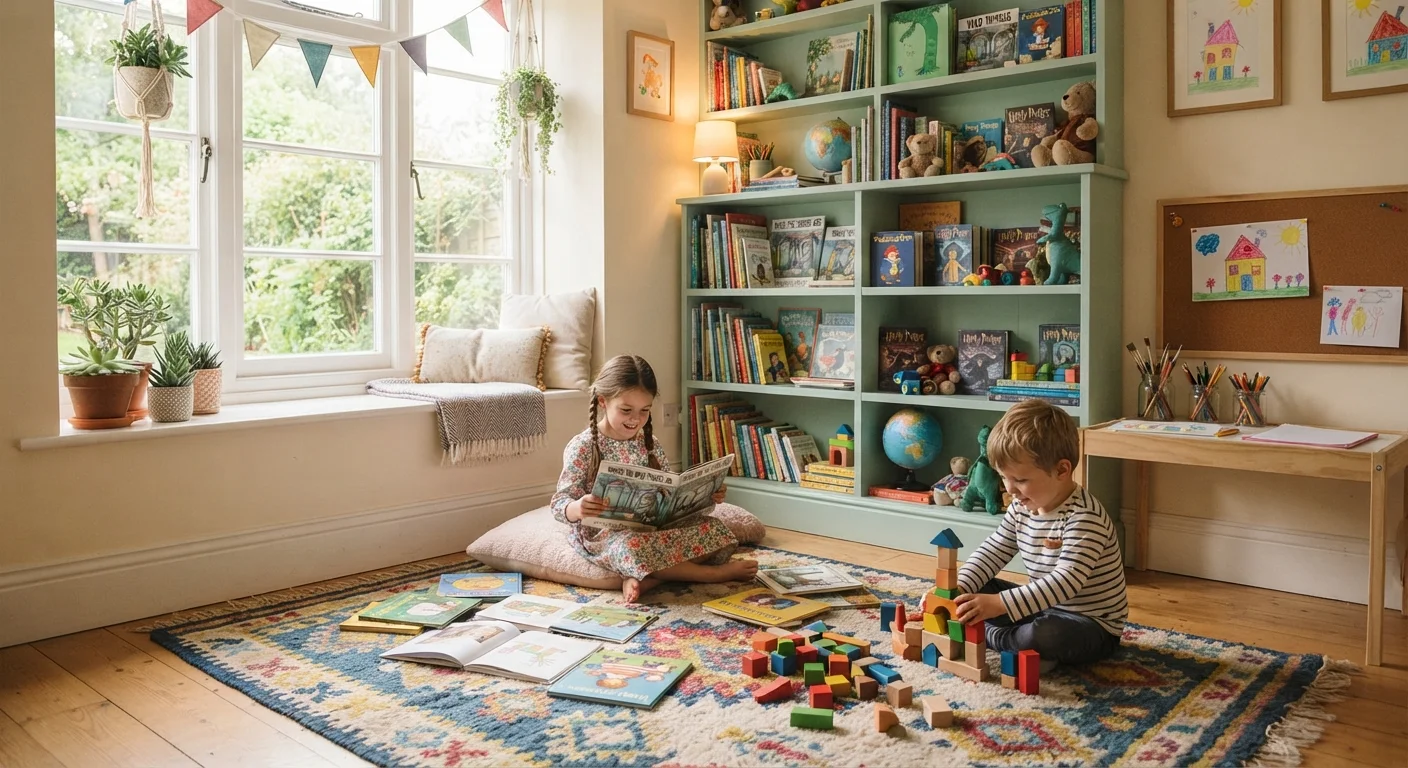
Why the Home Environment Shapes Curiosity
Children are naturally curious, but environment either nurtures or dampens that drive. Research in developmental psychology consistently finds that the home - its physical arrangement, the norms adults model, and the quality of daily interaction - plays a central role in shaping intrinsic motivation to learn.
This doesn't mean families need dedicated schoolrooms or expensive equipment. It means that small, deliberate choices - what's on a shelf, how questions are handled at dinner, whether exploration is welcomed or redirected - add up over time. For a broader look at how family habits reinforce this, see the guide to raising lifelong learners.
Make materials accessible without requiring adult permission
When children must ask before touching books, art supplies, or building materials, spontaneous curiosity is interrupted. Accessibility sends a signal that independent exploration is welcome and expected.
Respond to questions with curiosity rather than immediate answers
When adults model "I wonder how we could find out" instead of delivering answers, children learn that not-knowing is a starting point rather than a failure. This builds tolerance for uncertainty - a core component of intellectual curiosity.
Establish a household norm that mistakes are data, not failures
Fear of getting things wrong shuts down exploration. Families that openly discuss errors - including adults acknowledging their own - create psychological safety that allows children to take intellectual risks.
Read aloud together beyond early childhood
Shared reading builds vocabulary, exposes children to complex ideas, and models the pleasure of sustained attention. Its benefits extend well into the middle-school years, not just the early years.
Limit passive screen time during unstructured hours
Passive consumption - scrolling, autoplay video - fills cognitive space that might otherwise become boredom, which is a known precursor to creative and curious thinking. This isn't about eliminating screens but about preserving some blank time.
Let children follow an interest deeply, even if it seems narrow
Deep dives into a single topic - dinosaurs, trains, a particular historical era - build the skills of sustained inquiry, research, and pattern recognition that transfer broadly. Breadth follows naturally from depth.
Core Practices for a Curiosity-Supportive Home
The following practices draw on what educators and developmental researchers broadly recommend. None requires a complete overhaul - most can be phased in gradually.
Space, Clutter, and the Learning Atmosphere
A chaotic or overstimulating environment can make sustained focus difficult for children. This doesn't mean enforcing sterile tidiness, but rather creating predictable zones where thinking and creating feel possible. A dedicated corner - even a single basket of books and art supplies near natural light - signals that intellectual activity is valued in your home.
Reducing digital distractions during unstructured time is equally important. When screens are the default filler, children have fewer opportunities to sit with boredom long enough to become curious. For ideas on keeping shared family spaces functional for everyone, the guide to organizing shared spaces offers practical middle-ground strategies.
Curiosity Looks Different at Different Ages
Toddlers explore through touch and movement; school-age children gravitate toward collections, rules, and categorization; teenagers often pursue identity-linked interests. The same physical environment and household norms don't work uniformly across all ages. Adjusting materials and conversational approaches as children develop helps keep the environment genuinely stimulating rather than stagnant.
You don't need to reinvent your home overnight. Even shifting one corner of a living room or kitchen into an accessible materials zone can meaningfully change how children interact with their surroundings.
Curiosity also thrives beyond four walls. Everyday activities like cooking and neighborhood walks carry genuine educational value when adults frame them with open-ended questions rather than predetermined answers.
After-School Time: Structure vs. Open Exploration
How children spend the hours after school matters as much as classroom time. Families often wonder whether to set firm homework schedules or give children more agency over when and how they study. The answer depends on the child's age, temperament, and current academic demands. Our comparison of structured homework time and child-led study blocks walks through the trade-offs in detail.
~6 hrs
Average daily screen time for US children aged 8-12
According to Common Sense Media research, children in this age group spend roughly six hours per day on screen media outside of school, underscoring the challenge of preserving unstructured exploration time.
3x
Vocabulary gap linked to early home language exposure
Decades of research - building on Hart and Risley's foundational work - suggests that children from language-rich home environments hear significantly more varied vocabulary, with lasting effects on reading comprehension and academic confidence.
Regardless of which approach a family uses, carving out daily time for self-directed exploration - building, drawing, reading for pleasure, experimenting - is consistently associated with stronger intrinsic motivation and deeper learning over time.
The content provided on our blog site traverses numerous categories, offering readers valuable and practical information. Readers can use the editorial team’s research and data to gain more insights into their topics of interest. However, they are requested not to treat the articles as conclusive. The website team cannot be held responsible for differences in data or inaccuracies found across other platforms. Please also note that the site might also miss out on various schemes and offers available that the readers may find more beneficial than the ones we cover.