

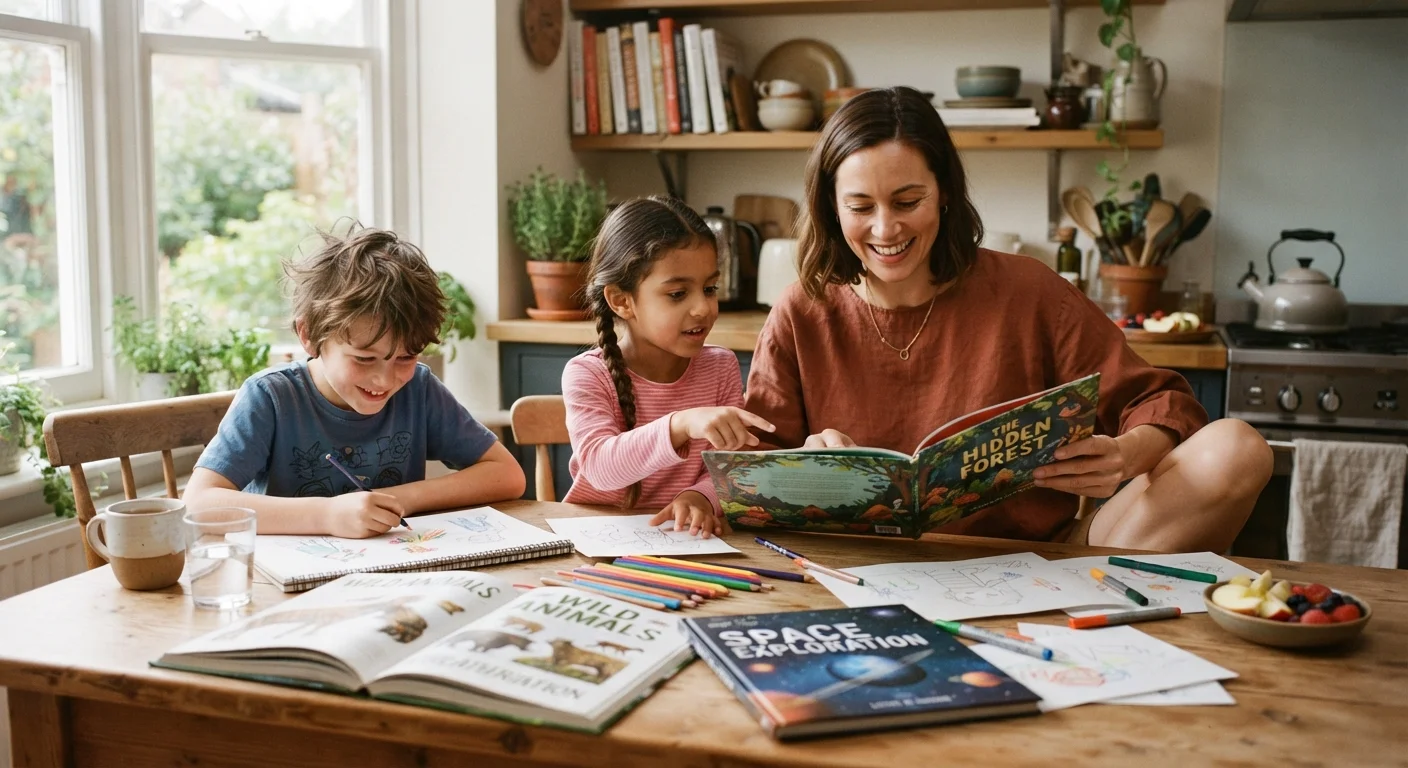
Why Lifelong Learning Starts at Home
Schools teach curriculum, but families teach how to learn. Research consistently shows that family environment - the conversations children hear, the habits they observe, and the attitudes toward effort and curiosity they absorb - predicts educational outcomes as reliably as school quality alone. Children whose parents treat questions as welcome rather than inconvenient, and who model intellectual engagement in daily life, develop a fundamentally different relationship with knowledge.
This guide is for families who want more than grade-level performance. It covers the practical habits, environmental choices, and mindset shifts that shape children who seek out learning independently - not just when a test is coming.
6,000+
Hours children spend at home per school year
Research from the Harvard Family Research Project highlights that children spend significantly more time at home than in school during a given year, making family environment a critical learning context.
~30%
Variance in student achievement explained by home environment
Studies in educational psychology consistently find that home learning environment accounts for a substantial portion of differences in academic achievement, independent of school quality.
2x
More likely to be engaged readers
According to literacy research, children with access to books at home are roughly twice as likely to read for pleasure regularly, regardless of household income.
The Mindsets That Matter Most
Psychologist Carol Dweck's research on growth mindset - the belief that abilities can be developed through dedication and hard work - has become one of education's most replicated findings. Children who hold a growth mindset are more likely to persist after failure, embrace difficult tasks, and recover from setbacks. The opposite, a fixed mindset, leads children to interpret struggle as evidence of low ability rather than as a normal part of learning.
Parents can reinforce growth mindset without lectures. The key is in everyday language:
- Praise effort and strategy, not intelligence - say "you worked through that carefully" rather than "you're so smart."
- When a child fails, ask what they'd try differently, not just what went wrong.
- Share your own learning struggles openly - curiosity and persistence are caught, not just taught.
When a child says 'I can't do this,' try responding with 'You can't do this yet' - that single word reframes the moment as a stage in learning rather than a verdict on ability.
Dweck's research shows that framing difficulty as temporary and process-oriented - rather than fixed - measurably shifts how children persist through challenges.
Avoid rewarding outcomes with tangible prizes. Instead, celebrate the process: 'You figured out a new strategy - that's the part that really matters.'
Studies on motivation suggest that external rewards tied to outcomes can actually undermine intrinsic motivation over time, particularly in children who already enjoy the activity.
Alongside growth mindset, intrinsic motivation - the internal drive to learn for the sake of understanding - is a powerful predictor of long-term academic engagement. Families support this by allowing children some choice in what they explore, and by valuing effort in non-school pursuits as much as in schoolwork.
Daily Habits That Reinforce Curiosity
Children form habits through repetition and observation. The following daily practices are grounded in developmental research and practical family experience:
- Read together regularly. Shared reading - even with older children who can read independently - builds vocabulary, comprehension, and conversational depth. The content matters less than the consistency.
- Ask open questions at mealtimes. "What surprised you today?" or "Is there anything you don't understand yet?" normalize intellectual curiosity as a daily value rather than a school-specific skill.
- Protect unstructured time. Boredom is productive. Children who have space to follow their own curiosity without adult direction develop stronger self-direction and creativity.
- Model your own learning. Let children see you read books on new subjects, look things up when you don't know, or pursue a skill. This demonstrates that learning isn't a childhood obligation - it's a lifelong practice.
For a broader look at how daily habits in different life domains reinforce one another, see our whole-person habits framework.
Creating a Home Environment Built for Learning
Environment shapes behavior in subtle but powerful ways. Families don't need expensive materials to create a learning-supportive home - intentional choices matter more than resources.
- Designate a consistent study space. A predictable, low-distraction location for homework or reading signals that this time and place have a specific purpose.
- Curate access to books and materials. Children with books readily available at home read more - regardless of income level, according to literacy research. Libraries are an underused equalizer.
- Be intentional about screen time. Not all screen time is equivalent. Active, creative, or educational digital engagement differs meaningfully from passive consumption. Discuss what children are watching and playing rather than simply limiting time.
- Manage noise and interruption during focus time. Children - especially those who are easily distracted - concentrate better when the household acknowledges that focus deserves protection.
Navigating Schooling Decisions as a Family
Families face a growing range of schooling choices: public, charter, private, magnet, and home education options each carry distinct tradeoffs. Research does not definitively favor any single model across all children and contexts - fit between a child's learning style, a family's values, and available options matters more than school type alone.
Key questions worth asking when evaluating any school setting include:
- How does this school respond when a child struggles - with support, or with labeling?
- What does student-teacher communication look like, and how involved can families be?
- Does the school's culture around grades and achievement encourage learning or anxiety?
For families navigating decisions about academic progression, our guide on grade retention and social promotion provides a research-grounded overview of what's at stake.
Talk to Teachers Early and Often
Don't wait for a scheduled conference to check in with your child's teacher. A brief email at the start of the school year to share your child's learning style, strengths, and any known challenges opens a collaborative relationship that pays dividends year-round. Teachers consistently report that engaged family communication makes it easier to catch problems early and tailor support appropriately.
When Children Struggle: What Families Can Do
Academic difficulty is not a character flaw. Children struggle for a wide range of reasons - learning differences, social-emotional challenges, mismatches between teaching style and learning style, or issues as concrete as sleep deprivation or inconsistent routines.
The first step is observation without judgment. Notice when and in what subjects difficulty appears, how the child responds to challenge (avoidance, frustration, shutdown), and whether the struggle is recent or longstanding. These patterns often point toward identifiable causes.
Our companion article, why smart kids struggle in school, covers the most common underlying causes and practical family responses in depth.
Early, targeted support - whether through school-based resources, tutoring, or adjustments at home - generally produces better outcomes than waiting and hoping for improvement. Communicate regularly with teachers, and frame conversations with your child around problem-solving rather than performance pressure.
Building a Bridge to Future Learning
The habits children build during their school years don't stay in school. Children who learn to manage their time, tolerate the discomfort of not-yet-knowing, ask good questions, and seek help when stuck carry those skills into college, career training, and adult life. The skills and careers hub explores how early learning habits connect directly to long-term professional development.
Raising a lifelong learner is less about engineering a perfect educational path and more about making curiosity feel safe, valued, and normal - every day, at home, in conversation, and through the way you approach your own learning. That consistency, sustained over years, is what shapes the habit of mind that lasts a lifetime.
This article is for informational and educational purposes only. Specific concerns about a child's development, learning, or academic performance should be discussed with qualified educators, school counselors, or child development professionals.
The content provided on our blog site traverses numerous categories, offering readers valuable and practical information. Readers can use the editorial team’s research and data to gain more insights into their topics of interest. However, they are requested not to treat the articles as conclusive. The website team cannot be held responsible for differences in data or inaccuracies found across other platforms. Please also note that the site might also miss out on various schemes and offers available that the readers may find more beneficial than the ones we cover.