

Why Routines Matter More Than Motivation
Most families assume that getting kids to study is a motivation problem. In practice, it is largely a structure problem. Motivation fluctuates - it is higher after a great day at school and nearly absent after a hard one. A well-designed routine sidesteps the motivation question entirely by making study time an expected, low-drama part of the day, like brushing teeth or eating dinner.
Research in habit formation consistently shows that environmental cues and consistent timing are more powerful drivers of behavior than willpower or enthusiasm alone. When the same conditions repeat - same time, same place, same sequence - the brain begins to automate the transition into focus mode. This is true for adults and children alike.
For families exploring broader daily structure, the principles behind morning routine architecture apply equally well to after-school blocks: sequence, timing, and environmental cues all compound over time.
Routine Is Not One-Size-Fits-All
What works for a second-grader will not work for a middle schooler. A child's developmental stage, after-school schedule, and individual temperament all shape what an effective study routine looks like. Build the routine with your child, not for them - ownership increases follow-through significantly.
The goal is not a perfectly optimized schedule. The goal is a predictable, repeatable structure that your child can eventually run with minimal adult prompting.
Getting Started: What You Need
Before building the routine, gather the basic tools and set realistic expectations. You do not need elaborate systems or expensive planners - consistency is the active ingredient, not complexity.
What you will need
Weekly planner or paper schedule
Helps children and parents map out study blocks alongside extracurriculars and family time.
Timer (analog or digital)
Supports time-boxing study sessions and teaches children to work in focused intervals.
Dedicated study space
A consistent, low-distraction area signals to a child that it is time to focus.
Homework tracking notebook or folder
Keeps assignments visible and organized so nothing is missed or forgotten.
Noise-canceling headphones
Useful for children who are easily distracted in shared or busy household spaces.
Avoid Overloading After-School Hours
Children need genuine downtime after a full school day. Packing the schedule too tightly - homework, extracurriculars, tutoring back-to-back - can lead to burnout and resistance to learning altogether. Build in a decompression buffer before any formal study block begins.
The Step-by-Step Process
Follow these steps in order for the smoothest implementation. Expect the first two weeks to feel effortful - that is normal. Most families find that by week three, the routine begins to run on its own momentum.
Use Transition Rituals to Signal Study Time
A short, predictable ritual - a snack, a five-minute walk, or even changing out of school clothes - helps a child's brain shift gears from social school mode to focused work mode. Consistent cues reduce the battle of getting started and make the routine feel natural rather than imposed.
Assess your child's schedule and energy patterns
Before setting any schedule, spend a week observing when your child seems most alert and receptive after school. Some children focus well immediately after arriving home; others need 30-60 minutes of unstructured time first. Note any recurring after-school activities that will shape available windows.
Also consider workload: a first-grader may have 10 minutes of reading practice, while a seventh-grader may need 60-90 minutes for multiple subjects. Building a realistic picture now prevents designing a routine that collapses in week two.
Choose a consistent start time for the study block
Pick a specific daily start time for homework and studying - and anchor it to an existing daily event (after dinner, after the after-school snack, after a younger sibling's nap). Anchoring to an existing habit reduces the mental effort of remembering when to begin.
For younger children (K-3), 20-30 minute blocks are typically appropriate. For older elementary students, aim for 30-45 minutes. Middle and high schoolers may need 60-90 minutes, split across subjects with short breaks in between.
Set up a dedicated, distraction-reduced study space
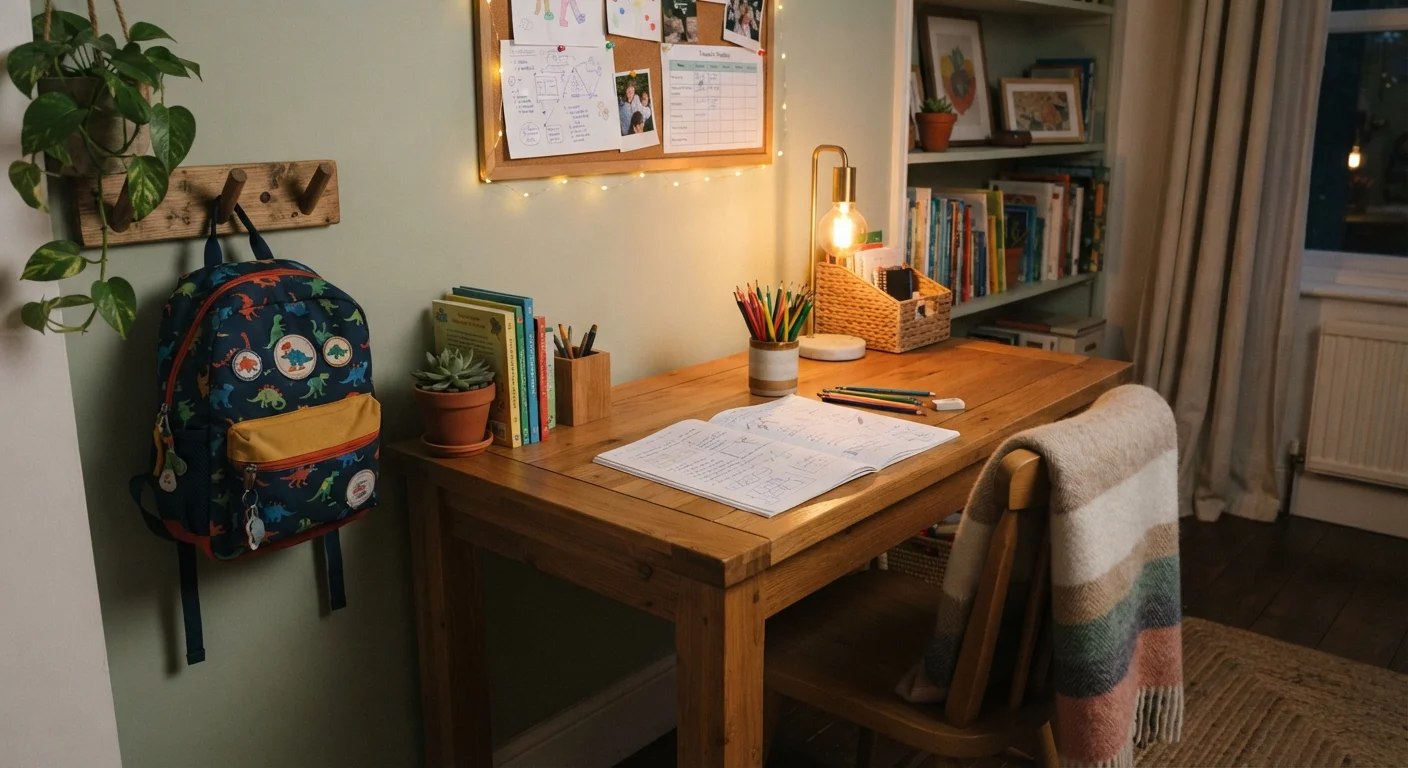
The physical environment shapes focus more than most parents realize. Choose a spot with adequate lighting, a flat work surface, and easy access to supplies. It does not need to be a separate room - a consistent corner of the kitchen table works well for many families.
Remove obvious distractions: phones face-down or in another room, TV off, non-study apps closed on any shared devices. For households where siblings are nearby, consider a visual signal (a small sign or colored card) that indicates a focus block is in progress.
Build the routine with your child, not for them
Sit down together and map out the weekly schedule on paper. Let your child choose the order of subjects, whether they tackle the hardest task first or ease in with something lighter. When children have input, they are more likely to follow through without resistance.
This is also a good moment to discuss what success looks like - not perfection, but consistent effort. Framing study time as a skill being practiced, rather than a chore to survive, helps shape a healthier long-term relationship with learning. For a deeper look at the philosophy behind this, see raising lifelong learners.
Introduce a transition ritual before study time begins
A predictable short ritual signals the brain that focused work is coming. This might be a healthy snack, a five-minute walk around the block, or a few minutes of free drawing. The activity itself matters less than its consistency - the same cue, in the same order, each day.
For families looking to reinforce learning beyond the desk, everyday activities that double as learning opportunities offers practical ideas for weaving academic skills into ordinary moments.
Monitor, review, and adjust monthly
No routine survives first contact with a new semester unchanged. Set a monthly check-in - five minutes at the kitchen table - to ask your child what is working and what feels hard. Adjust start times, block lengths, or the study location based on honest feedback.
Watch for signs that screen time is creeping into study blocks; understanding the difference between productive and passive screen use can help. See screen time and learning for practical guidance on drawing that line.
Adapting the Routine as Kids Grow
A study routine that worked in third grade will likely need a significant overhaul by sixth grade. Academic demands increase, social schedules grow more complex, and children develop stronger opinions about how they learn best. Treat the routine as a living document rather than a fixed rule.
For younger children, parental presence nearby (not hovering - just available) tends to lower anxiety and increase time on task. For older students, gradual independence is the goal: shift from sitting with them to checking in at the end of the session, then to weekly rather than daily check-ins.
Reading aloud together is one practice that can extend well beyond the early years and reinforce vocabulary and comprehension at any age. Explore the case for reading aloud for the reasoning behind keeping this habit alive even into middle school.
The content provided on our blog site traverses numerous categories, offering readers valuable and practical information. Readers can use the editorial team’s research and data to gain more insights into their topics of interest. However, they are requested not to treat the articles as conclusive. The website team cannot be held responsible for differences in data or inaccuracies found across other platforms. Please also note that the site might also miss out on various schemes and offers available that the readers may find more beneficial than the ones we cover.