

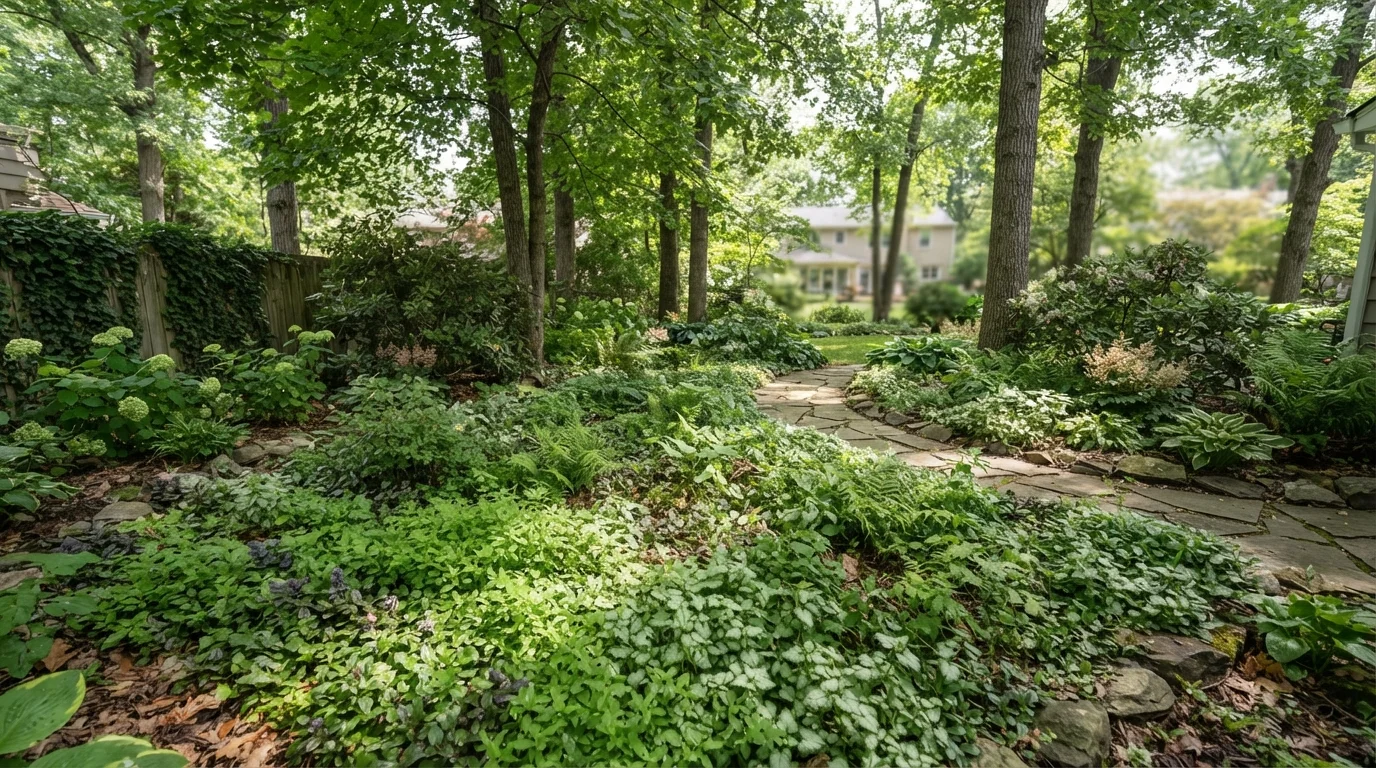
Why Ground Covers Deserve a Place in Your Yard
Lawn grass is demanding. It needs regular mowing, fertilizing, overseeding, and often significant irrigation - and still struggles in shaded corners, steep banks, or compacted areas under tree canopies. Ground covers offer a practical alternative: plants that spread low and densely, outcompeting weeds and protecting bare soil without requiring weekly attention.
The term "ground cover" refers broadly to any low-growing plant used to blanket an area. That includes creeping perennials, spreading shrubs, ornamental grasses, and even some vines trained to stay horizontal. The right choice depends heavily on your site conditions - sun exposure, soil drainage, climate zone, and foot traffic levels all matter. This list highlights options worth knowing, along with honest notes on where each performs well and where it falls short.
If you're deciding between a traditional lawn and alternative plantings, our comparison of grass seed vs. sod can help frame the broader lawn decision first. Ground covers often work best as complements to lawn, filling in the problem spots where turf struggles.
Creeping Thyme
Creeping thyme (Thymus serpyllum and related species) is one of the most versatile low-growing options for sunny, well-drained spots. It forms a dense, fragrant mat typically 2-4 inches tall, producing small pink or purple flowers in summer that pollinators appreciate. It tolerates light foot traffic better than most ground covers, making it a reasonable choice for spaces between stepping stones or along pathways.
Creeping thyme is drought-tolerant once established and thrives in poor, rocky soils where other plants falter. It does not perform well in heavy clay or consistently wet conditions, and it needs at least six hours of sun. In colder USDA hardiness zones (below Zone 4), winter hardiness can vary by cultivar - check specifics for your region.
Creeping thyme tolerates light foot traffic and poor, dry soils where most plants struggle.
Pachysandra
Japanese pachysandra (Pachysandra terminalis) is a go-to choice for shaded areas under trees, where grass rarely thrives. It grows 6-12 inches tall, spreads via underground runners, and maintains deep green foliage year-round in most of its growing range (Zones 4-9). Once established, it forms a dense carpet that suppresses weeds effectively and requires almost no maintenance beyond occasional edging to keep it from spreading into adjacent beds.
Pachysandra prefers moist, well-drained, acidic soil and struggles in full sun, which can scorch its leaves. It's also not drought-tolerant, so in drier climates it will need supplemental watering. A native alternative - Allegheny spurge (Pachysandra procumbens) - performs similarly in parts of the eastern US and is generally considered less aggressive.
Pachysandra thrives in deep shade under trees, forming a weed-suppressing carpet with minimal upkeep.
Creeping Phlox
Creeping phlox (Phlox subulata) earns its place through sheer seasonal impact: in spring, it covers itself in masses of small flowers in pink, white, lavender, or red. Outside of bloom, it provides dense, semi-evergreen foliage that spreads steadily without becoming invasive. It grows 4-6 inches tall and works particularly well cascading over retaining walls or covering dry, sunny slopes where erosion is a concern.
It performs best in well-drained soil and full sun to light shade. Like creeping thyme, it dislikes consistently wet feet. After flowering, shearing it back lightly encourages compact, healthy growth. Creeping phlox is a legitimate workhorse for gardeners dealing with difficult slopes - a situation where growing conditions are often too dry and exposed for standard lawn grass.
Creeping phlox offers dramatic spring color on sunny slopes where erosion control is a priority.
Mondo Grass
Mondo grass (Ophiopogon japonicus) is technically a member of the lily family, not a true grass, but it behaves like one visually. It forms tidy, dark green clumps that spread slowly to create a grass-like carpet without ever needing mowing. Dwarf varieties stay under 4 inches; standard forms reach 8-10 inches. Black mondo grass (O. planiscapus 'Nigrescens') offers a striking dark-leafed alternative for gardeners who want visual contrast.
Mondo grass tolerates shade reasonably well and handles the moderate drought conditions common in the Southeast US. It grows slowly, so patience is required during establishment - planting at closer spacing speeds canopy closure. It's hardy in roughly Zones 6-10 and prefers mild, humid climates.
Mondo grass creates a tidy, mow-free carpet that handles shade and mild drought without complaint.
Ajuga (Bugleweed)
Ajuga (Ajuga reptans) spreads quickly via surface runners, making it one of the faster-establishing ground covers on this list - and one that warrants a note of caution. In some regions, particularly in parts of the Pacific Northwest, it can spread beyond intended areas. Check with your local cooperative extension service before planting to confirm it's appropriate for your location.
Where it's suitable, ajuga offers real advantages: it tolerates both sun and partial shade, produces attractive blue flower spikes in spring, and comes in cultivars with purple, bronze, or variegated foliage. It handles moderate foot traffic and generally stays 3-6 inches tall. It performs best in moist, well-drained soil but adapts to varying conditions more readily than many alternatives. For gardeners interested in balancing perennial plants for color and low effort, ajuga offers both qualities in one plant.
Ajuga establishes fast and adapts to sun or shade, though its spread rate requires monitoring in some regions.
Native Sedges
Sedges (Carex spp.) are among the most ecologically valuable ground covers available to American gardeners, and the range of native species means there's likely one suited to almost any region and condition. Pennsylvania sedge (Carex pensylvanica) works beautifully under trees in the Northeast and Midwest. Berkeley sedge (Carex divulsa) handles dry shade in the West. Most stay under 12 inches, require minimal mowing (once or twice per year at most), and provide habitat value for insects and birds.
Native sedges generally prefer to be matched to regional conditions - a native of the Pacific Coast won't necessarily perform well in the Southeast. Consulting your state's native plant society or local extension service helps identify the right species for your climate and soil. Establishment can be slower than some non-native options, but the long-term maintenance payoff and environmental benefit are meaningful.
Native sedges offer region-specific ground coverage with real ecological value and very low maintenance needs.
Setting Ground Covers Up for Success
Even low-maintenance plants need a good start. Planting into weed-free, loosened soil and watering consistently through the first growing season gives ground covers the best chance of establishing quickly enough to do their job. Once they've filled in, most require only occasional trimming, division, or deadleading.
Give New Plants Time Before Judging
Most ground covers follow the familiar gardening pattern: sleep, creep, leap - slow in year one, moderate spread in year two, and vigorous coverage by year three. Resist the urge to add more plants prematurely if coverage seems slow. Overcrowding can cause problems once plants hit their stride, and patience during establishment typically pays off with a denser, healthier planting.
Ground covers and mulch work well together during the establishment phase. A layer of organic mulch between new transplants suppresses weeds while roots spread - see our guide to mulching depth and timing for principles that apply directly here. Once plants close the canopy, mulch becomes less necessary.
For gardeners thinking more broadly about bed design and soil management, it's also worth reviewing the trade-offs between raised beds and in-ground planting. Ground covers are almost always an in-ground solution, which means working with your native soil rather than engineering around it. Understanding your soil's drainage and structure upfront saves frustration later.
The content provided on our blog site traverses numerous categories, offering readers valuable and practical information. Readers can use the editorial team’s research and data to gain more insights into their topics of interest. However, they are requested not to treat the articles as conclusive. The website team cannot be held responsible for differences in data or inaccuracies found across other platforms. Please also note that the site might also miss out on various schemes and offers available that the readers may find more beneficial than the ones we cover.