

Start Before You Store
The most common organization mistake homeowners make is reaching for bins, labels, and shelving before deciding what actually belongs in a space. Buying storage solutions for items you no longer need wastes both money and space. Before touching a single drawer or shelf, work through what you own and make deliberate decisions about what stays.
Our guide on the right order of operations before organizing walks through this process in detail - and why skipping it almost always leads to re-doing the work. The core principle: every item should earn its place based on how often it's used and whether it genuinely belongs in that room.
Organize a room in a single session when possible - partially organized spaces create more visual confusion than fully cluttered ones, and momentum matters.
Incomplete organization leaves ambiguous zones where items accumulate without a clear system, often resulting in more disorder than before you started.
Before purchasing any storage container, measure the space and bring the dimensions with you - most storage frustration comes from bins that almost fit.
Ill-fitting storage forces workarounds that undermine the system and discourage consistent use, which is why precise measurements are a professional organizer's non-negotiable first step.
Label storage from the user's perspective, not the contents' perspective - 'where I look for batteries' beats 'electronics' every time.
Labels that match how people think and search for items dramatically increase how consistently a system gets used by all household members.
Entryways and Mudrooms
Your entryway sets the tone for the entire home. It's also the most likely spot for daily clutter to pile up - shoes, bags, keys, mail, and outerwear all converge here. The goal is a frictionless drop zone that channels items to their proper place automatically.
- Hooks at multiple heights accommodate adults, kids, and guests without crowding.
- A dedicated tray or basket for shoes keeps the floor clear and contains the mess.
- A narrow console or shelf with a small dish for keys and cards provides a landing spot without becoming a dumping ground.
- Seasonal rotation is essential - store off-season gear elsewhere rather than letting it crowd current-use items.
If your entryway doubles as a mudroom, wall-mounted cubbies with labeled sections for each household member distribute responsibility and reduce conflicts over shared space.
Kitchen and Pantry
Kitchens accumulate clutter faster than almost any other room because they serve multiple overlapping functions: cooking, eating, homework, charging, and sometimes bill-paying. Start by assigning each zone a single primary function and only store items relevant to that task within reach.
Countertops should hold only daily-use appliances. Everything else belongs in a cabinet or pantry. Inside drawers, use dividers to separate categories - utensils, tools, and gadgets each get their own lane. For a deeper dive into keeping drawers functional, see our article on sorting and zoning kitchen drawers.
In the pantry, group items by type and place frequently used goods at eye level. Canned goods, grains, and snacks each occupy a defined zone. Transparent containers help you track inventory at a glance and reduce duplicate purchases.
25%
Of two-car garages that can't fit any cars
According to the U.S. Department of Energy, approximately one in four two-car garages is too cluttered to hold a vehicle.
40%
Of housework eliminated by reducing clutter
Research from the National Soap and Detergent Association has suggested that clutter is responsible for around 40% of the average home's cleaning burden.
Bedrooms and Closets
Bedrooms function best as calm, low-stimulation environments - which means clutter has an outsized negative effect here compared to other rooms. Limit what lives in this space to sleep, dressing, and relaxation-related items.
In closets, hang items by category and frequency of use. Daily wear at eye level; formal or seasonal pieces higher up or in garment bags. Folding methods that allow items to stand upright in drawers (rather than stack horizontally) let you see everything at once without disturbing other items to find one piece.
- Shoes stored in clear boxes or on a tiered rack keep the closet floor accessible.
- Shelf dividers prevent sweater stacks from toppling.
- Over-the-door organizers add surface area without requiring extra furniture.
For guest rooms or shared bedrooms, our piece on organizing homes with multiple people offers practical strategies for navigating different organizational preferences under one roof.
Bathrooms
Bathroom organization is almost entirely a space management challenge. Most bathrooms offer limited storage relative to what gets used in them daily. The solution is vertical thinking and ruthless curation of what actually stays on hand.
Under the sink tends to become a catch-all. Use stackable bins or a small shelf insert to create layers - cleaning supplies on one level, backup toiletries on another. A turntable (lazy Susan) on a deep shelf makes corner items reachable without digging.
Medicine cabinets should be edited regularly. Expired products take up prime real estate. Drawer organizers inside vanity drawers keep daily-use items separated from occasional-use ones. If your bathroom feels perpetually cluttered despite good organization, it may benefit from targeted upgrades - our guide to refreshing a bathroom without a full remodel covers structural and aesthetic changes that can meaningfully improve function.
Living and Common Areas
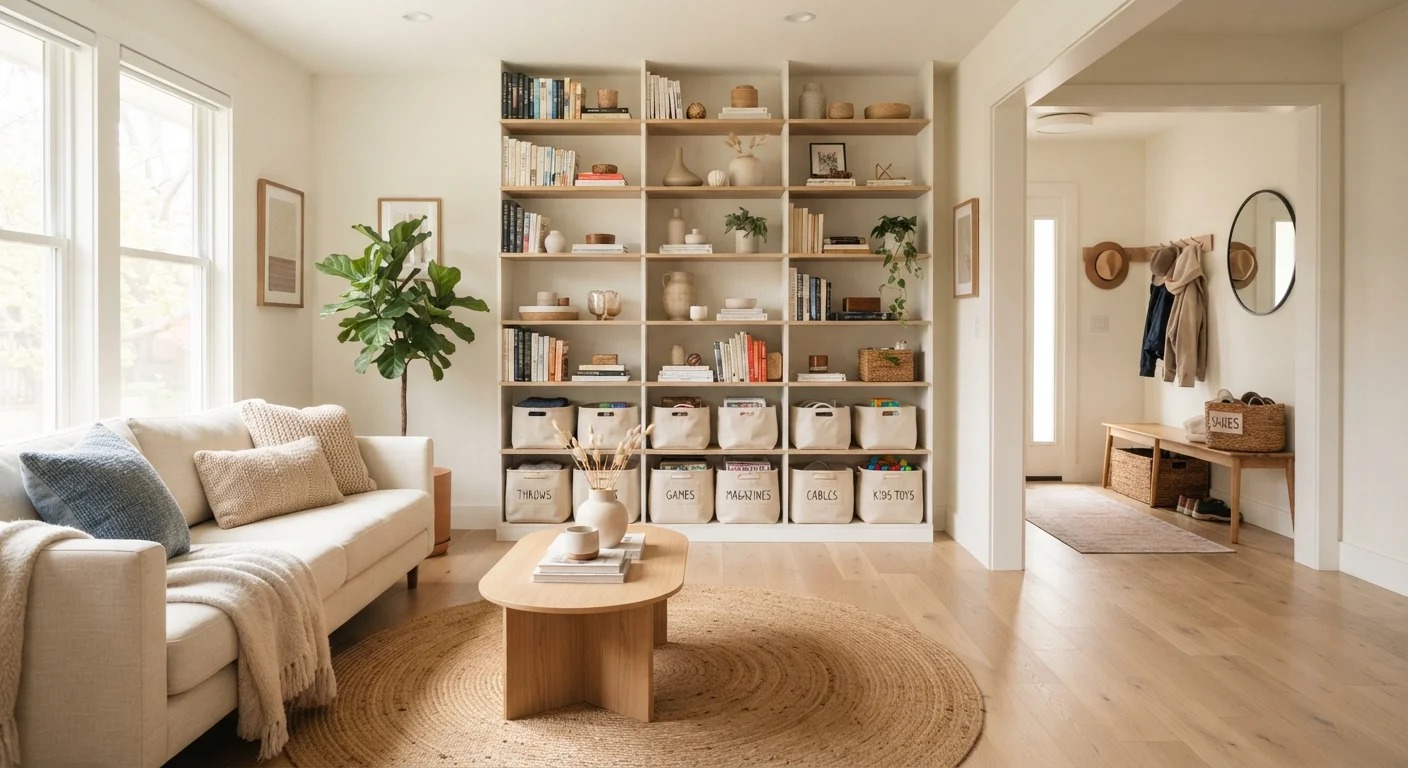
Living rooms and family rooms are high-traffic, multi-use spaces where organization has to be both functional and visually tolerable. The key is closed storage for items you want out of sight and intentional display for things that contribute to the room's character.
Media consoles, ottomans with internal storage, and baskets on lower shelves absorb remote controls, blankets, chargers, and kids' items without making the room feel cluttered. Coffee table surfaces stay clear when there's a designated home for every recurring object nearby.
Shared spaces are particularly vulnerable to drift - items migrate in from other rooms and never leave. A quick nightly reset, where each person returns items to their designated rooms, is one of the most effective habits for maintaining order without a daily deep clean.
Garage and Utility Spaces
Garages often become the default storage zone for everything that doesn't have a clear home elsewhere - which means organizing one requires confronting years of deferred decisions. Approach it in categories: automotive, tools, lawn and garden, sports gear, and seasonal items each get their own zone.
Wall-mounted systems (pegboards, rail systems, overhead platforms) free up floor space and keep items visible. Heavy items stay low; lightweight or infrequently used items go overhead. Label everything, especially bins that close.
For lawn and garden equipment specifically, consider vertical storage for long-handled tools and wall hooks for hoses and extension cords. Our lawn and garden hub covers maintenance and care for the equipment itself. For broader guidance on home project planning and knowing when professional help is warranted, see our first-timer's home improvement orientation.
Maintaining Order Long-Term
Organization is not a one-time project. Homes naturally accumulate new items, and without deliberate habits, even well-organized spaces revert to clutter over time. The most effective maintenance strategy is building small, consistent routines rather than scheduling infrequent overhauls.
Practices like the one-in, one-out rule - where a new item entering the home prompts removing one - prevent slow accumulation. Seasonal reviews of each room catch drift before it becomes overwhelming. For a full set of sustainable habits, our piece on daily habits that keep homes organized is a practical companion to this room-by-room roadmap.
If you're just beginning and feel unsure where to start at all, this beginner's guide to home organization walks through the mindset and first steps before any room-specific work begins.
The content provided on our blog site traverses numerous categories, offering readers valuable and practical information. Readers can use the editorial team’s research and data to gain more insights into their topics of interest. However, they are requested not to treat the articles as conclusive. The website team cannot be held responsible for differences in data or inaccuracies found across other platforms. Please also note that the site might also miss out on various schemes and offers available that the readers may find more beneficial than the ones we cover.