

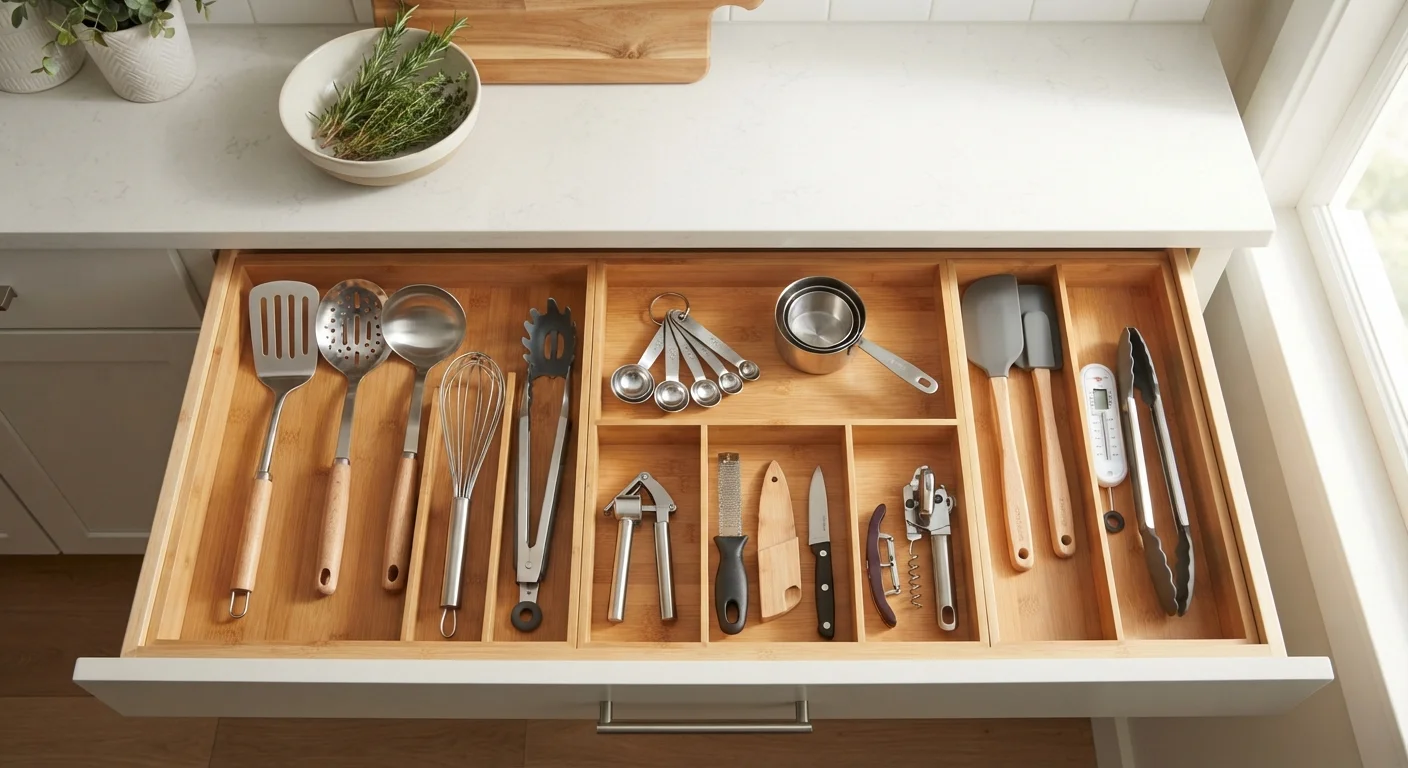
Why Kitchen Drawers Become Chaos Magnets
Kitchen drawers absorb clutter because they offer easy, low-visibility storage. Unlike open shelves or countertops, a closed drawer hides disorder - which means problems compound quietly until the drawer barely closes. The mix of spatulas, takeout menus, rubber bands, and mystery batteries is familiar to most households.
The root cause is rarely laziness. It's the absence of a defined system. When a drawer has no clear purpose, everything ends up in it. The fix is zoning: assigning each drawer a specific function and organizing within that function. This approach is part of a broader principle covered in our room-by-room organization guide.
Before you reorganize, it also helps to understand why decluttering must come first. Sorting around items you no longer use just entrenches the problem - a point covered in detail in Before You Organize, Do This.
Thinking Beyond Drawers
If drawer space is limited in your kitchen, you may have more storage potential than you realize elsewhere. Unusual spots like the inside of cabinet doors or narrow vertical gaps can supplement drawer storage effectively. Our guide on storage solutions for awkward spaces covers those options in depth.
What You'll Need
You don't need expensive specialty products to get kitchen drawers under control. A few practical tools make the process faster and the results more durable.
Drawer dividers or organizer trays
Create fixed zones within a drawer so different categories of items stay separated.
Measuring tape
Measure drawer interior dimensions before purchasing any organizers to ensure a proper fit.
Small labeled containers or bins
Corral loose small items - twist ties, batteries, bag clips - into visible, contained groups.
Adhesive drawer liner
Prevents dividers from sliding and protects drawer surfaces from scratches and moisture.
What you will need
Step-by-Step: Sort, Zone, and Maintain
Follow these steps in order. Skipping the sorting phase and going straight to dividers is the most common mistake - it locks disorganized groupings in place rather than solving them.
Empty the drawer completely
Pull everything out and place it on a flat surface. This step is non-negotiable - you cannot properly assess what you have or what belongs together while items are still jumbled inside. Wipe the drawer interior clean before proceeding.
Sort items into functional categories
Group everything by how it's used, not by what it looks like. Typical kitchen categories include: cooking utensils, baking tools, cutting and prep tools, gadgets and appliances accessories, wraps and bags, and miscellaneous (the category to minimize). Set aside anything broken, duplicated, or unused.
Decide on a zone assignment for each drawer
Match categories to drawers based on proximity to use. Cooking utensils belong near the stove. Prep tools belong near the cutting board. Baking tools can live farther away if you bake infrequently. One category per drawer is the goal - mixing zones is what created the problem in the first place.
Measure, then fit dividers
Measure your drawer's interior width, depth, and height before purchasing or repositioning dividers. Organizers that don't fit correctly slide around and lose their effectiveness quickly. Adjustable bamboo or plastic dividers work well for most standard drawer sizes.
Return items to their zones
Place items back into the drawer within their designated sections. Store the most frequently used items at the front of the drawer and less-used items toward the back. Ensure everything is visible at a glance - if you have to dig, the zone is too dense.
Build a quick weekly reset habit
Set aside two to five minutes once a week - perhaps before grocery shopping or during a kitchen cleanup - to return any misplaced items to their correct zones. This prevents the gradual drift that returns drawers to chaos. Consistency matters far more than perfection.
Don't Organize What You Should Discard
Fitting too many items into a well-divided drawer just means a tidier version of the same problem. If a category won't fit comfortably in one drawer, revisit how many items you're keeping - not how many dividers you can squeeze in. Less volume is the most durable organization solution.
Once your drawers are set up, the long-term challenge is consistency. Households with multiple people using the same kitchen may need to agree on placement rules - a challenge explored in our guide on organizing shared spaces. And for habits that help any organization system last, see One-In, One-Out and Other Habits That Keep Homes Organized.
The content provided on our blog site traverses numerous categories, offering readers valuable and practical information. Readers can use the editorial team’s research and data to gain more insights into their topics of interest. However, they are requested not to treat the articles as conclusive. The website team cannot be held responsible for differences in data or inaccuracies found across other platforms. Please also note that the site might also miss out on various schemes and offers available that the readers may find more beneficial than the ones we cover.