

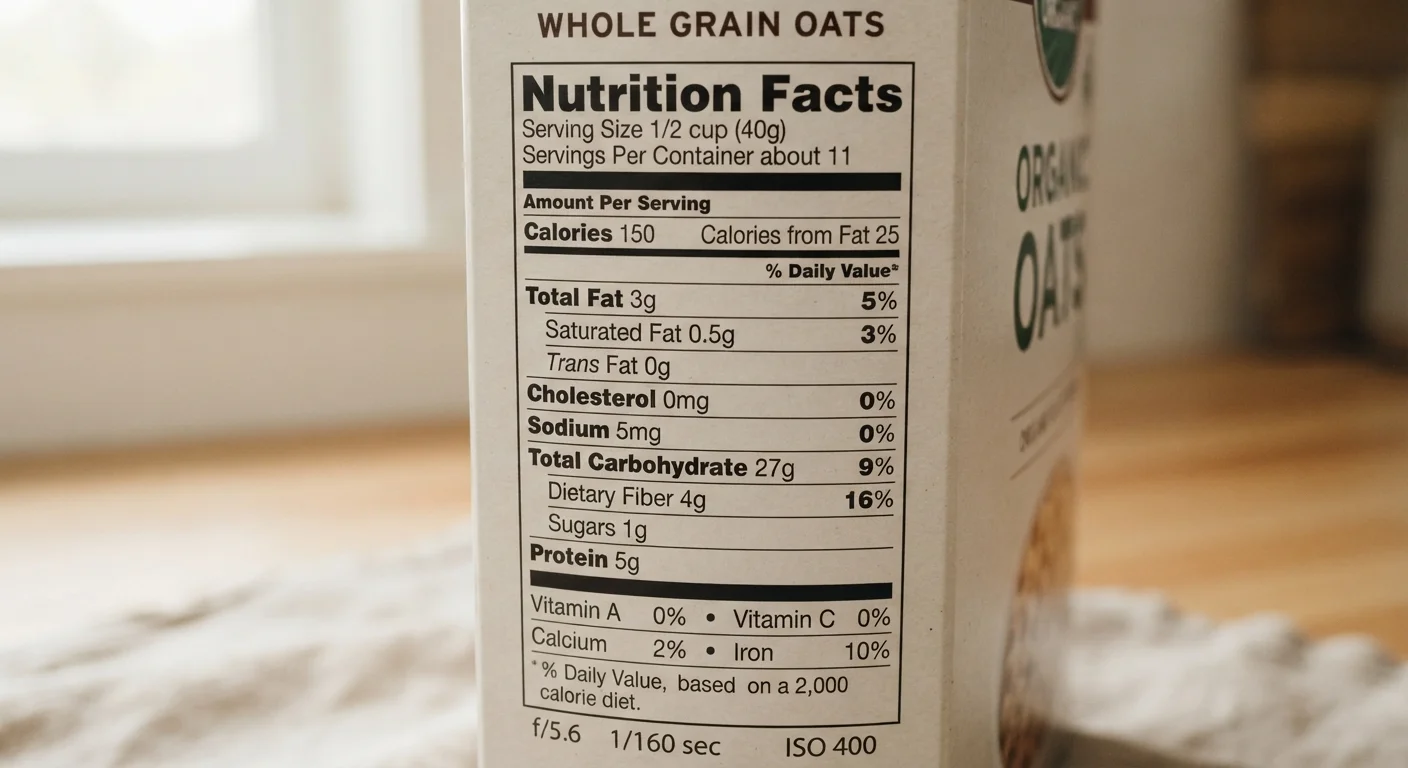
The Serving Size Problem
The first number on any Nutrition Facts panel sets the stage for every value that follows: the serving size. It sounds straightforward, but it's one of the most commonly misread elements on any label.
Serving sizes on U.S. food labels are set by the FDA and are meant to reflect amounts that people typically consume in one sitting - not a recommended portion. That means a bag of chips listed as "2 servings" may realistically be eaten in one sitting, effectively doubling every calorie, sodium, and fat figure on the label.
A quick habit worth building: before reading any other number, multiply all figures by the number of servings you'll actually eat. If you're having the whole 2.5-serving container of soup, the sodium number on the label is 2.5 times what's printed. See our plain-language walkthrough of every panel section for a more complete breakdown.
| Serving size basis | Reflects typical consumption amounts, not dietary recommendations (U.S. FDA Nutrition Labeling Requirements) |
| Low %DV threshold | 5% DV or less per serving (FDA %DV guidance) |
| High %DV threshold | 20% DV or more per serving (FDA %DV guidance) |
| Calorie reference diet for %DV | 2,000 calories per day (FDA Nutrition Facts label standard) |
| Ingredient list order | Descending by weight - first ingredient is most abundant (FDA ingredient labeling regulations) |
| Added sugars disclosure | Required as a separate line item since updated FDA labeling rules (FDA Nutrition Facts label update) |
Percent Daily Value: A Reference Tool, Not a Rule
The % Daily Value (%DV) column tells you what share of a nutrient's recommended daily intake one serving provides, based on a 2,000-calorie reference diet. This is a population-level benchmark - your actual needs may be higher or lower depending on age, activity level, and health status.
As a general guide, the FDA considers 5% DV or less "low" for a nutrient, and 20% DV or more "high." These thresholds are useful for quick comparison shopping: a cereal with 20% DV of sodium per serving is contributing significantly to daily sodium intake, while one at 3% DV is not.
Use %DV to compare similar products or to gauge whether a food is a meaningful source of a nutrient you want more of - like dietary fiber - or less of, like saturated fat. For vitamins and minerals specifically, micronutrient context can help you evaluate which %DV figures matter most for your diet.
Serving Size
The standardized amount of food used as the reference point for all nutrition values on the label. Set by the FDA to reflect typical consumption amounts, not a dietary recommendation.
% Daily Value (%DV)
A percentage showing how much of a nutrient one serving contributes to a 2,000-calorie daily reference diet. Used to gauge whether a food is high or low in a given nutrient.
Added Sugars
Sugars introduced during food processing or preparation, distinct from naturally occurring sugars in fruit or dairy. The FDA requires added sugars to be listed separately on Nutrition Facts panels.
Ingredient Splitting
A formulation practice where a single ingredient (commonly sugar) appears in multiple forms across the ingredient list, each listed separately and therefore appearing lower individually than one combined entry would.
Saturated Fat
A type of dietary fat, found primarily in animal products and some tropical oils, that health authorities generally recommend limiting as part of a balanced diet.
Daily Value (DV)
The reference level of a nutrient established by the FDA for nutrition labeling purposes, based on a 2,000-calorie daily intake. Used as the basis for calculating %DV figures.
The Ingredient List: Order and What It Signals
Ingredients are listed in descending order by weight - what appears first is present in the largest amount. This makes the ingredient list one of the most informative sections on any package, if you know how to read it.
If sugar (or any of its many aliases - cane syrup, dextrose, maltose, fruit juice concentrate) appears in the first three ingredients of a product marketed as a "healthy" snack, that's meaningful context. Similarly, whole grain listed second carries more weight than whole grain listed tenth.
Watch for ingredient splitting: a manufacturer may list three different forms of added sugar separately, each appearing lower on the list than a single combined entry would. This is legal and common. Front-of-package claims like "multigrain" or "natural" don't have to correspond to what the ingredient list reveals - for more on that, see how front-of-package claims can mislead.
For a broader look at common misconceptions that affect how people interpret these labels, nutrition myths most Americans still believe is a useful companion read.
This article provides general nutrition education and is not a substitute for personalized dietary advice. Consult a registered dietitian or qualified healthcare professional for guidance tailored to your individual health needs.
The content provided on our blog site traverses numerous categories, offering readers valuable and practical information. Readers can use the editorial team’s research and data to gain more insights into their topics of interest. However, they are requested not to treat the articles as conclusive. The website team cannot be held responsible for differences in data or inaccuracies found across other platforms. Please also note that the site might also miss out on various schemes and offers available that the readers may find more beneficial than the ones we cover.