

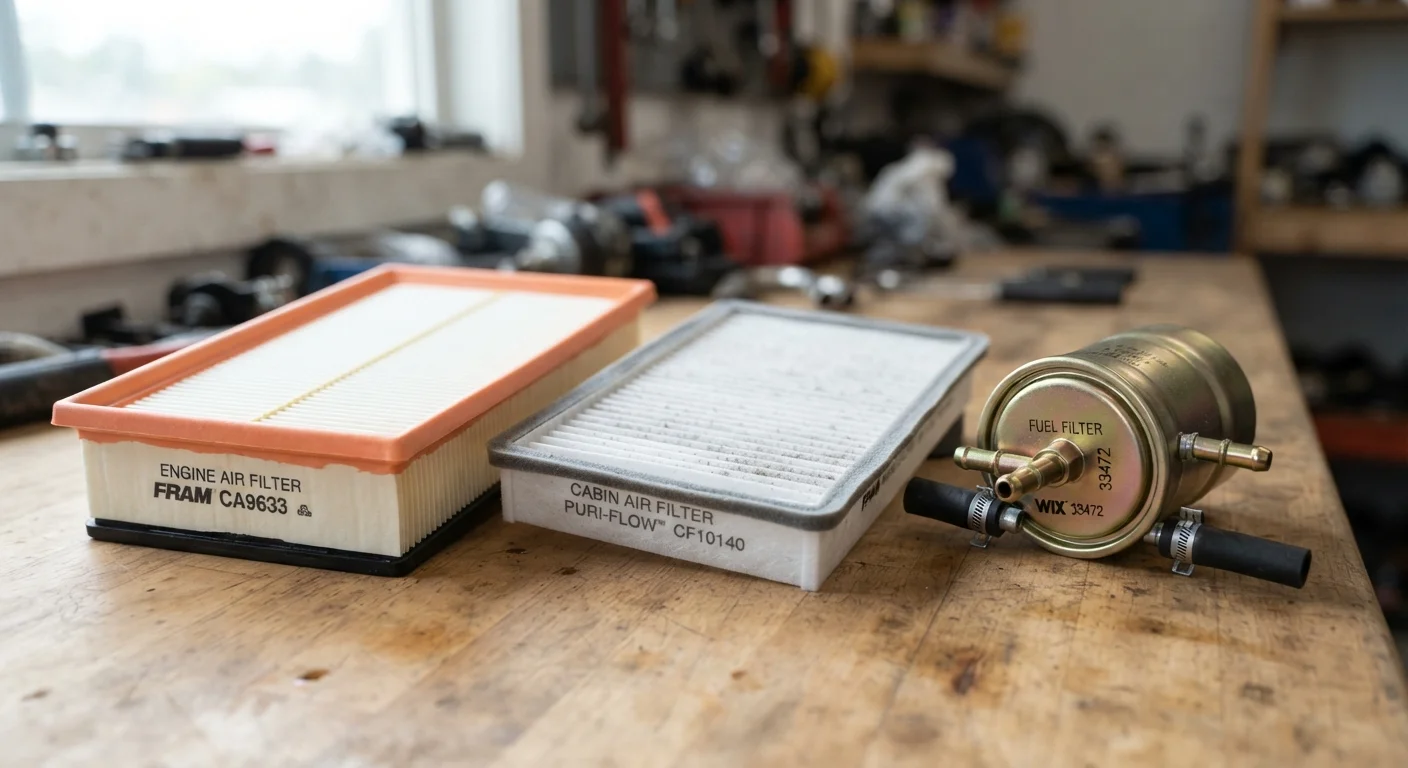
The Engine Air Filter: Your Engine's First Line of Defense
The engine air filter sits at the beginning of your vehicle's intake system. Its job is straightforward: prevent airborne contaminants - dust, pollen, insects, road debris - from entering the engine where they could cause abrasive wear on pistons, cylinders, and other precision components.
Engines need a precise mix of air and fuel to run efficiently. When a filter becomes clogged, airflow is restricted. The engine compensates, but not without consequences: reduced throttle response, diminished fuel economy, and in some cases, increased exhaust emissions. Think of it like trying to breathe through a fabric mask caked with dust - the effort goes up while the result goes down.
Replacement intervals generally fall between 15,000 and 30,000 miles, but dusty environments - gravel roads, dry climates, construction zones - can shorten that window considerably. A visual inspection at each oil change is a sensible habit. See our full maintenance schedule guide for how filter checks fit into broader service intervals.
Check Your Air Filter During Oil Changes
Ask your mechanic to pull and inspect the engine air filter every time you have your oil changed. It takes less than a minute, costs nothing to inspect, and ensures you're never driving too long on a filter that's past its useful life. In dusty or rural driving conditions, consider checking more frequently than the standard interval.
The Cabin Air Filter: Protecting What You Breathe
The cabin air filter is one of the most overlooked components in a vehicle, yet it directly affects the air quality inside the passenger compartment every time you run the heater or air conditioning. Located in the HVAC (heating, ventilation, and air conditioning) system - usually behind the glove box or under the dashboard - it traps pollen, dust, mold spores, fine particulate matter, and in some cases, exhaust odors.
A clogged cabin filter doesn't just let more contaminants through - it also reduces airflow from your vents, making your climate system work harder and potentially reducing its effectiveness. Drivers who notice musty smells from the vents or reduced airflow on high fan settings often find a neglected cabin filter is the culprit.
If you or your passengers have allergies or asthma, maintaining this filter matters beyond simple comfort. Pet owners should pay particular attention: vehicles that frequently carry animals accumulate dander more rapidly. For more on how airborne particles like dander circulate and why they're difficult to contain, see what pet dander actually is.
Most cabin filters are rated for 15,000 to 25,000 miles, but annual replacement is a reasonable rule of thumb for average drivers.
15,000-25,000 mi
Typical cabin air filter replacement interval
General industry guidance from vehicle manufacturers; always verify against your specific owner's manual.
Up to 10%
Potential fuel economy reduction from a clogged engine air filter
The U.S. Department of Energy has noted that a severely restricted air filter can measurably reduce fuel economy on older carbureted engines; effects on modern fuel-injected engines are typically smaller but still present.
30,000-60,000 mi
Common external fuel filter replacement range
Interval varies by vehicle make, model, and fuel system design; consult your owner's manual for the precise schedule.
The Fuel Filter: Keeping Your Fuel System Clean
The fuel filter works upstream of your fuel injectors, trapping rust particles, sediment, and other contaminants that can accumulate in fuel or the fuel tank over time. Clean fuel reaching your injectors means more consistent combustion, better engine performance, and less risk of injector clogging - a repair that can run into the hundreds of dollars.
Symptoms of a failing fuel filter often appear gradually: slightly harder starts, hesitation when accelerating from a stop, rough idling, or a tendency to stall under load. These symptoms can overlap with other issues, so diagnosis by a qualified mechanic is worthwhile before assuming the filter is the cause.
Replacement schedules vary significantly. Older vehicles with externally mounted filters often call for replacement every 30,000 miles. Many newer vehicles integrate the filter inside the fuel tank as part of a fuel pump assembly, with manufacturers rating these for much longer intervals or even the life of the vehicle - though your owner's manual remains the authoritative source.
Neglecting filters is one of the habits that quietly strain your engine over time, alongside more visible driving behaviors. And unlike many mechanical repairs, filter replacements are typically low-cost when done on schedule.
Making Filter Maintenance a Consistent Habit
The common thread across all three filters is this: when they work, you don't notice them. When they fail, the consequences range from diminished comfort to genuine mechanical damage. The good news is that staying ahead of filter maintenance is among the most affordable things you can do for your vehicle.
A practical approach is to check all three during the same service visit - your engine air filter visually, your cabin filter if accessible, and your fuel filter interval against your owner's manual. Bundling these checks reduces the risk of any single filter being forgotten. Many drivers are surprised to learn how rarely cabin filters are inspected, despite having a direct effect on daily comfort.
It's also worth separating filter maintenance facts from fiction. The idea that you can clean and reuse standard paper-element filters, for example, is not supported by most manufacturers for typical OEM filters. For a broader look at common misconceptions, the car care myths that cost drivers money guide is worth reviewing alongside your maintenance planning.
Filters work quietly in the background - a small investment in their upkeep pays dividends in engine longevity, fuel efficiency, and the quality of air you breathe every time you drive.
“Filters are the unsung heroes of vehicle maintenance. Replacing them on schedule costs very little, but ignoring them can turn a five-dollar part into a five-hundred-dollar repair.”
— Car Know-How Editorial Team, Automotive maintenance educators
Frequently Asked Questions
Visual inspection is the simplest method - a clean filter is white or off-white, while a dirty one appears gray or brown with visible debris. Many mechanics check it during oil changes. Your owner's manual will also list a recommended replacement interval, typically every 15,000 to 30,000 miles depending on driving conditions.
Yes, in practical terms it can. A saturated cabin filter loses its ability to trap pollen, dust, mold spores, and fine particles, allowing more contaminants into the passenger compartment. Drivers and passengers with allergies or respiratory sensitivities are most likely to notice the difference. Regular replacement helps maintain cleaner in-cabin air.
Over time, a clogged fuel filter restricts fuel flow to the engine, which can cause hard starting, rough idling, hesitation under acceleration, and ultimately stalling. In severe cases, the fuel pump works harder to compensate, which can shorten its lifespan and lead to a much more expensive repair than a simple filter swap.
No - they are separate components with different locations and purposes. The engine air filter sits in the intake system and cleans air entering the engine for combustion. The cabin air filter is located in the HVAC system and cleans air that circulates through your vents into the passenger compartment.
Replacement intervals vary widely by vehicle - anywhere from 30,000 to over 60,000 miles - and some modern vehicles use filters integrated into the fuel tank that are designed to last the vehicle's lifetime under normal conditions. Check your owner's manual for the interval specific to your make and model.
The content provided on our blog site traverses numerous categories, offering readers valuable and practical information. Readers can use the editorial team’s research and data to gain more insights into their topics of interest. However, they are requested not to treat the articles as conclusive. The website team cannot be held responsible for differences in data or inaccuracies found across other platforms. Please also note that the site might also miss out on various schemes and offers available that the readers may find more beneficial than the ones we cover.