

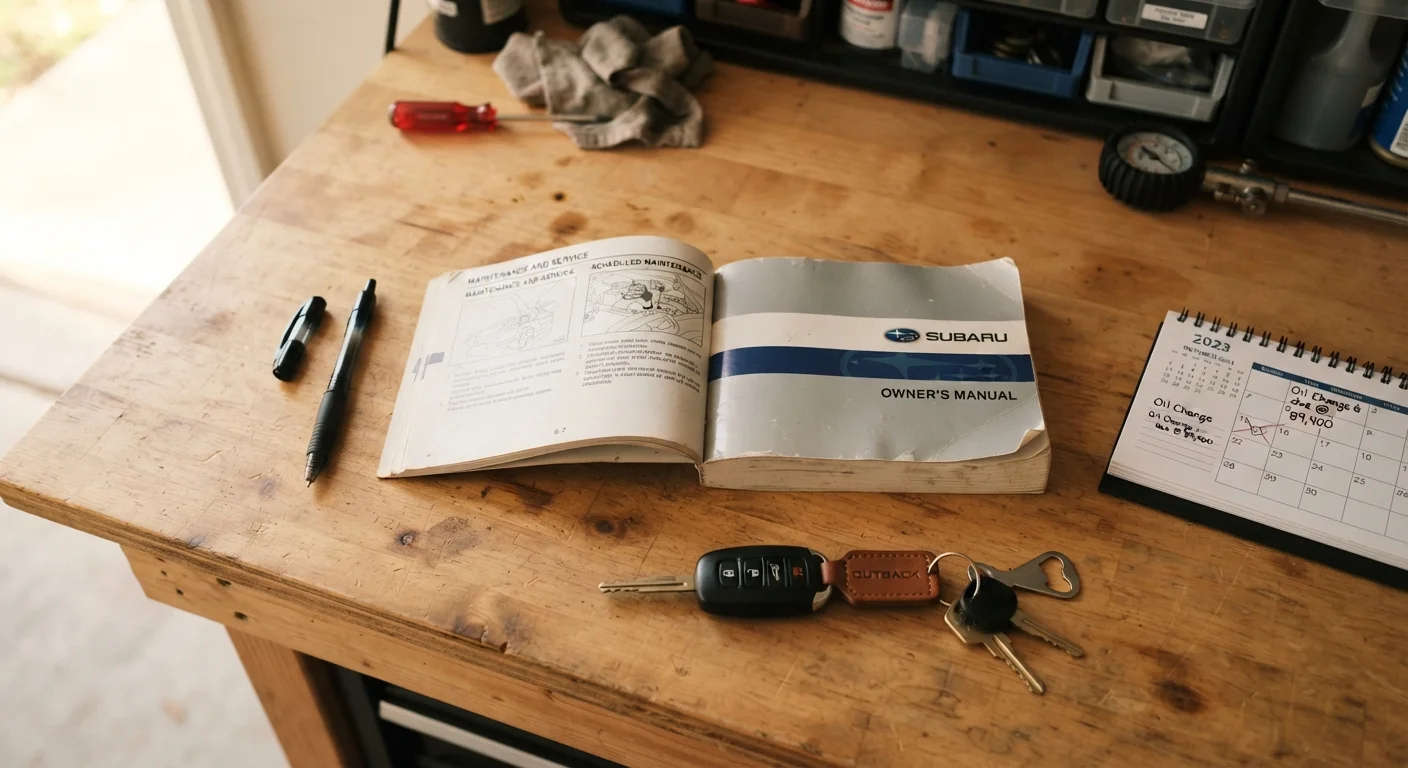
What the Milestone Numbers Actually Mean
Flip open your owner's manual and you'll typically see a grid: rows of service tasks down the left, columns of mileage milestones across the top - 5,000, 15,000, 30,000, 60,000, and so on. Each checkmark at an intersection means that task is due at that mileage point.
The intervals aren't arbitrary. Engineers determine them by testing how quickly fluids degrade, how fast filter media saturates, and at what mileage wear items reach the edge of their safe service life under typical conditions. The result is a schedule designed to catch problems before they become failures.
Two measurements govern every interval: miles driven and elapsed time. The rule is always whichever comes first. A vehicle parked for most of the year may reach its 12-month oil change interval long before it accumulates enough miles to trigger the mileage marker. Ignoring the time dimension is one of the most common - and costly - maintenance mistakes drivers make.
~$1,200
Average annual vehicle maintenance cost per AAA
AAA's annual "Your Driving Costs" study estimates that routine maintenance and tire costs average around $1,200 per year for a typical sedan, underscoring how significant planned upkeep is as an ownership expense.
35%
Vehicles found with at least one critical maintenance item overdue
The Car Care Council's periodic Vehicle Health Index surveys consistently find that a substantial portion of vehicles on the road are overdue for at least one scheduled service item.
The Most Misunderstood Service Milestones
Certain intervals generate the most confusion. Here's what's actually happening at each major checkpoint:
- Every 5,000-10,000 miles: Oil and filter changes are the cornerstone of engine health. Modern full-synthetic oils last longer than older conventional formulas, but degraded oil loses its ability to lubricate and cool engine components. Oil change intervals explained in detail in our dedicated guide.
- Every 15,000-30,000 miles: Cabin and engine air filters typically reach saturation. A clogged engine air filter restricts airflow and can reduce fuel efficiency. Tire rotations also fall in this range, evening out wear across all four tires.
- Every 30,000 miles: Fuel filters, brake fluid, and transmission fluid may be due depending on your vehicle. These are often overlooked because their degradation is invisible - you won't notice anything until performance is already compromised.
- Every 60,000-100,000 miles: Spark plugs, timing belts or chains (where applicable), coolant flushes, and brake pad replacements commonly appear here. These are higher-cost services but prevent catastrophic failures - a snapped timing belt, for instance, can destroy an engine entirely.
Normal vs. Severe Duty: Which Schedule Applies to You?
The "normal" schedule assumes consistent highway driving in moderate temperatures - conditions that represent an idealized driver, not a typical one. The severe duty schedule accounts for the real stresses most vehicles face.
You likely qualify for the severe schedule if you regularly make short trips under five miles (engine never fully warms up, accelerating moisture and acid buildup in the oil), spend significant time in stop-and-go traffic, tow or haul loads, or operate in very hot, very cold, or dusty environments.
Using the normal schedule when your driving habits demand the severe one means your fluids and components are working harder than the service intervals assume - shortening their effective life between changes. When in doubt, the severe schedule is the more protective choice.
For drivers navigating seasonal extremes, our seasonal car maintenance guide covers how temperature shifts change your vehicle's specific needs throughout the year.
Check Your Oil Life Monitor - But Verify Against the Manual
Many modern vehicles display an oil life percentage on the dashboard that adjusts based on actual driving conditions. This system is genuinely useful, but it monitors engine operating parameters - not the time-elapsed component of your interval. Always cross-reference the monitor reading with your owner's manual's time-based guideline to make sure neither dimension gets overlooked.
Keeping Your Records - and Why It Pays Off
A maintenance schedule is only as valuable as your ability to prove it was followed. A complete service record - whether a dedicated logbook, digital app, or dealer printouts - serves three practical purposes:
- Warranty protection: Manufacturers can deny powertrain warranty claims if they cannot verify scheduled maintenance was performed. Your records are your evidence.
- Faster diagnostics: A mechanic who can see your service history can spot gaps and patterns that point toward the root cause of a problem, saving diagnostic time and your money.
- Resale value: A documented service history is a tangible asset when selling or trading in. Buyers and dealers can verify the vehicle was cared for, which supports a stronger asking price.
Learn how to build and maintain a service log - it's one of the simplest habits that pays dividends over your entire ownership period. And before your next service appointment, review our guide to getting the most out of every service visit so you know exactly what questions to ask and what to watch for on the estimate.
If your vehicle is approaching or has passed the 100,000-mile mark, maintenance priorities shift meaningfully - our high-mileage vehicle guide details which components deserve closer attention at that stage.
Frequently Asked Questions
Your owner's manual is the definitive source - look for a section titled "Maintenance Schedule" or "Scheduled Maintenance." Many automakers also host digital versions on their websites. If you've lost the manual, a dealer's service department can usually provide the schedule for your vehicle's year and trim.
Skipped services allow fluids to degrade, filters to clog, and wear items to go unchecked. Over time this causes accelerated component failure and can void manufacturer warranties. Catching up is usually straightforward, but repeatedly skipping intervals compounds repair costs significantly.
For most modern vehicles, no. Many newer engines using full synthetic oil have manufacturer-recommended intervals of 7,500 to 10,000 miles or more. Always follow your specific owner's manual rather than a general rule of thumb. See our <a href="/car-know-how/car-maintenance/oil-change-intervals-what-the-numbers-in-your-owners-manual-really-mean">oil change interval guide</a> for a full breakdown.
Severe conditions include frequent short trips under five miles, stop-and-go traffic, towing or hauling heavy loads, driving in extreme heat or cold, and operating on unpaved or dusty roads. If several of these apply regularly, use the severe-duty schedule in your owner's manual.
Some tasks - like checking tire pressure, topping off fluids, and replacing cabin air filters - are straightforward for capable DIYers. However, tasks involving the brake system, transmission, or timing components should be performed by a qualified mechanic. Always document any self-performed service with receipts and notes to protect your records.
Mileage-based intervals trigger at specific odometer readings, while time-based intervals trigger after a set number of months regardless of miles driven. A vehicle driven infrequently may hit the time interval before the mileage interval - which is why manufacturers specify whichever comes first.
The content provided on our blog site traverses numerous categories, offering readers valuable and practical information. Readers can use the editorial team’s research and data to gain more insights into their topics of interest. However, they are requested not to treat the articles as conclusive. The website team cannot be held responsible for differences in data or inaccuracies found across other platforms. Please also note that the site might also miss out on various schemes and offers available that the readers may find more beneficial than the ones we cover.