

Why Financial Risks Abroad Are Different From Home
Traveling introduces financial vulnerabilities that most people don't encounter in daily life. You're operating in unfamiliar banking environments, often on public networks, and under the cognitive load of navigating a new place. That combination creates openings for both technical fraud - like card skimming - and softer traps, like unfavorable currency conversions buried in a payment prompt.
The good news: nearly all of these risks are manageable with preparation done before you leave. See our pre-trip planning checklist for a broader framework of what to handle before departure. This guide focuses specifically on protecting your money once you're on the road.
What you will need
What You'll Need Before You Go
Getting your financial setup right before departure is far easier than dealing with a blocked card or a fraudulent charge from overseas. Review the tools and steps below, then follow the step-by-step instructions in the next section.
Primary travel card (credit or debit)
Your main payment method abroad - ideally one with no foreign transaction fees.
Backup card
A second card stored separately in case your primary card is lost, stolen, or blocked.
Small amount of local currency cash
For situations where cards are not accepted - small vendors, rural areas, transit systems.
Bank's international customer service number
Saved offline so you can reach your bank quickly if a card is compromised or blocked.
Mobile banking app with transaction alerts enabled
Lets you monitor charges in real time and spot unauthorized transactions immediately.
RFID-blocking wallet or sleeve
Reduces the risk of contactless card data being skimmed in crowded environments.
Step-by-Step: Securing Your Finances for Travel
Work through these steps in order - most take only a few minutes but can prevent significant headaches mid-trip. For context on how financial fees and conversion charges fit into your overall trip cost, see the hidden costs travelers routinely underestimate.
Notify your bank and card issuers of your travel dates
Contact each bank or card issuer before you depart and inform them of your destination countries and travel dates. Many institutions allow this through their mobile app under a travel notice or travel alert setting. Without this, routine purchases in a foreign country can trigger automated fraud blocks - leaving you without access to funds at an inconvenient moment.
Enable real-time transaction alerts on all cards
Log in to each bank's app or web portal and turn on push notifications or SMS alerts for every transaction. Set the threshold to the lowest available amount - ideally any charge at all. This gives you an immediate signal if a card is used without your knowledge, allowing you to freeze it before further charges accumulate.
Identify and pack a backup card stored separately
Choose a second card - ideally from a different card network or bank - and store it somewhere physically separate from your wallet: a hidden compartment in your luggage, a money belt, or the hotel safe. If your primary card is lost or stolen, you'll have immediate access to funds without waiting for a replacement card to be mailed internationally.
Understand your cards' fee structures before you leave
Review the fee schedule for each card you plan to use: foreign transaction fees (typically 1-3% per purchase), ATM withdrawal fees, and whether the card reimburses ATM surcharges. This matters for planning - see our guide on building a realistic travel budget for how to factor fees into your overall estimates. Cards with no foreign transaction fees are generally preferable for international use.
Withdraw local currency from bank-affiliated ATMs only
When you need cash, use ATMs located inside or directly attached to bank branches rather than standalone kiosks in airports, tourist zones, or convenience stores. Bank-affiliated machines are more likely to be regularly inspected and less likely to have skimming hardware attached. Withdraw slightly more than you think you'll need to minimize the number of times you expose your card at a machine.
Always pay in local currency when given a choice
At any foreign point-of-sale terminal or ATM, you may be prompted to pay in your home currency (USD) rather than the local currency. Decline this option. Dynamic currency conversion hands the exchange rate calculation to the merchant's payment processor, which typically applies a less favorable rate plus a markup. Paying in local currency means your card issuer performs the conversion, which is generally more favorable and more transparent.
Consider a Dedicated Travel Card
Some travelers open a separate checking account or prepaid travel card specifically for international trips, funded with only what they plan to spend. This limits exposure - if that card is compromised, your primary accounts remain untouched. Check the fee structure of any prepaid card carefully before relying on it, as some carry high reload or withdrawal fees.
Ongoing Vigilance During Your Trip
Setup is only part of the picture. A few habits practiced consistently while traveling do most of the heavy lifting.
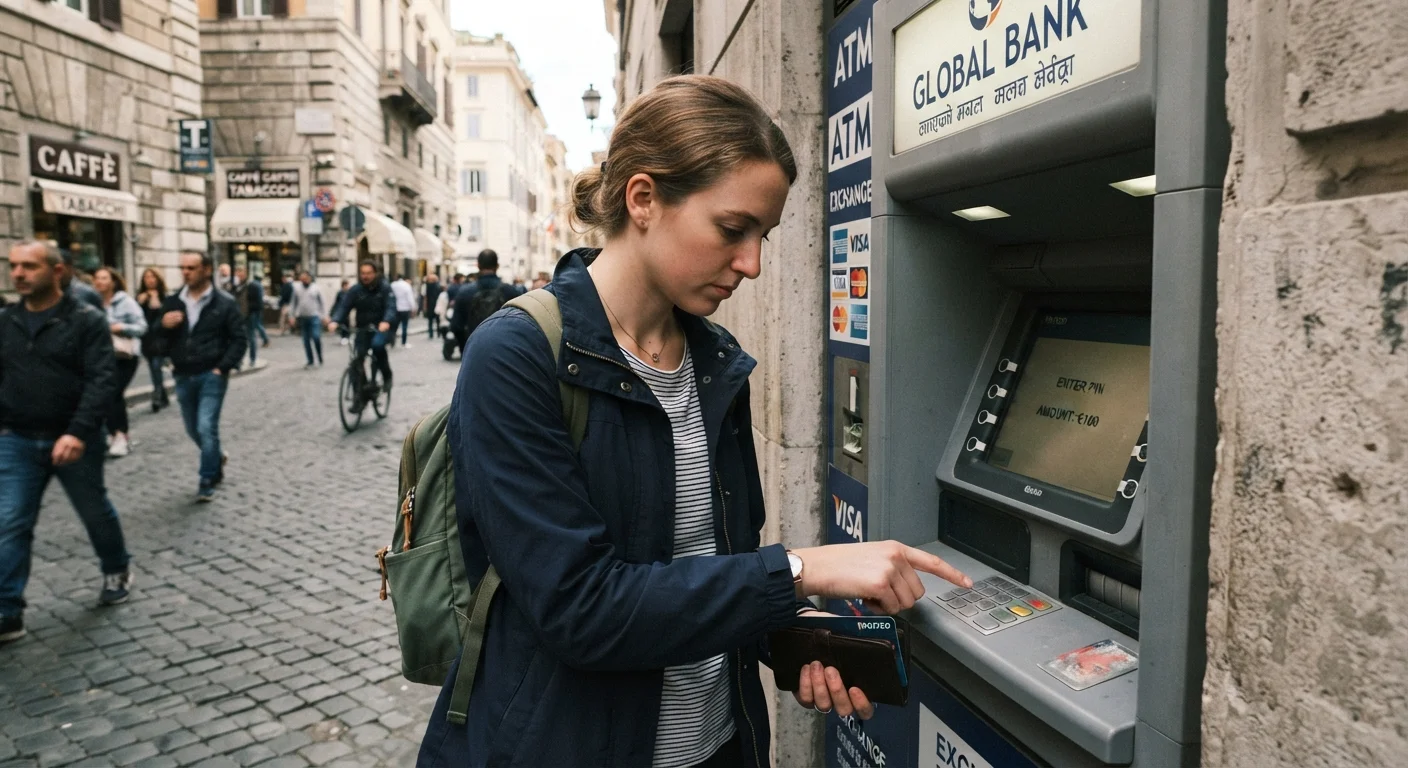
At ATMs: Inspect the card reader and keypad for anything loose, misaligned, or thicker than usual. Skimming devices are often glued over legitimate readers. Cover your hand when entering your PIN - this defeats most hidden camera setups. Bank-branded ATMs inside branch lobbies carry lower risk than standalone machines in tourist-heavy areas.
At point-of-sale terminals: When paying by card, a terminal may ask whether you want to pay in your home currency or local currency. Always choose local currency. Paying in your home currency - a practice called dynamic currency conversion (DCC) - routes the exchange through the merchant's processor at a marked-up rate. Your bank's rate is almost always more favorable.
Monitor your accounts daily. Transaction alert notifications let you catch unauthorized charges within hours, not weeks. If something looks wrong, call your bank immediately - most have 24-hour international lines printed on the back of your card.
For travelers who also want to protect personal data alongside financial data, our guide on digital security on the road covers public Wi-Fi risks and device security in detail.
Don't Rely on a Single Payment Method
Depending entirely on one card is a common and avoidable mistake. Banks can block cards without warning if their fraud algorithms flag unusual activity - even legitimate purchases in a new location. Always travel with at least two cards and some local cash, and never keep all of them in the same place.
The content provided on our blog site traverses numerous categories, offering readers valuable and practical information. Readers can use the editorial team’s research and data to gain more insights into their topics of interest. However, they are requested not to treat the articles as conclusive. The website team cannot be held responsible for differences in data or inaccuracies found across other platforms. Please also note that the site might also miss out on various schemes and offers available that the readers may find more beneficial than the ones we cover.