

Our Verdict
Group classes and private training are not competing options so much as complementary tools. Group settings excel at socialization and foundational skills in a cost-effective format, while private sessions offer the depth and individualization needed for complex behavioral work. Understanding what each genuinely delivers helps you invest your time and money where it will have the most impact.
| Best for | Recommended |
|---|---|
| Puppies and dogs needing socialization with people and other animals | Group Classes |
| Pets with specific behavioral challenges like anxiety, reactivity, or fear | One-on-One Training |
| Owners on a limited budget seeking foundational obedience skills | Group Classes |
| Owners who want training tailored to their schedule, home environment, or lifestyle | One-on-One Training |
What Group Classes Are Actually Designed to Do
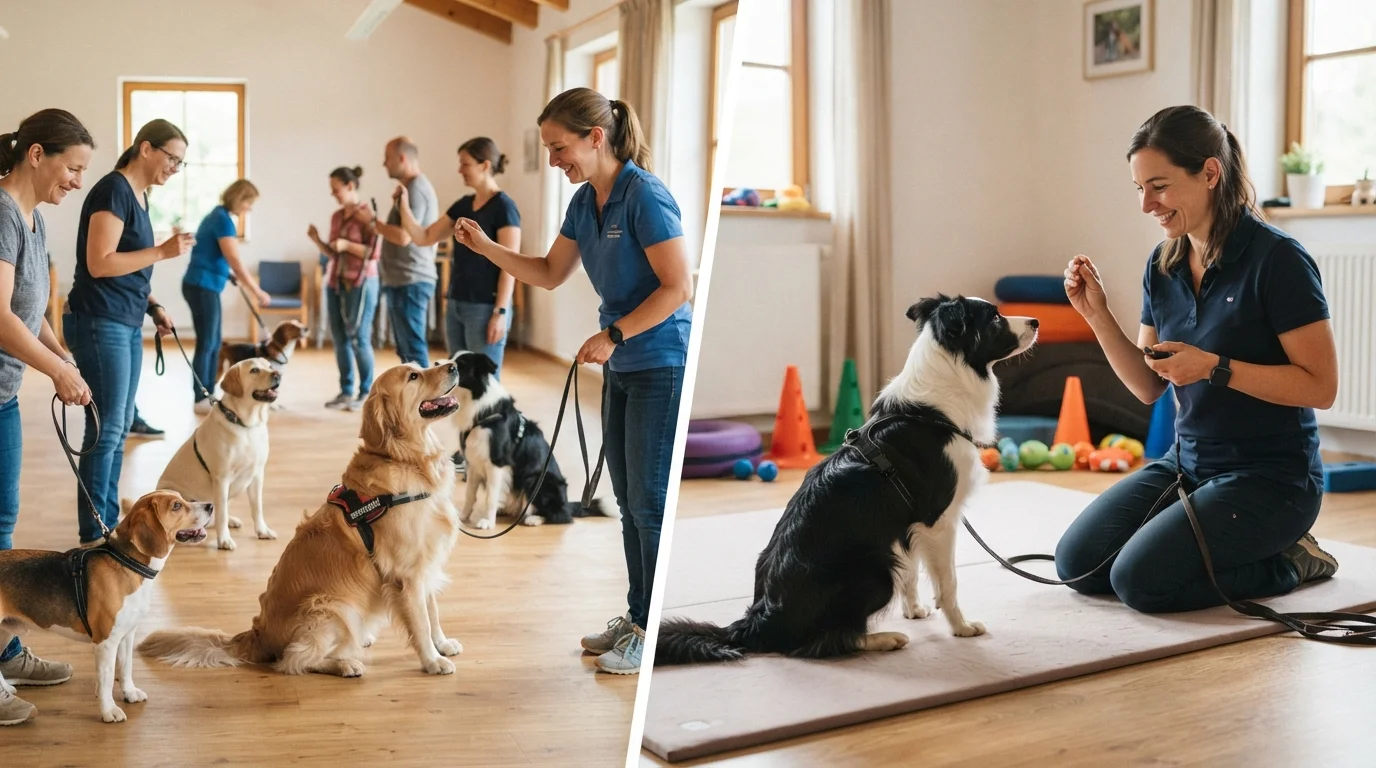
Group training classes are structured sessions where multiple pet-owner pairs learn alongside one another, typically guided by a single certified trainer. Most classes run in weekly sessions over four to eight weeks and focus on foundational cues like sit, stay, recall, and leash manners.
The real value of a group setting goes beyond the commands themselves. Practicing behaviors in the presence of other dogs and humans teaches a pet to respond reliably amid distractions - arguably one of the hardest things to replicate at home. For puppies especially, this exposure is developmentally significant. The early socialization window is narrow, and structured group environments can help fill it with positive experiences.
Group classes also provide something less often discussed: community for the owner. Sharing the experience with others who are navigating the same challenges can normalize setbacks, reinforce motivation, and offer informal peer support.
The trade-off is individual attention. A trainer managing six to ten pairs cannot meaningfully observe every nuance of your specific dog's posture, timing issues in your handling, or subtle triggers affecting performance. For well-adjusted pets learning general manners, this is rarely a problem. For dogs with more complex needs, it can be a real limitation.
What One-on-One Training Offers That Groups Cannot
Private training sessions center the entire trainer's attention on one pet and one owner. This matters most when a dog's behavior falls outside what a group environment can safely or effectively address.
Reactivity toward other dogs, fear-based responses, resource guarding, and separation anxiety are examples where individual assessment is essential. A skilled trainer can observe body language in detail, identify the specific antecedents driving a behavior, and build a protocol suited to that animal's history and threshold - work that simply isn't possible in a multi-dog classroom.
Ask to Observe Before You Commit
Many reputable trainers and training facilities will allow prospective clients to observe a class or meet for a brief consultation before enrolling. This gives you a chance to assess training methods firsthand, see how the trainer handles challenges in real time, and determine whether the environment suits your pet's temperament. Don't skip this step - it's one of the most reliable ways to evaluate quality.
Private sessions are also valuable for owners themselves. Handling mechanics - leash tension, timing of reinforcement, body positioning - are highly individual, and a trainer can give immediate, specific feedback that a group setting cannot accommodate. This matters because owner behavior directly shapes pet behavior; small adjustments in how you communicate often produce faster progress than any number of repetitions.
The practical consideration is cost. Private sessions typically run significantly higher per session than group classes, and an effective behavior modification program may require multiple sessions over weeks or months. That said, for dogs with significant behavioral concerns, attempting to resolve issues in an unsuitable environment can slow progress or create new problems - making the investment more defensible. This mirrors a broader principle seen across learning contexts, whether you're weighing online vs. in-person formats or choosing between group and individual professional support.
Comparing the Two Settings Side by Side
Choosing between formats becomes clearer when you look at the specific dimensions that matter most to pet owners: cost, individual attention, socialization value, flexibility, and suitability for behavioral challenges.
| Group Classes | One-on-One Training | |
|---|---|---|
| Cost | Lower per session; package pricing common | Higher per session; varies by trainer and location |
| Individual attention | Limited; shared among multiple pairs | Full focus on one pet and owner |
| Socialization value | High; structured exposure to dogs and people | Low to none; single-pet environment |
| Behavioral issue suitability | Best for mild to no behavioral concerns | Better for reactivity, fear, or complex issues |
| Scheduling flexibility | Fixed schedule; class cohort format | More flexible; arranged around owner availability |
| Owner skill development | General guidance shared with group | Targeted, immediate feedback on handling technique |
It's worth noting that these categories are not mutually exclusive in practice. Some trainers offer hybrid programs - beginning with a private assessment, transitioning to group reinforcement, and returning for individual follow-ups as needed. This approach reflects how most behavioral decisions work in pet care: the most effective strategy often draws from multiple approaches rather than committing to one absolutely.
Similarly, just as owners might consider both professional grooming and DIY methods depending on the task, training formats can be layered over time based on where your pet is in their development and what specific goals you're working toward.
How to Choose - and When to Reassess
Start with an honest assessment of your pet's current behavior and your specific goals. A healthy, sociable young dog learning basic manners is a strong candidate for group classes. A dog displaying anxiety, aggression, or persistent problem behaviors warrants individual evaluation before group placement - both for safety and for training effectiveness.
Trainer credentials matter in both formats. Look for professionals who use humane, science-based methods grounded in positive reinforcement. Certifications from recognized bodies such as the Certification Council for Professional Dog Trainers (CCPDT) or membership in professional organizations can signal a commitment to continuing education and ethical practice, though credentials alone don't substitute for observing a class or session firsthand when possible.
Finally, whatever format you choose, remember that what happens between sessions determines results. The trainer's role is to teach you how to communicate with your pet - the work of building that relationship happens in daily life, not just in class. Revisit your choice if progress stalls; a format that doesn't fit your dog's needs can always be adjusted.
This article is for general informational and educational purposes. Consult a certified professional trainer or veterinary behaviorist for guidance specific to your pet's behavior and health.
The content provided on our blog site traverses numerous categories, offering readers valuable and practical information. Readers can use the editorial team’s research and data to gain more insights into their topics of interest. However, they are requested not to treat the articles as conclusive. The website team cannot be held responsible for differences in data or inaccuracies found across other platforms. Please also note that the site might also miss out on various schemes and offers available that the readers may find more beneficial than the ones we cover.