

Our Verdict
Crate training and free-roaming are not opposing philosophies so much as different stages or tools on the same continuum. Crating offers structure, safety, and predictability that benefits puppies, newly adopted dogs, and anxious individuals. Free-roaming works well for dogs who have demonstrated reliable self-regulation. Most dogs will move through both approaches over the course of their lives.
| Best for | Recommended |
|---|---|
| Puppies and newly adopted dogs still learning house rules | Crate Training |
| Adult dogs with solid impulse control and a track record at home | Free-Roaming |
| Dogs prone to separation anxiety or stress-related destruction | Crate Training (with gradual desensitization) |
| Multi-dog households needing individualized safe spaces | Crate Training |
What the Behavioral Science Actually Says
Dogs are facultative den animals - meaning they can use enclosed spaces for comfort and security, but they don't require them the way obligate burrowers do. This nuance matters because it means crate training is biologically supported, not biologically necessary. The appeal of a crate lies in its predictability: a dog who knows where its safe space is experiences less ambient stress when left alone.
Free-roaming, by contrast, works best when a dog has developed sufficient self-regulation - the ability to make low-arousal choices in the absence of a human directing behavior. Research in canine cognition consistently shows that impulse control is a trainable skill, not a fixed trait, which means most dogs can move toward greater freedom as their training matures.
The critical error either way is misreading readiness. Giving a young or under-trained dog full household access often leads to destructive behavior and safety risks, while confining a well-adjusted adult dog excessively can produce frustration and stereotypic behaviors like pacing or excessive vocalization. For a broader grounding in canine behavioral foundations, see what new owners need to know before day one.
| Crate Training | Free-Roaming | |
|---|---|---|
| Best suited for | Puppies, new adoptees, anxious dogs | Trained adult dogs with proven self-control |
| Supports housetraining | Yes - strongly | Only if already housetrained |
| Safety during unsupervised time | High - limits access to hazards | Variable - depends on environment and dog |
| Enrichment and autonomy | Limited by design | Greater spatial and behavioral freedom |
| Risk of misuse | Overuse or punishment association | Premature freedom before readiness |
| Transition requirement | Gradual desensitization needed | Staged room-by-room expansion recommended |
The Case for Crate Training
A properly introduced crate gives dogs a predictable anchor point during the developmental window when they cannot yet be trusted to make safe choices unsupervised. For puppies, this directly supports housetraining: dogs are naturally reluctant to soil their sleeping area, and crating during short supervised absences reinforces bladder control far faster than unrestricted access would.
Crating also serves dogs who experience anxiety. For some individuals, a covered crate in a quiet space functions as a genuine stress buffer - a controllable, low-stimulation zone when the household is chaotic. The key distinction is that the crate must be introduced gradually and associated with positive experiences, not used as a timeout or punishment. A crate that a dog is forced into under stress will carry that negative association forward.
Make the Crate a Choice, Not a Trap
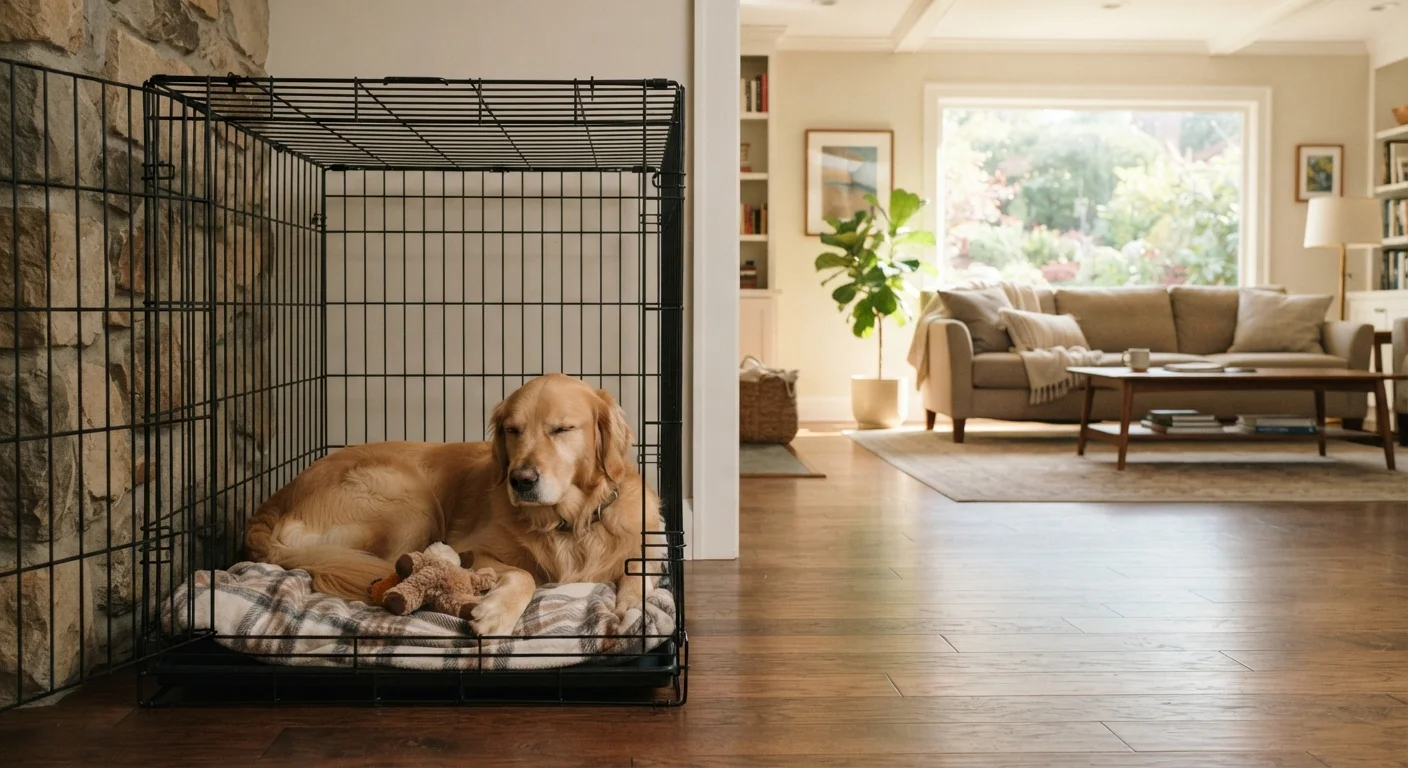
Leave the crate door open during off-duty hours so your dog can enter and exit freely. Dogs who choose to rest in their crate voluntarily are showing that it functions as genuine shelter, not imposed confinement. This voluntary use is the clearest sign that your introduction process worked.
Duration matters. Veterinary behaviorists generally caution against crating adult dogs more than four to five hours at a stretch during waking hours. Puppies need even shorter intervals matched to their age in months, plus one. Exceeding these limits regularly undermines the approach's welfare benefits.
The Case for Free-Roaming
Free-roaming reflects the goal of crate training, not a shortcut past it. A dog given household freedom has, ideally, demonstrated that it can navigate the environment safely - not chewing hazardous objects, not practicing unwanted behaviors, not escalating into destructive patterns when alone.
The behavioral benefits are real. Dogs with more spatial freedom engage in more self-directed exploratory behavior, which itself is a form of enrichment. They can regulate their own rest cycles, self-soothe by moving between spaces, and feel greater agency over their environment - a factor linked to lower overall stress markers in domestic dogs.
The transition from crate to free-roaming should be staged. Start with a single room, then expand access based on observed behavior during short absences before committing to full home access. In multi-pet households, this process may look different for each animal - a consideration explored in our guide on keeping multiple pets under one roof.
Making the Right Call for Your Dog
The most useful frame is not "which approach is better" but "where is my dog right now, and what does it need next?" A newly adopted adult rescue dog may need the structure of crating even though it is not a puppy. A confident three-year-old who has lived with the same family since eight weeks may be ready for full free-roaming.
Key factors to assess include: current housetraining reliability, history of destructive behavior when unsupervised, response to being alone (calm vs. distressed), and how the dog interacts with the physical environment when no one is directing it. If you are introducing a dog to your home for the first time, the foundational guidance in bringing home your first dog covers how these early choices fit into a broader care framework.
If destructive behavior or signs of distress persist despite a consistent training approach, consulting a certified applied animal behaviorist or a veterinary behaviorist is appropriate. These are welfare issues, not just inconveniences, and professional guidance can make a meaningful difference in outcomes.
This article is for general informational and educational purposes. It does not constitute veterinary or behavioral advice for any individual animal. If your dog shows signs of significant anxiety, aggression, or distress, please consult a qualified veterinary professional.
The content provided on our blog site traverses numerous categories, offering readers valuable and practical information. Readers can use the editorial team’s research and data to gain more insights into their topics of interest. However, they are requested not to treat the articles as conclusive. The website team cannot be held responsible for differences in data or inaccuracies found across other platforms. Please also note that the site might also miss out on various schemes and offers available that the readers may find more beneficial than the ones we cover.