

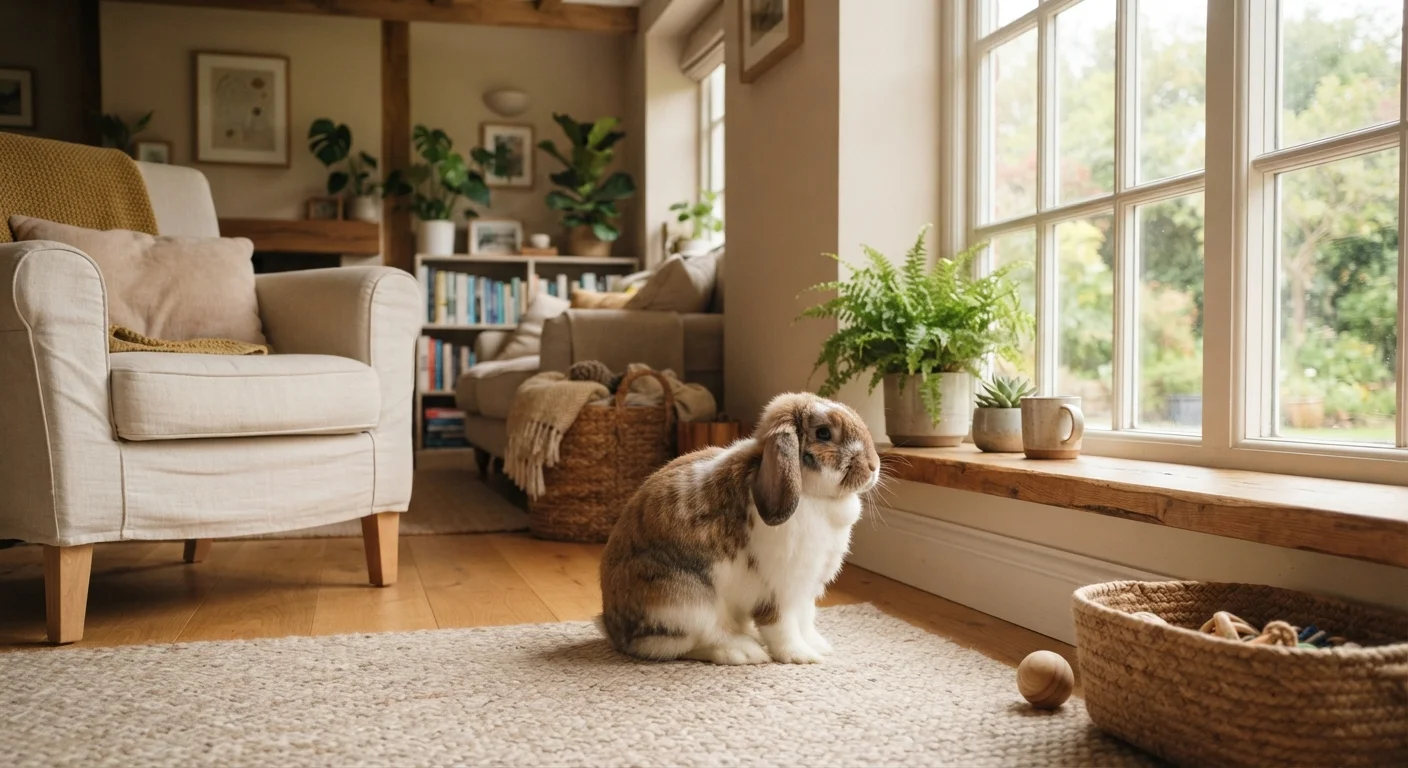
Option A
Indoor Housing
The closely integrated, climate-controlled choice.
Best for: Owners who want daily social interaction with their rabbit and a highly controlled environment free from outdoor hazards.
Option B
Outdoor Housing
The natural-environment, space-rich alternative.
Best for: Owners with secure, predator-proof setups who can provide consistent monitoring and weather protection year-round.
Why Housing Location Matters More Than Most Owners Realize
Rabbits are often mischaracterized as low-maintenance pets that do fine in a backyard hutch. In reality, they are intelligent, social prey animals with nuanced physical and behavioral needs. Where they live - indoors or outdoors - affects their exposure to danger, their temperature regulation, their mental stimulation, and even the depth of their bond with you.
This isn't a question with a single right answer, but it does require honest assessment of your living situation, local climate, and the time you can realistically invest. For additional perspective on how housing decisions shape small animal wellbeing more broadly, see our piece on housing realities for small mammals.
| Criterion | Indoor Housing | Outdoor Housing |
|---|---|---|
| Predator exposure | Minimal with basic rabbit-proofing | High - requires robust, tested enclosure |
| Temperature control | Easy; standard HVAC sufficient | Demanding; seasonal modifications needed |
| Social interaction | High; passive + active daily contact | Lower unless owner is highly committed |
| Space available | Limited by home layout | Potentially larger; depends on yard |
| Natural enrichment | Must be created deliberately | Grass, soil, scent variation available |
| Disease/parasite risk | Lower overall | Higher (fleas, mites, wild animal contact) |
| Owner monitoring ease | Easier - rabbit visible daily | Requires deliberate outdoor check-ins |
Safety and Predator Risk
Outdoor rabbits face threats that indoor rabbits simply do not. Predators - including raccoons, foxes, neighborhood dogs, and even hawks - can cause fatal stress or direct injury even without breaching an enclosure. Research on rabbit behavior confirms that prey animals can die from cardiac stress induced by a predator's presence alone, without any physical contact occurring.
Indoor housing eliminates these threats almost entirely, though rabbit-proofing the home (covering electrical cords, blocking access under furniture, preventing ingestion of toxic houseplants) becomes essential. If you share your home with cats or dogs, careful management is critical - our article on keeping multiple pets under one roof offers practical strategies for multi-pet households.
Outdoor hutches must meet rigorous standards: heavy-gauge wire mesh on all sides, double-bolt latches, solid flooring or buried wire skirting to prevent digging entry, and a covered roof. A hutch that merely looks sturdy is often not sufficient against determined predators.
Temperature, Weather, and Physical Health
Rabbits thrive in temperatures between roughly 60°F and 72°F and are poorly equipped to handle extremes at either end. Heat stress above 85°F can become life-threatening within hours, and freezing temperatures carry risks of hypothermia and respiratory illness. Unlike dogs, rabbits cannot pant effectively to cool themselves.
85°F
Heat danger threshold for rabbits
Veterinary sources consistently identify temperatures above 85°F as a serious heat-stress risk for domestic rabbits, who cannot pant to cool themselves.
3-4 hrs
Minimum daily exercise time recommended
Many rabbit welfare organizations recommend at least 3-4 hours of daily free-roaming time outside a hutch or enclosure for physical and behavioral health.
Indoor environments make temperature management straightforward - standard home heating and cooling systems generally maintain a safe range. Outdoor housing requires seasonal modifications: insulated hutch panels in winter, shaded placement and frozen water bottle cooling aids in summer, and vigilant daily monitoring of ambient conditions. The burden of weather management outdoors is significant and should not be underestimated.
Moisture is also a concern outdoors. Damp bedding promotes bacterial and fungal growth and raises the risk of conditions like sore hocks (ulcerative pododermatitis, a painful inflammation of the feet). Outdoor enclosures require more frequent cleaning and bedding replacement than most new owners anticipate.
Social Needs, Enrichment, and Your Daily Routine
Rabbits are highly social animals. Isolated rabbits - particularly those kept alone in outdoor hutches with minimal human contact - commonly develop behavioral signs of chronic stress: lethargy, repetitive movements, and over- or under-grooming. The British Rabbit Council and many veterinary behaviorists recommend that rabbits living alone have at least several hours of active human interaction daily.
Indoor rabbits naturally receive more passive social time - they observe household activity, respond to human voices, and engage during morning and evening routines. This doesn't replace active playtime or enrichment, but it significantly reduces isolation risk. For comparison, see how a similar indoor-versus-outdoor debate plays out with cat housing trade-offs - the core tension between safety and enrichment applies across species.
Outdoor rabbits can thrive socially when kept in bonded pairs or small groups, and when owners commit to regular, meaningful outdoor interaction. A rabbit that only sees its owner during feeding is not receiving adequate socialization regardless of how well-designed its enclosure is.
Enrichment - tunnels, digging boxes, chew toys, foraging opportunities - matters in both setups. Outdoor environments offer more natural stimulation (scent variation, grass, soil), but indoor rabbits can access comparable enrichment through thoughtful setup and scheduled free-roam time in a rabbit-proofed room.
This article is for general informational purposes only. For guidance specific to your rabbit's health or behavior, consult a veterinarian experienced in exotic or small animal medicine.
The content provided on our blog site traverses numerous categories, offering readers valuable and practical information. Readers can use the editorial team’s research and data to gain more insights into their topics of interest. However, they are requested not to treat the articles as conclusive. The website team cannot be held responsible for differences in data or inaccuracies found across other platforms. Please also note that the site might also miss out on various schemes and offers available that the readers may find more beneficial than the ones we cover.