

Why the 'How Much' Question Misses the Point
Most family conversations about screen time start with the clock - two hours, one hour, no screens on school nights. But researchers and educators have increasingly shifted focus toward a different question: what is the child actually doing on that screen?
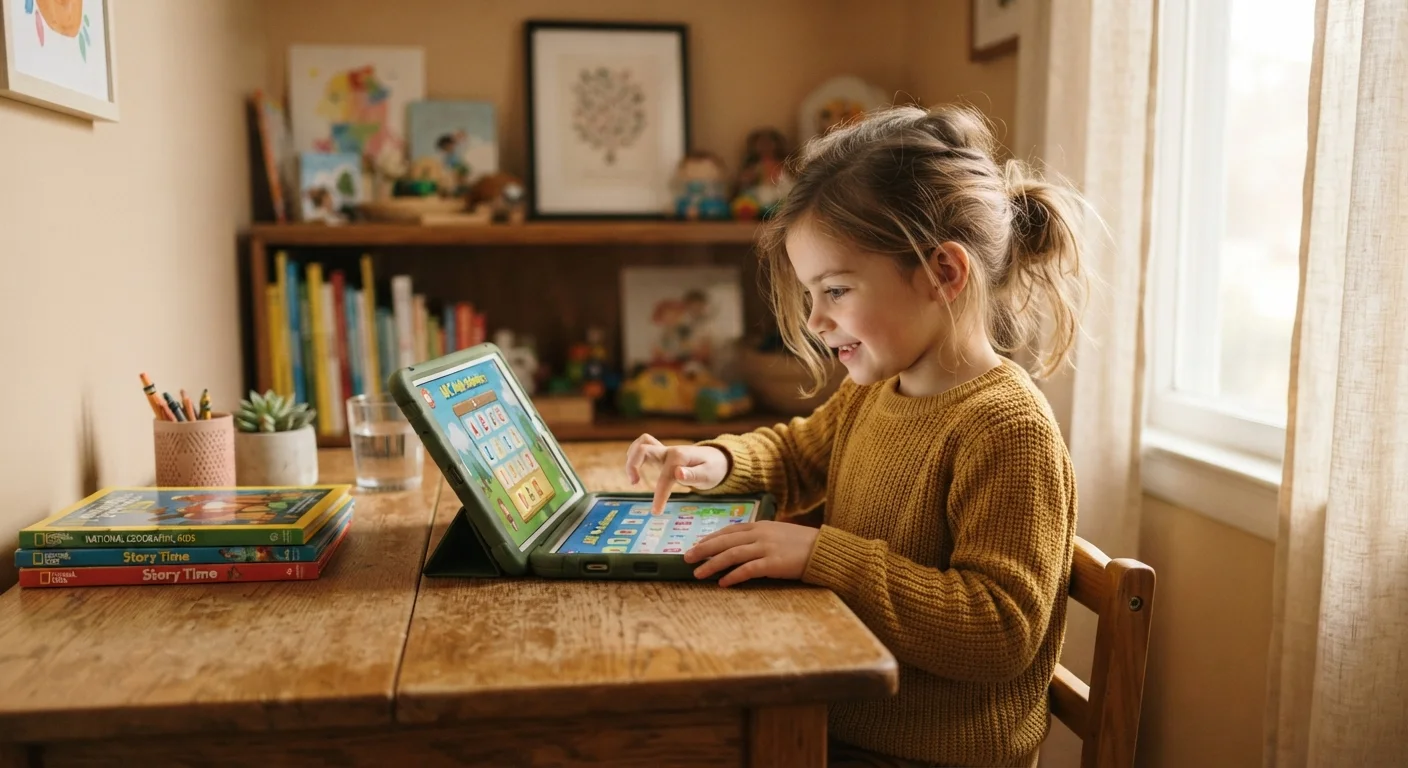
A child using an adaptive reading app to practice decoding skills is having a fundamentally different experience than a child passively watching unrelated videos on autoplay. Both count as screen time. Only one is likely to support learning. Understanding this distinction gives families a more useful framework than time limits alone.
The American Academy of Pediatrics moved away from strict hour-based guidelines for older children precisely because the evidence pointed to content quality, context, and engagement level as more meaningful factors. Blanket limits can be a useful starting point, but they are not a substitute for knowing what your child is actually doing and why.
For a broader look at building structure around learning time, see our guide to building a study routine that works for children of different ages.
Common Myths - and What the Evidence Actually Shows
Misconceptions about screen time cluster around two extremes: that all screens are harmful, or that educational labels guarantee learning. The reality sits in between, shaped by research that is still developing. Here are the most persistent myths and the evidence that corrects them.
Myth
All screen time harms children's ability to learn and focus.
Fact
Screen time quality and context - not screen time itself - are what research links to learning outcomes.
Studies that lump all screen use together consistently find weaker effects than studies that distinguish between content types. Passive, fast-paced, or purely entertainment-driven content has been associated with reduced attention in younger children. However, interactive, goal-directed applications - such as coding platforms, reading programs, or educational video with embedded questions - show neutral to modestly positive associations with learning outcomes when used appropriately. The device is not the determining variable; what it delivers is.
Myth
If an app or video is labeled 'educational,' it genuinely supports learning.
Fact
The 'educational' label is not regulated or standardized; content quality varies enormously and must be evaluated independently.
Any developer can describe an app as educational without meeting a defined standard. Research from organizations like the Joan Ganz Cooney Center has found that many apps marketed for learning rely primarily on superficial game mechanics rather than evidence-based instructional design. Parents and caregivers should look for content that builds specific, named skills; provides feedback; and adapts to the child's level - not simply content that uses classroom-adjacent imagery or vocabulary words.
Myth
Screen time under two hours per day is always safe for school-age children.
Fact
Time thresholds are useful reference points, not universal safety guarantees - developmental stage, content, and what the screen replaces all matter.
Guidelines from pediatric organizations are population-level averages intended to help families set reasonable boundaries - they are not individually calibrated thresholds. A seven-year-old spending 90 minutes on passive entertainment videos while skipping outdoor play may face more learning-related risk than a child spending the same time on a structured reading program. Conversely, a teenager using 90 minutes of screen time to complete homework and collaborate on a school project is in a very different situation. Time matters, but it is one variable among several.
Myth
Co-viewing or sitting with a child during screen time doesn't change its educational value.
Fact
Adult co-engagement - asking questions, discussing content, and making connections - consistently amplifies what children retain from screen-based content.
The concept of 'video deficit' - where younger children learn less from screens than from live interaction - is significantly reduced when a responsive adult engages alongside them. Research shows that when caregivers ask open-ended questions about what is happening on screen, connect content to real-world experience, and provide verbal feedback, children's comprehension and vocabulary gains improve measurably. This does not require continuous supervision, but occasional intentional engagement during or after screen time makes a real difference, especially for children under seven.
Myth
Reading on a screen is just as good as reading a physical book for comprehension.
Fact
Some studies suggest comprehension of longer, complex texts may be modestly stronger with print - though the gap narrows with practice and intentional digital reading habits.
Research on this question is ongoing and results vary by age, text length, and reading purpose. Several studies have found that readers on screens tend to skim more quickly and retain less detail from narrative or argumentative texts, compared with the same content on paper. However, the effect is not universal and depends heavily on the reader's habits and the type of text. For children developing fluency with longer texts, alternating between print and digital formats - and encouraging annotation or note-taking in digital environments - may help preserve comprehension depth. For a complementary perspective, consider the benefits of reading aloud even after children are literate.
~8 hrs
Average daily screen time for U.S. teens
According to Common Sense Media's research, American teenagers average roughly eight hours of recreational screen time per day - not counting school-related use.
~2x
Learning benefit increase with co-viewing
Studies cited in early childhood media research suggest children's vocabulary and comprehension gains from educational video can roughly double when a responsive adult engages alongside them.
Making Practical Choices for Your Household
Evaluating screen use does not require a research degree. A few consistent questions help families sort productive engagement from passive drift:
- Is the child active or passive? Typing, drawing, problem-solving, or responding to prompts signals engagement. Watching without interaction generally does not.
- Does the content connect to a goal? Learning a skill, completing a project, or building knowledge are clear purposes. Background noise while doing something else is not.
- What is it displacing? Screen time that replaces sleep, outdoor movement, reading, or conversation carries higher risk than screen time that replaces other passive activities.
- Is an adult occasionally co-engaging? Research consistently shows that parental co-viewing and discussion amplify educational benefit, especially for younger children.
Families who want to think beyond screens can explore how everyday activities double as learning opportunities - from cooking to neighborhood walks.
Watch for Displacement, Not Just Duration
The clearest documented risk from heavy screen use is not the screen itself - it is what it crowds out. When screen time consistently displaces sleep, physical activity, or in-person social interaction, those losses carry measurable developmental costs. Before adjusting total screen hours, audit what your child is not doing during that time. That is often where the real concern lies.
It is also worth noting that screen-related mental health effects are genuinely debated. For a careful look at what the research does and does not establish, our article on digital devices and mental health separates real effects from overblown claims.
The content provided on our blog site traverses numerous categories, offering readers valuable and practical information. Readers can use the editorial team’s research and data to gain more insights into their topics of interest. However, they are requested not to treat the articles as conclusive. The website team cannot be held responsible for differences in data or inaccuracies found across other platforms. Please also note that the site might also miss out on various schemes and offers available that the readers may find more beneficial than the ones we cover.