

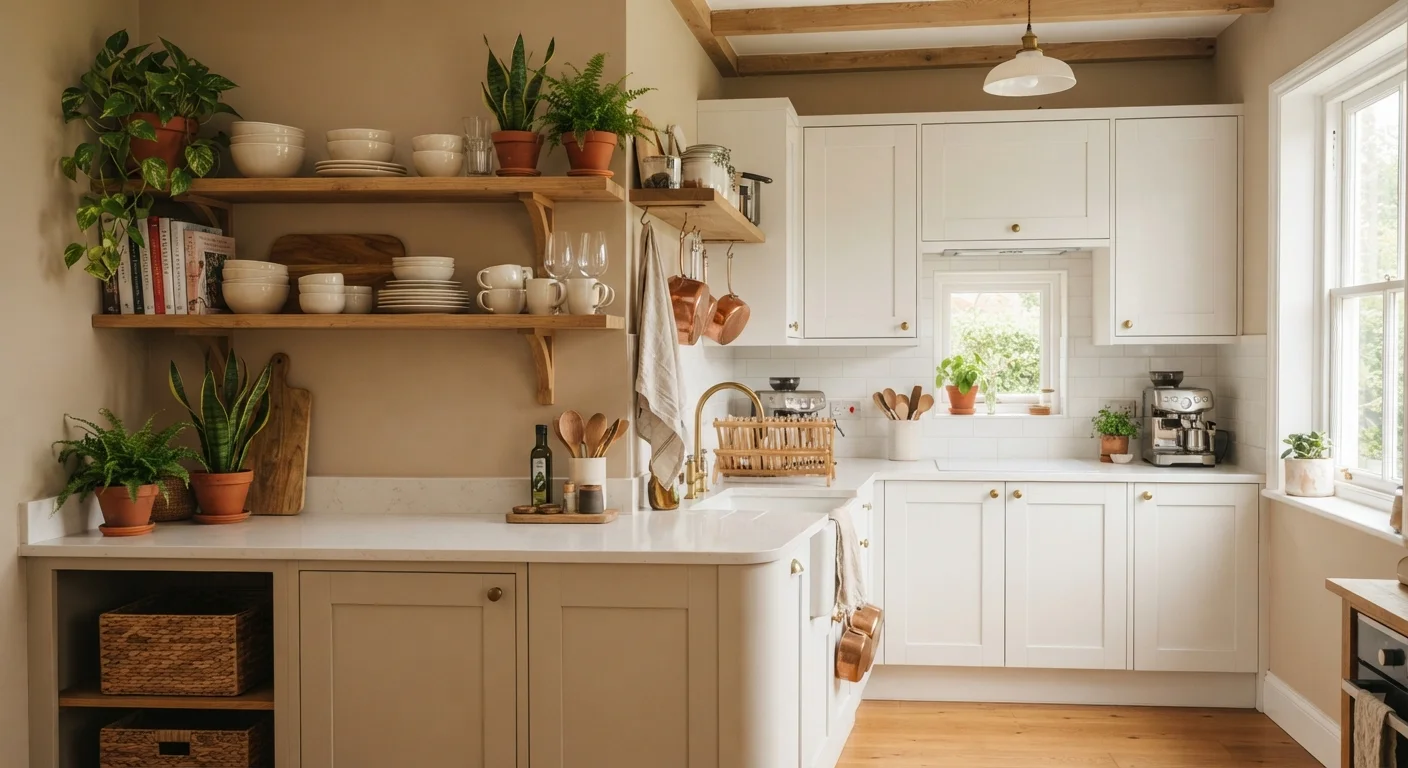
Option A
Open Shelving
The visible, design-forward storage approach.
Best for: Households that maintain tidy habits and want easy, at-a-glance access to frequently used items.
Option B
Closed Cabinets
The contained, clutter-concealing classic.
Best for: Busy households with mixed organizational habits who need a forgiving, low-maintenance storage solution.
The Real Difference Between Looking Tidy and Staying Tidy
Open shelving is one of the most debated storage choices in home design - and the debate usually misses the point. The question isn't which option looks better in a magazine. It's which one holds up under your household's actual daily habits.
Closed cabinets win the low-effort tidiness competition consistently. Doors conceal whatever is behind them, so a room reads as organized even when the cabinet interior is somewhat chaotic. That's not a flaw - for many households, it's the entire value proposition. When life gets busy, the visual payoff of closed storage requires far less daily discipline to maintain.
Open shelving operates on an opposite principle: everything is always on display. That visibility creates gentle accountability - most people are more likely to return items neatly when they can see the shelf from across the room. But it also means that a single cluttered zone is immediately visible to everyone, including guests. There's no door to close on a bad day.
For households navigating different tidiness standards among household members, this distinction matters enormously. Closed cabinets give everyone a faster path to "done" without requiring visual consensus.
| Criterion | Open Shelving | Closed Cabinets |
|---|---|---|
| Visual tidiness effort | High - always visible | Low - doors conceal contents |
| Dust & grease accumulation | Higher maintenance required | Protected interiors, less upkeep |
| Access speed | Faster - no door friction | Slightly slower to open/close |
| Works with mixed habits | Challenging - all visible | Forgiving - hides inconsistency |
| Design flexibility | High visual impact, curated look | Cleaner, more neutral aesthetic |
| Best room fit | Living rooms, low-humidity spaces | Kitchens, bathrooms, pantries |
Practical Factors Most People Overlook
Beyond the tidiness question, several practical factors determine whether a storage choice actually works long-term.
Dust and Maintenance
Open shelves - particularly in kitchens - accumulate grease particles and dust significantly faster than enclosed storage. Items stored on open kitchen shelving need wiping down more frequently, and the shelves themselves require regular attention. In bathrooms, open shelves near showers trap humidity and can develop mildew on stored items. These aren't dealbreakers, but they are real ongoing costs of the open-shelf lifestyle that often go unmentioned.
Access Patterns
Think about which items you reach for daily versus occasionally. Open shelves genuinely shine for frequently used objects - everyday dishes, cooking oils, current books. The absence of a door handle reduces micro-friction, making it marginally faster to grab and return things. For items used occasionally, though, closed cabinets protect against dust and keep less attractive necessities out of sight.
Cognitive Load
Visual clutter - even the attractive, curated kind - creates low-level cognitive noise for some people. Research in environmental psychology suggests that cluttered visual fields can contribute to feelings of stress, even when the mess is aesthetically intentional. If you find yourself anxious when counters are busy, closed storage may support your wellbeing more effectively regardless of how organized the shelf actually is.
62%
Americans report clutter causes stress
A survey by the American Cleaning Institute found that a majority of American adults associate household clutter with elevated stress levels.
3×
More dust on open vs. closed surfaces
Home organization researchers generally note open shelving in active kitchens requires significantly more frequent cleaning than enclosed cabinet interiors.
For kitchen-specific organization, pairing your storage approach with a clear drawer zoning strategy will make either approach more functional.
Hybrid Strategies That Outperform Either Extreme
In practice, most well-organized homes use both open and closed storage - intentionally assigned by context. The guiding principle: open storage for items you use daily and don't mind displaying; closed storage for everything else.
A common approach in kitchens is to use upper open shelves for attractive, frequently used items (everyday mugs, a few cookbooks, a plant) while keeping lower or pantry cabinets closed for dry goods, appliances, and anything visually uneven. This limits the total surface area that requires daily upkeep while still delivering the accessibility benefits of open storage where they matter most.
In living rooms and home offices, open shelving for books and decor alongside a closed console or credenza for electronics and paperwork follows the same logic. The vertical versus horizontal storage question also comes into play here - wall-mounted open shelving frees floor space without adding visual weight at eye level.
The most sustainable organization systems aren't built on willpower or aesthetic aspiration - they're built on honest habits. Daily routines and consistent habits will do more for long-term tidiness than any particular shelving choice. Choose storage that matches your real-life behavior, not the version of yourself you hope to become after a weekend reorganization project.
The content provided on our blog site traverses numerous categories, offering readers valuable and practical information. Readers can use the editorial team’s research and data to gain more insights into their topics of interest. However, they are requested not to treat the articles as conclusive. The website team cannot be held responsible for differences in data or inaccuracies found across other platforms. Please also note that the site might also miss out on various schemes and offers available that the readers may find more beneficial than the ones we cover.