

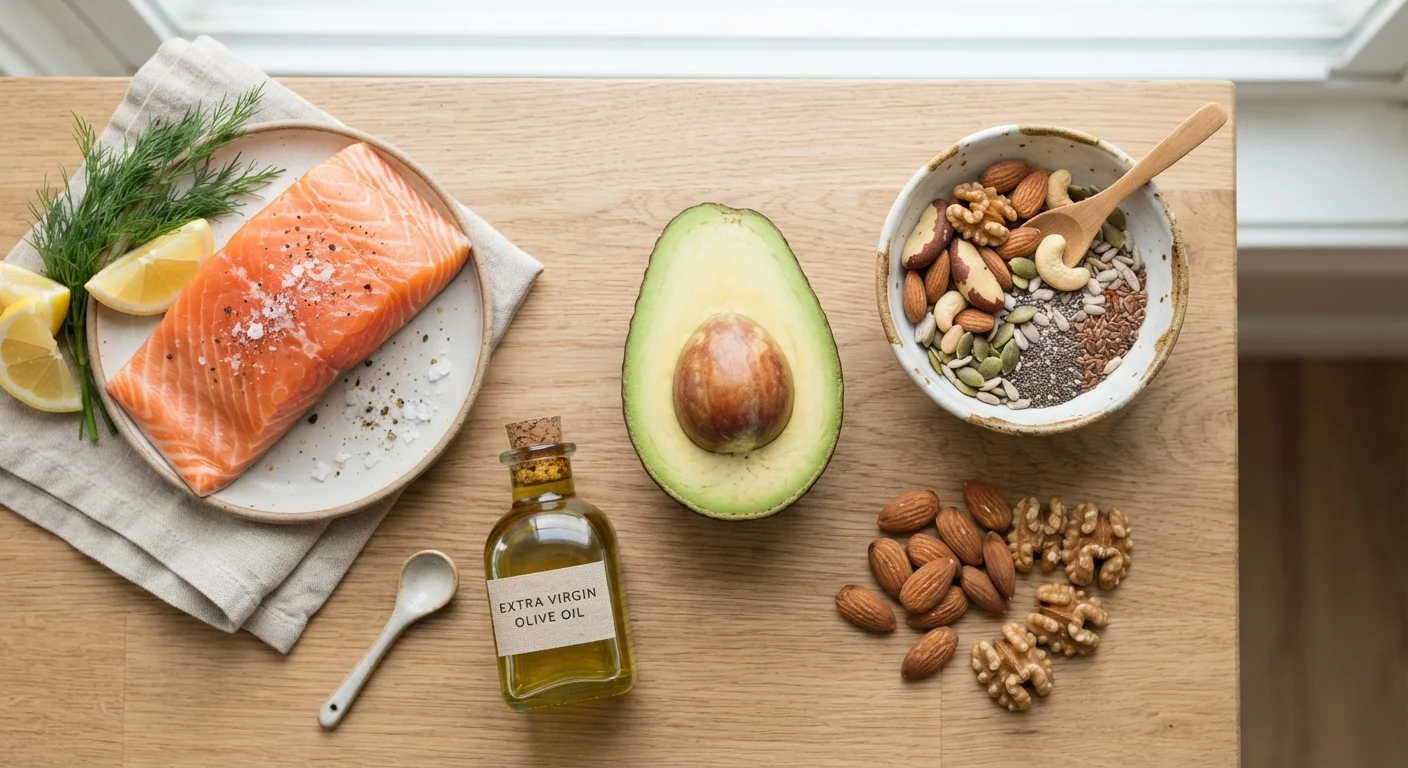
Why Fat Is Not the Enemy
For decades, low-fat diets were promoted as the gold standard for health. That framing left many Americans believing dietary fat was something to minimize at all costs. The science has since evolved considerably - fat is not only acceptable, it is essential.
The body relies on fat for energy storage, building cell membranes, producing hormones, and absorbing fat-soluble vitamins A, D, E, and K. Without adequate fat intake, these functions are compromised. The key insight nutrition research has clarified is that the type of fat matters far more than fat as a category.
If you want a broader foundation for understanding how nutrients fit together, see this nutrition starting point for everyday readers new to thinking about what they eat.
Focus on Fat Sources, Not Just Totals
Rather than tracking grams of total fat, pay attention to where your fat is coming from. A diet naturally rich in nuts, fish, avocados, and olive oil tends to favor unsaturated fats without requiring close calculation. Small, consistent food-source shifts often have more practical impact than strict macro tracking.
Unsaturated Fats: The Well-Studied Fats
Unsaturated fats are divided into two categories: monounsaturated and polyunsaturated. Both are found primarily in plant-based foods and fish, and both are liquid at room temperature.
Monounsaturated fats - found in olive oil, avocados, and most nuts - have been associated in research with supporting healthy cholesterol levels. The Mediterranean dietary pattern, which is rich in these fats, is one of the most studied for cardiovascular health.
Polyunsaturated fats include omega-3 and omega-6 fatty acids. Omega-3s, found in fatty fish, walnuts, and flaxseed, have a substantial body of research supporting their role in heart and brain health. Omega-6s, found in many vegetable oils, are also essential - though the balance between omega-3 and omega-6 intake is an active area of nutrition research.
20-35%
Recommended fat share of daily calories
According to the Dietary Guidelines for Americans, fat should make up roughly 20-35% of total daily caloric intake for adults.
9 kcal/g
Calories per gram of fat
Fat is the most calorie-dense macronutrient at 9 calories per gram, compared to 4 calories per gram for protein or carbohydrate.
~70%
US adults consuming above saturated fat limit
Research using NHANES data has consistently shown that a majority of American adults consume more saturated fat than the 10% of calories limit recommended by federal dietary guidelines.
Saturated Fats: Context and Moderation
Saturated fats are solid at room temperature and found mainly in animal products - red meat, butter, full-fat dairy - as well as tropical oils like coconut and palm oil. US dietary guidelines generally recommend keeping saturated fat intake moderate, as higher consumption has historically been linked to elevated LDL (low-density lipoprotein) cholesterol in some studies.
That said, nutritional science rarely operates in simple cause-and-effect terms. Research has increasingly shown that the overall dietary pattern - what replaces saturated fat when you reduce it - matters significantly. Replacing saturated fat with refined carbohydrates, for example, may not provide the expected benefit. Replacing it with unsaturated fats generally does.
This nuance is part of why common nutrition myths persist - the full picture is more complex than early dietary messaging suggested.
Trans Fats: A Clearer Case
Artificial trans fats - created by partially hydrogenating vegetable oils to make them solid and shelf-stable - represent the one category where scientific consensus is the most unified. Research consistently linked these fats to increased LDL cholesterol, decreased HDL (high-density lipoprotein) cholesterol, and greater cardiovascular risk.
In response, the FDA determined that partially hydrogenated oils were no longer Generally Recognized as Safe, effectively banning them from the US food supply by 2020. This was a meaningful public health shift, particularly for packaged baked goods and fried foods that previously relied on these oils.
Small amounts of naturally occurring trans fats exist in some meat and dairy products, and current evidence does not associate these natural forms with the same risks as artificial versions.
Naturally Occurring vs. Artificial Trans Fats
Not all trans fats are created the same way. Artificial trans fats from partially hydrogenated oils have a well-documented negative health profile and have been removed from the US food supply. Naturally occurring trans fats, found in small amounts in beef and dairy, have a different chemical structure and are not associated with the same risks in current research. Reading ingredient lists can help you distinguish residual artificial sources from naturally occurring ones.
Reading Labels and Making Practical Food Choices
The Nutrition Facts label on US packaged foods lists total fat, saturated fat, and trans fat per serving. Unsaturated fats are not always broken out explicitly - you can estimate them by subtracting saturated and trans fat from total fat. The ingredient list can also signal fat quality: partially hydrogenated oil in the ingredients indicates residual artificial trans fats even if the label shows 0g (amounts under 0.5g per serving can be rounded down).
In practice, a dietary pattern emphasizing whole foods - vegetables, legumes, whole grains, nuts, seeds, and fish - naturally skews toward unsaturated fat sources. This connects to a broader conversation about food quality explored in the spectrum between whole and processed foods.
For a handy reference on other nutrition vocabulary you may encounter on labels or in health content, this nutrition terms guide covers key concepts in plain language.
This article is for general informational and educational purposes only and does not constitute medical or dietary advice. Consult a qualified healthcare professional or registered dietitian before making significant changes to your diet, especially if you have a health condition.
Frequently Asked Questions
Fat is not inherently bad - it is a necessary macronutrient. The type and quantity of fat matter more than fat itself. Unsaturated fats are broadly considered beneficial, while excessive saturated fat and artificial trans fats are linked to health risks according to established dietary guidelines.
Avocados, olive oil, canola oil, most nuts, seeds, and fatty fish like salmon or sardines are rich in unsaturated fats. These foods also tend to come with other beneficial nutrients, making them well-regarded in most dietary patterns.
General US dietary guidelines suggest that fat can make up roughly 20-35% of total daily calories, with emphasis on unsaturated sources. Individual needs vary based on age, health status, and activity level. A registered dietitian can help determine what's right for you personally.
Artificial trans fats (partially hydrogenated oils) have been banned from the US food supply by the FDA since 2020. However, small amounts of naturally occurring trans fats exist in some animal products, and trace artificial trans fats may appear in products manufactured before the ban's full enforcement.
Saturated fats have no double bonds between carbon atoms in their fatty acid chains and are usually solid at room temperature. Unsaturated fats have one or more double bonds and tend to be liquid at room temperature. This structural difference affects how the body metabolizes each type.
Weight change is driven by overall calorie balance, not fat consumption alone. Fat is calorie-dense (9 calories per gram), so portions matter, but dietary fat does not uniquely cause weight gain compared to excess calories from any source. This is one of the most common nutrition misconceptions.
The content provided on our blog site traverses numerous categories, offering readers valuable and practical information. Readers can use the editorial team’s research and data to gain more insights into their topics of interest. However, they are requested not to treat the articles as conclusive. The website team cannot be held responsible for differences in data or inaccuracies found across other platforms. Please also note that the site might also miss out on various schemes and offers available that the readers may find more beneficial than the ones we cover.