

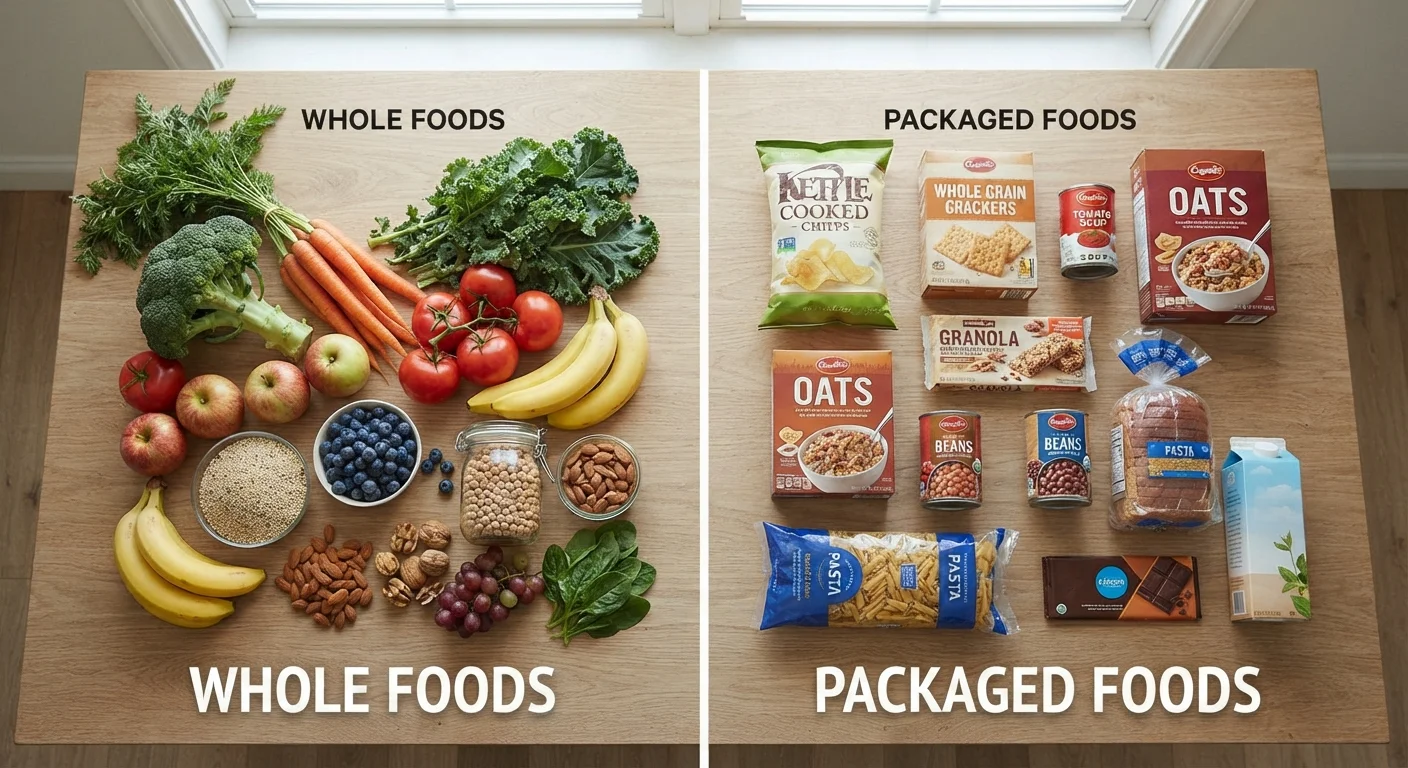
Option A
Whole Foods
Foods in or close to their natural, unaltered state.
Best for: People seeking the most nutrient-dense, minimally altered options for building a health-supportive diet.
Option B
Processed Foods
A broad spectrum from minimally altered to heavily manufactured.
Best for: Understanding that "processed" covers everything from canned beans to ultra-processed snack foods - context matters greatly.
Why the Whole vs. Processed Distinction Is More Complicated Than It Sounds
Most people learn early on that whole foods are "good" and processed foods are "bad." But that binary framing oversimplifies what nutrition science actually describes. The word processed covers an enormous range - from washing and bagging salad greens to engineering a snack food with dozens of additives, flavor enhancers, and shelf stabilizers. Treating these as equivalent leads to real confusion in everyday food decisions.
Consider plain rolled oats: technically processed (the grain is steamed and flattened), yet nutritionally dense and widely recommended by dietitians. Or consider cold-pressed olive oil: extracted through mechanical pressing, but far from harmful. Meanwhile, some products marketed as "natural" contain significant amounts of added sugars or sodium. Understanding the spectrum - not just two poles - is what actually helps at the grocery store.
For a broader foundation on food and nutrition vocabulary, see our guide to everyday nutrition terms that demystify common label language.
The NOVA Classification: A Science-Based Framework
The most widely cited scientific tool for understanding food processing levels is the NOVA classification system, developed by researchers at the University of São Paulo. NOVA groups foods into four categories based on the extent and purpose of their industrial processing - not simply their nutrient content.
| Criterion | Whole Foods | Processed Foods |
|---|---|---|
| Definition | Unaltered or minimally altered from natural state | Any food changed from its original form - a wide spectrum |
| Nutrient retention | Nutrients generally intact | Varies widely; ultra-processed often nutrient-depleted |
| Added sugar & sodium | Naturally low or absent | Highly variable; often elevated in ultra-processed products |
| Fiber content | Typically high in plant-based whole foods | Often reduced through refining; sometimes added back |
| Convenience | Requires more preparation time | Generally more convenient and shelf-stable |
| Cost | Varies; fresh produce can be expensive | Canned/frozen minimally processed can be very affordable |
| Health research association | Consistently linked to positive diet quality outcomes | Ultra-processed linked to risk; minimally processed largely neutral |
| NOVA category | Groups 1-2 | Groups 3-4 depending on extent of processing |
- Group 1 - Unprocessed or minimally processed foods: Fresh fruits, vegetables, plain meats, eggs, plain milk, legumes, nuts, and grains. These are either entirely unaltered or altered only to remove inedible parts, dry, freeze, or pasteurize.
- Group 2 - Processed culinary ingredients: Oils, butter, flour, sugar, and salt - substances extracted from whole foods and used in home or restaurant cooking. Not typically eaten alone.
- Group 3 - Processed foods: Foods made by adding Group 2 ingredients to Group 1 foods. Examples include canned vegetables with salt, cheese, smoked fish, and simple breads. Processing here is primarily for preservation or flavor.
- Group 4 - Ultra-processed foods: Industrially formulated products containing ingredients rarely found in home kitchens - emulsifiers, flavor enhancers, colorings, and preservatives. Packaged snacks, sugary cereals, reconstituted meat products, and many soft drinks fall here.
Research published in peer-reviewed journals has found that higher consumption of Group 4 ultra-processed foods is associated with increased risk of obesity, cardiovascular disease, and type 2 diabetes - though it's important to note that association does not establish direct causation, and overall dietary patterns remain the key measure of diet quality.
~57%
Share of US calories from ultra-processed foods
A study published in BMJ Open estimated that ultra-processed foods account for roughly 57% of total caloric intake among American adults.
90%+
Americans falling short of fiber recommendations
Dietary surveys consistently show that the vast majority of US adults do not meet recommended daily fiber intake levels, largely due to low whole food consumption.
4 groups
NOVA food processing classification categories
The NOVA system, developed by University of São Paulo researchers, organizes all foods into four groups based on processing extent and purpose.
What Whole Foods Actually Offer Nutritionally
Whole foods - fruits, vegetables, whole grains, legumes, nuts, seeds, and unprocessed proteins - arrive with their nutritional matrix essentially intact. This matters because nutrients in food often work synergistically. Fiber in whole grains, for example, slows glucose absorption, feeds beneficial gut bacteria, and contributes to satiety. These effects can be diminished or lost when a grain is refined and then re-fortified with isolated nutrients.
Whole foods are also naturally low in added sugar and sodium, two nutrients most Americans consume in excess relative to federal dietary guidelines. They tend to provide more dietary fiber - something approximately 90% of Americans fall short of meeting recommended intake levels for, according to dietary surveys. The fiber, vitamins, minerals, and phytonutrients in whole plant foods also interact in ways that isolated supplements have not consistently replicated in clinical trials.
That said, not every whole food is nutritionally superior in every context. Whole milk versus skim, for instance, involves trade-offs depending on age, health status, and total diet. These nuances are worth discussing with a registered dietitian rather than applying a one-size-fits-all rule. For more on how specific macronutrients function in the body, see our macronutrients explainer.
Where Processed Foods Fit in a Practical Diet
Eliminating all processed foods is neither realistic for most American households nor supported by nutrition science as necessary. The practical goal, as reflected in dietary guidelines, is to emphasize minimally processed whole foods while limiting ultra-processed options - not to avoid anything that has ever touched a factory.
Canned tomatoes, frozen edamame, plain Greek yogurt, and whole-grain bread are all technically processed. They also represent convenient, affordable, and nutritionally reasonable choices that make it easier for busy families to eat well. Our aisle-by-aisle grocery guide helps identify which packaged products tend to align with nutrition goals and which to approach more carefully.
When evaluating any packaged food, the ingredient list and Nutrition Facts panel tell you more than front-of-package claims. Understanding how added sugars differ from natural sugars is one useful starting point for reading those labels critically. Fewer ingredients, recognizable ingredients, and lower amounts of added sugar and sodium are generally reliable signals that a product sits closer to the minimally processed end of the spectrum.
This article is for general informational purposes only and does not constitute medical or dietary advice. Consult a registered dietitian or qualified healthcare professional for guidance tailored to your individual health needs.
The content provided on our blog site traverses numerous categories, offering readers valuable and practical information. Readers can use the editorial team’s research and data to gain more insights into their topics of interest. However, they are requested not to treat the articles as conclusive. The website team cannot be held responsible for differences in data or inaccuracies found across other platforms. Please also note that the site might also miss out on various schemes and offers available that the readers may find more beneficial than the ones we cover.