

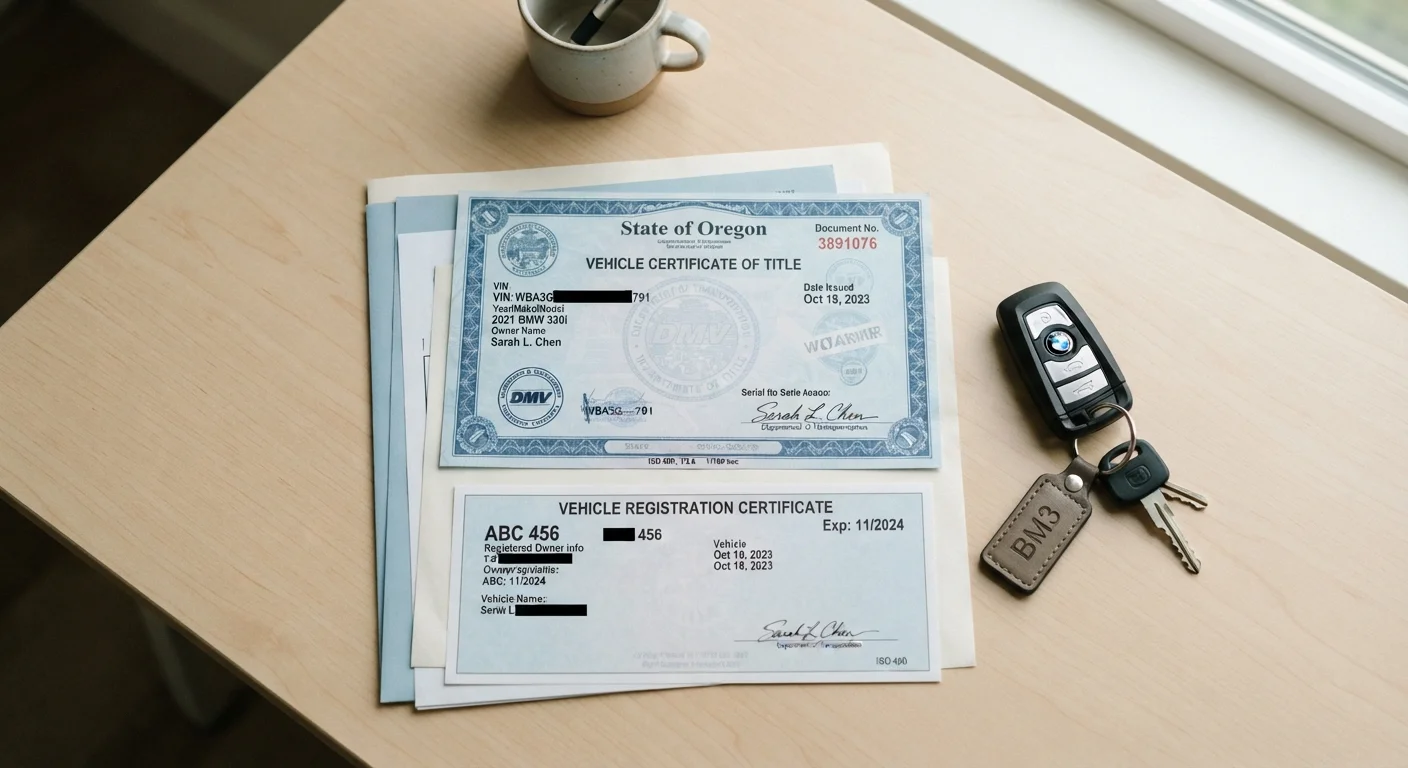
Title vs. Registration: Two Different Documents
Many drivers use the terms interchangeably, but a vehicle title and a registration serve completely different legal functions.
A title is a legal document that establishes who owns the vehicle. It is issued by your state's motor vehicle authority and stays with the owner - not the car. When you pay off a loan, the lender's name is removed from the title. When you sell, you sign the title over to the buyer.
A registration is permission from the state to operate that vehicle on public roads. It must be renewed periodically - typically every one or two years - and is tied to the vehicle's current owner and address. Your registration card and sticker are proof that you have paid the required fees and, where applicable, passed required inspections.
Think of it this way: the title proves you own the car; the registration proves you are allowed to drive it legally right now. For a broader look at annual renewal responsibilities, see our annual car ownership checklist.
| Who issues titles and registrations | Your state's Department of Motor Vehicles (DMV) or equivalent agency |
| Typical registration renewal cycle | Every 1-2 years, depending on state |
| Time to re-register after moving states | 30-90 days (varies by state) |
| Expected lien release window after payoff | 30-60 days from final loan payment |
| Duplicate title typical fee range | Varies by state; commonly $10-$25 |
Liens, Lien Releases, and Paying Off a Loan
When you finance a vehicle, the lender places a lien on the title - a legal claim against the vehicle until the debt is paid in full. In most states, the lienholder's name appears directly on the title, and you cannot sell or transfer the vehicle without satisfying that lien.
Once your loan is paid off, the lender must issue a lien release. Depending on your state, the process works one of a few ways:
- The lender mails you a paper lien release to submit to your DMV.
- The lender electronically notifies the state, and the DMV mails you a clean title automatically.
- You visit the DMV with the lien release document to receive a new title in your name only.
If you do not receive confirmation within 30 to 60 days of your final payment, contact the lender directly. Do not assume the process is complete without written or electronic proof. If you are navigating vehicle paperwork for the first time, our first-time car owner's orientation covers related basics in plain language.
Store Your Title Somewhere Secure
A vehicle title is difficult and time-consuming to replace if lost, and it is required for any ownership transfer. Store the original in a fireproof home safe or a secure location - not in the glove compartment. A missing title in a private sale situation can significantly delay or complicate the transaction for both parties.
Common Title and Registration Problems - and How to Address Them
Paperwork problems are more common than most drivers realize. Here are the situations that come up most often and what you can generally do about each one.
Vehicle Title
A legal document issued by the state that identifies the registered owner of a vehicle. It is required to sell, donate, or transfer ownership and must be updated whenever ownership changes.
Vehicle Registration
State-issued authorization to operate a specific vehicle on public roads. It must be renewed periodically and is separate from the title. Your registration card and renewal sticker are proof of current status.
Lien
A legal claim a lender holds against a vehicle used as collateral for a loan. The lien appears on the title and must be formally released before the owner can freely sell or transfer the vehicle.
Lien Release
A document or electronic notification from a lender confirming that a vehicle loan has been paid in full and the lender's legal claim on the title has been cleared.
Duplicate Title
A replacement copy of a vehicle title issued by the state DMV when the original is lost, damaged, or destroyed. It carries the same legal weight as the original.
Title Transfer
The legal process of changing registered ownership from one party to another, typically completed at the DMV after a sale, gift, or inheritance using the signed original title.
Lost or Damaged Title
Apply for a duplicate title through your state DMV. You will typically need a completed application form, valid ID, payment of a state fee (amounts vary), and confirmation of no outstanding liens. Processing times range from a few days to several weeks depending on your state and how you apply.
Title in Someone Else's Name After a Private Sale
A seller must sign over the title to you at the time of sale. If you received a vehicle without a properly signed title, contact your DMV promptly. Most states have a resolution process, but it may require additional documentation such as a bill of sale or notarized statement.
Expired Registration
Driving with an expired registration is a traffic violation in every state and can result in a fine. Renew as soon as you notice the lapse. Many states allow online renewal; others require proof of a current emissions test or safety inspection first. Late fees may apply after the expiration date. See our annual ownership checklist for renewal timing guidance.
Out-of-State Vehicle Transfers
When you move to a new state, you are generally required to register your vehicle in your new state within 30 to 90 days. Requirements vary: you may need a vehicle inspection, a new title issued by the new state, and proof of insurance meeting local minimums. Check your new state's DMV website for the exact requirements before your deadline passes.
The content provided on our blog site traverses numerous categories, offering readers valuable and practical information. Readers can use the editorial team’s research and data to gain more insights into their topics of interest. However, they are requested not to treat the articles as conclusive. The website team cannot be held responsible for differences in data or inaccuracies found across other platforms. Please also note that the site might also miss out on various schemes and offers available that the readers may find more beneficial than the ones we cover.