

Our Verdict
Most drivers can confidently handle a defined set of low-risk, straightforward maintenance tasks at home with basic tools and careful preparation. However, jobs involving brakes, steering, fuel systems, or advanced electronics require professional training and equipment - and attempting them without that background creates real safety and legal risk. The smartest approach is a clear-eyed assessment of your skill level, tools, and the stakes involved before picking up a wrench.
| Best for | Recommended |
|---|---|
| Drivers comfortable with basic mechanical tasks and standard tools | DIY Maintenance |
| Safety-critical repairs, complex diagnostics, or warranty-sensitive work | Licensed Mechanic |
| High-mileage vehicles with multiple interconnected issues | Licensed Mechanic |
| Budget-conscious drivers handling routine upkeep between professional visits | DIY Maintenance |
Why the DIY vs. Professional Question Actually Matters
Deciding which car maintenance tasks to handle yourself - and which to hand off - isn't just about saving money. It's about matching the complexity and risk of a job to your actual skill level, tools, and workspace. A mistake on a wiper blade costs you a few minutes. A mistake on a brake caliper can cost you much more.
For a deeper look at how this same framework applies across home projects, see our guide to deciding when to DIY. And if you're newer to vehicle ownership overall, building strong maintenance habits early is the right starting point.
The goal here is straightforward: give you a realistic picture of what's genuinely manageable at home and what's better left to a trained technician.
Tasks Most Drivers Can Handle at Home
These jobs share a common profile: they require basic tools, pose minimal injury risk when done carefully, and have clearly visible results you can verify yourself.
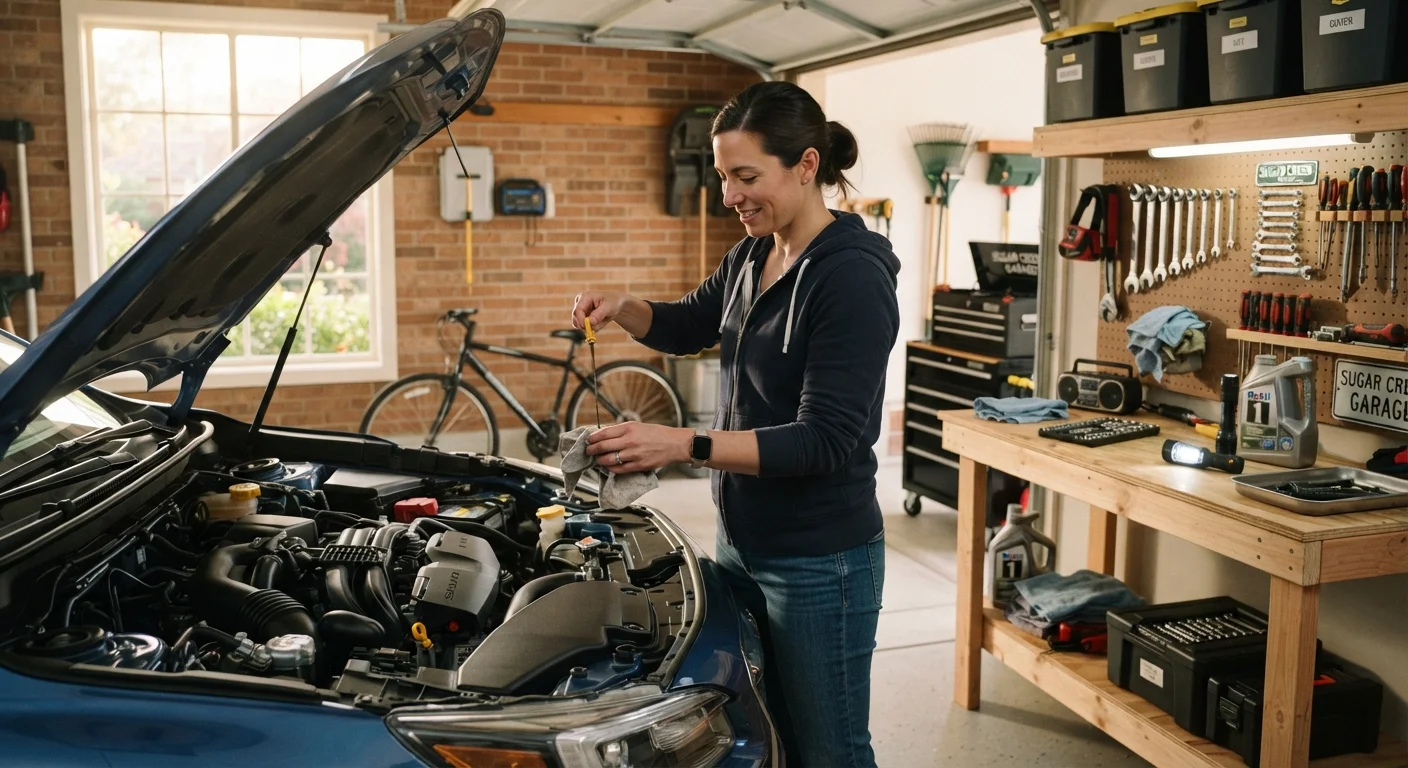
- Engine oil and filter changes: With a drain pan, the correct oil grade (check your owner's manual), and a filter wrench, this is manageable for most drivers. Dispose of used oil at an auto parts store or recycling center - never pour it down a drain.
- Air filter replacement: Both engine air filters and cabin air filters are typically accessible without specialized tools. Replacement intervals vary; your owner's manual will specify.
- Wiper blade replacement: Most wiper blades snap on and off in minutes. Match the correct size to your vehicle before purchasing.
- Battery terminal cleaning: Corrosion on battery terminals can cause starting problems. A wire brush, baking soda solution, and gloves are all you need - but always disconnect the negative terminal first.
- Tire pressure checks and rotation: Checking pressure with a gauge is basic and important. Tire rotation requires a floor jack and jack stands used correctly on flat, stable ground - never rely on a scissor jack alone for this task.
- Exterior bulb replacement: Many headlight and taillight bulbs can be swapped at home, though some modern vehicles require partial disassembly.
Always Use a Torque Wrench for Fasteners
Over-tightening bolts is one of the most common and damaging DIY errors. Refer to your vehicle's service manual for torque specifications on oil drain plugs, lug nuts, and any fastener you remove. A basic torque wrench is a worthwhile addition to any home tool kit and is available at most hardware stores.
For drivers managing older, higher-mileage vehicles, maintenance priorities shift meaningfully after 100,000 miles - some tasks that were simple earlier may warrant professional attention as components age.
Jobs That Belong with a Licensed Mechanic
The following jobs involve systems where an error has immediate safety consequences, requires specialized tools, or where improper work can affect other drivers on the road.
| Task | DIY Appropriate | Professional Recommended | |
|---|---|---|---|
| Engine oil & filter change | Yes - with correct oil grade and disposal | If preferred or no suitable workspace | |
| Air & cabin filter replacement | Yes - typically tool-free access | Rarely necessary | |
| Wiper blade replacement | Yes - straightforward snap-on process | Not needed | |
| Brake pad & caliper work | Only experienced DIYers, basic pad swaps | Recommended for most drivers | |
| Suspension / steering parts | Not recommended | Yes - safety-critical | |
| Airbag / SRS system | Never - serious injury risk | Always required | |
| Fuel system repairs | Not recommended - fire risk | Yes - specialized equipment needed | |
| Advanced electrical diagnostics | Code reading only | Full diagnosis and repair |
- Brake system repairs: Replacing brake pads on some vehicles is achievable for experienced DIYers, but bleeding brake lines, replacing calipers, or machining rotors involves hydraulic systems where air or fluid contamination directly compromises stopping power. If you're not experienced with brake work specifically, this belongs with a professional.
- Suspension and steering components: Ball joints, tie rods, and control arms affect how your vehicle handles and stays stable at highway speeds. Errors here can cause loss of vehicle control.
- Airbag and SRS system work: Supplemental Restraint Systems can deploy unexpectedly during servicing, causing serious injury. Federal regulations govern their repair - this is strictly professional territory.
- Transmission service: Beyond a fluid check or drain-and-fill on some vehicles, internal transmission work requires specialized knowledge and diagnostic equipment.
- Fuel system repairs: Working on fuel injectors, fuel lines, or the fuel pump involves flammable materials under pressure. Fire and explosion risk make this a professional job.
- Advanced electrical and computer diagnostics: Modern vehicles rely heavily on interconnected control modules. A fault code reader can tell you a code exists; it takes a trained technician with the right software to accurately interpret and resolve the underlying cause.
Also worth noting: unauthorized repairs on emissions control systems can violate federal and state law. Don't tamper with catalytic converters, EGR valves, or oxygen sensors outside of legitimate replacement. Driving smarter includes understanding the rules that apply to your vehicle, not just the road.
Before You Start Any DIY Job: What to Assess
Even on tasks that fall squarely in the DIY-appropriate column, honest self-assessment matters. Ask yourself:
- Do I have the right tools? Improvising with the wrong socket size or skipping torque specs can strip bolts or leave components loose.
- Is my workspace safe? A level, stable surface is non-negotiable for any work that involves going under the vehicle.
- Have I read the vehicle-specific procedure? Generic YouTube tutorials may not reflect your exact model year's layout or specifications.
- What's the consequence of getting this wrong? Low stakes (wiper blades) and high stakes (brake hardware) deserve different levels of caution.
It's also worth separating fact from common misconception before you start. Several widely repeated car care myths lead drivers to either over-service or under-service their vehicles - both of which cost money in the long run.
Finally, remember that car ownership carries legal and financial responsibilities beyond the driveway. Work that affects vehicle safety, emissions compliance, or warranty coverage can have real downstream consequences worth understanding before you begin.
Never Work Under a Vehicle Supported Only by a Jack
A hydraulic floor jack is a lifting tool, not a support device. Always place rated jack stands under designated vehicle lift points before going underneath. Vehicle collapses cause serious injuries every year - this step is non-negotiable regardless of how brief the job seems.
The content provided on our blog site traverses numerous categories, offering readers valuable and practical information. Readers can use the editorial team’s research and data to gain more insights into their topics of interest. However, they are requested not to treat the articles as conclusive. The website team cannot be held responsible for differences in data or inaccuracies found across other platforms. Please also note that the site might also miss out on various schemes and offers available that the readers may find more beneficial than the ones we cover.