

Why Batteries Rarely Fail Without Warning
A dead battery feels sudden, but the evidence usually builds gradually. Most drivers miss the early signals because they're subtle - a slightly sluggish start here, a flickering interior light there. Understanding what those signals mean puts you in control instead of waiting for a breakdown to force your hand.
If you're newer to car ownership, building awareness of your vehicle's normal behavior is a foundational skill. Our first-time car owner's orientation covers how to recognize what's normal versus what warrants attention. Battery health fits squarely in that category.
Below are the key signals that your battery is weakening - and the habits and conditions that accelerate that decline.
Slow or labored engine cranking
When you turn the key or press the start button, the battery delivers a large burst of current to the starter motor. As the battery ages and its internal resistance increases, that burst weakens. You'll notice the engine taking longer to catch - a drawn-out "rrrr" before ignition rather than an immediate start.
This is one of the most consistent early indicators. It's especially noticeable on cold mornings, when batteries naturally deliver less power. If cranking feels sluggish in mild weather, treat it as a serious prompt to have the battery tested.
Slow cranking in mild weather is a serious prompt - don't wait for a full failure.
Headlights or interior lights dimming at idle
A healthy battery and charging system keep voltage stable regardless of engine speed. When a battery is weakening, you may notice headlights that dim noticeably at a stop and brighten when you rev the engine. The same can happen with interior lighting or the instrument cluster backlight.
This behavior suggests the alternator is compensating for a battery that can no longer hold adequate charge between charges - a sign the system is already under stress.
Lights that dim at idle and brighten when revving signal the battery can't hold its charge.
Frequent need to jump-start the vehicle
One jump-start after leaving lights on is an honest mistake. Needing jumps repeatedly under normal use - especially after the car has sat for just a few hours - points to a battery that can no longer hold a usable charge. At this stage, the battery is likely nearing the end of its service life and should be tested promptly.
Relying on jump-starts as a routine fix accelerates damage to both the failing battery and the charging system.
Repeated jump-starts under normal use mean the battery can no longer hold a usable charge.
Visible corrosion on the terminals
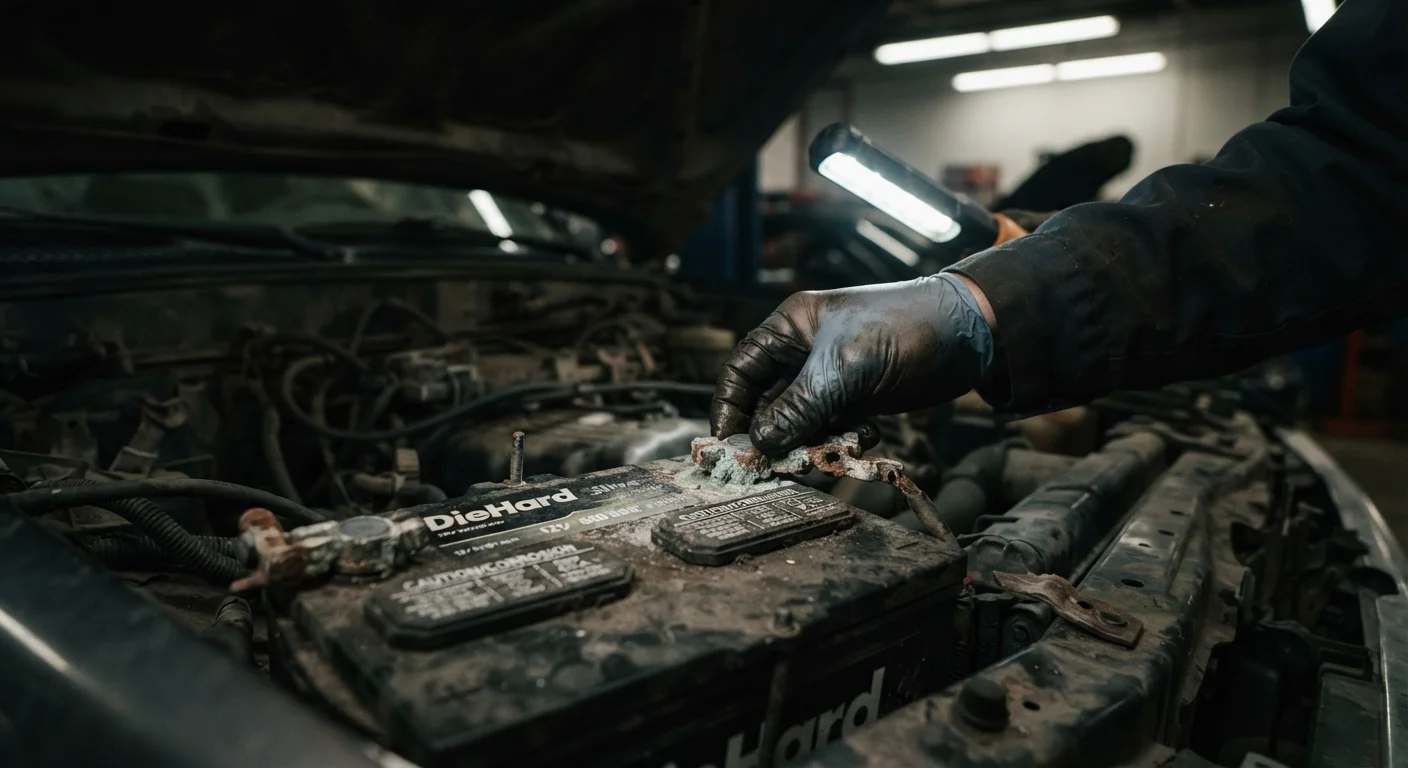
Bluish-white or grey powdery buildup around the battery terminals is a sign of hydrogen gas venting and chemical reaction at the connection points. Minor surface corrosion is common and can be cleaned, but heavy buildup restricts electrical flow and can indicate the battery is aging or overcharging.
Corroded terminals can mimic the symptoms of a dead battery - poor starts, electrical glitches - even when the battery itself still has capacity. Inspecting the terminals is a simple visual check anyone can do safely with the engine off.
Heavy terminal corrosion restricts electrical flow and can mimic the symptoms of a dead battery.
Electrical accessories behaving erratically
Modern vehicles rely on stable voltage to run everything from window motors to infotainment systems. A battery that can't maintain consistent output may cause power windows to move slowly, the radio to reset, or warning lights to flicker on briefly without an obvious cause.
Intermittent electrical gremlins that come and go - especially multiple systems at once - are worth flagging during a battery or charging system inspection rather than chasing each fault separately.
Multiple intermittent electrical faults at once often trace back to unstable battery voltage.
Battery age beyond three to five years
Even a battery that starts the car reliably every day degrades internally over time. Most conventional lead-acid batteries have a service life of roughly three to five years, though extremes of heat, cold, and usage patterns can shorten or extend this range. If you don't know when your battery was last replaced, a date sticker is often found on the top or side of the battery case.
Age alone isn't a reason to replace a battery that tests well, but it's a reason to test it - particularly before a long trip, before winter, or after a string of very short daily drives.
A battery older than four years deserves a load test even if it starts the car reliably.
Short trips that prevent a full recharge
The alternator recharges the battery while the engine runs, but it needs time to do so. Trips under ten to fifteen minutes - common in urban driving - may not restore what starting the engine consumed. Over weeks and months of exclusively short trips, the battery can enter a state of chronic undercharge, which degrades its capacity faster than normal use would.
If your driving pattern consists mainly of brief runs, consider a periodic longer drive or a maintenance charger to keep the battery at full charge.
Exclusively short trips can chronically undercharge a battery and shorten its lifespan significantly.
What to Do When You Spot the Signs
Noticing one or two of these signals doesn't always mean immediate failure, but it does mean the battery deserves attention soon. Most auto parts retailers and service shops offer free or low-cost battery load tests - a reliable way to measure remaining capacity under real-world electrical demand. A load test is more accurate than a simple voltage reading, which can look normal even on a battery that's near the end of its life.
Request a Load Test, Not Just a Voltage Check
A resting voltage reading can appear normal even on a battery close to failure. A load test applies a controlled electrical demand to the battery and measures how well it maintains voltage under stress - this is a far more accurate picture of real-world capacity. Many service centers and auto parts retailers perform load tests at no charge, making it one of the lowest-barrier health checks available to drivers.
Battery health is also intertwined with seasonal driving. Heat accelerates internal corrosion, while cold reduces cranking power. Our guide to seasonal car maintenance walks through what to inspect as conditions change - including battery checks before winter and summer. Beyond temperature, many of the everyday driving habits that quietly strain your vehicle also affect electrical system health over time.
If a test confirms the battery is below acceptable capacity, replacement is straightforward and inexpensive compared to the cost of a tow or a missed commitment. Keep a record of your replacement date so you can proactively test again as you approach the three-to-five-year window.
The content provided on our blog site traverses numerous categories, offering readers valuable and practical information. Readers can use the editorial team’s research and data to gain more insights into their topics of interest. However, they are requested not to treat the articles as conclusive. The website team cannot be held responsible for differences in data or inaccuracies found across other platforms. Please also note that the site might also miss out on various schemes and offers available that the readers may find more beneficial than the ones we cover.