

The Core Difference and Why It Matters
When you borrow money, the lender takes on risk. How they manage that risk shapes every term of your loan - the interest rate, the approval criteria, and what happens if you can't pay. The most fundamental dividing line is whether the debt is secured or unsecured.
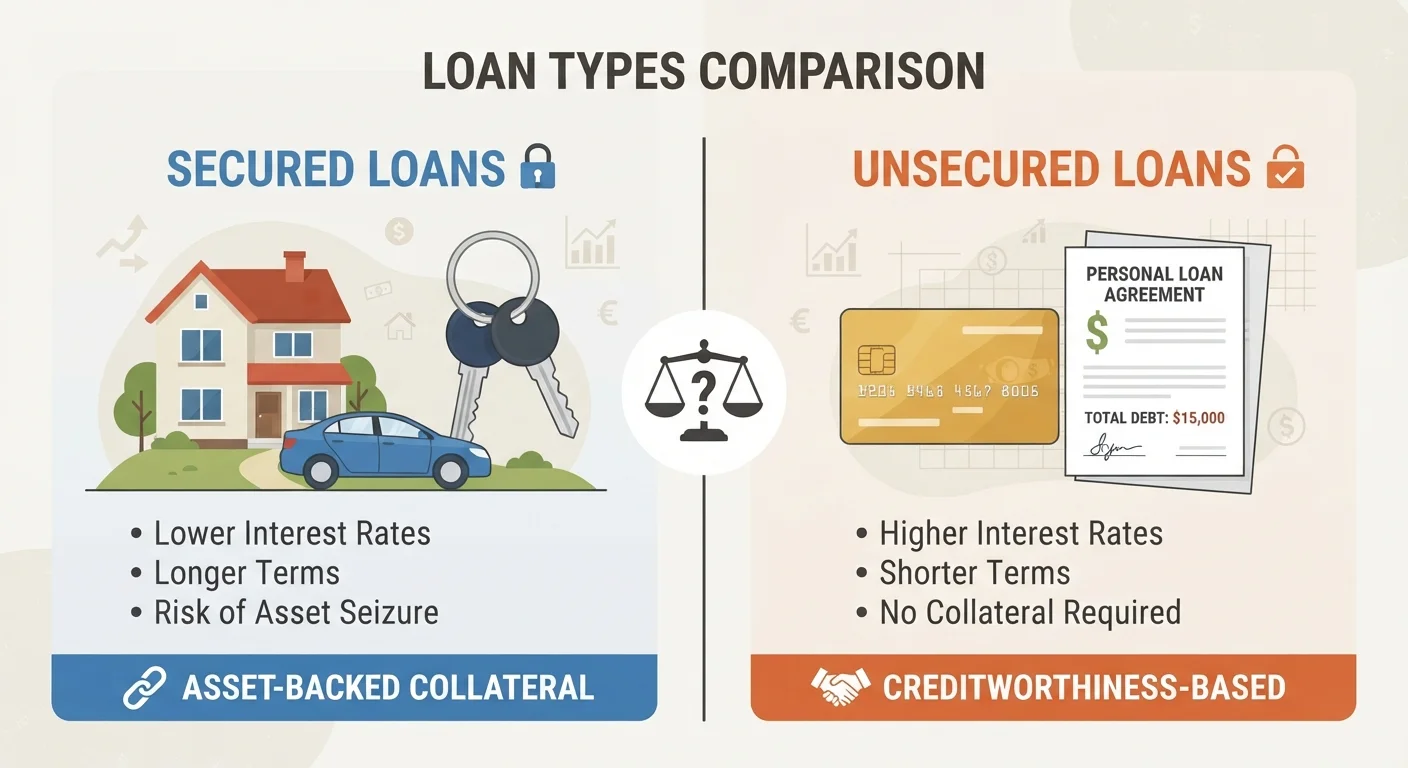
With secured debt, you pledge a specific asset as collateral. The lender holds a legal claim - called a lien - on that asset until you repay the balance. Default gives the lender the right to take the asset and sell it to recover what you owe. With unsecured debt, there is no lien and no asset on the line. The lender extended credit based on your promise to repay, backed only by your creditworthiness.
This distinction isn't just technical. It determines the stakes of every payment you miss. For a deeper foundation on how credit works in practice, see our debt and credit primer.
Secured Debt Is Not Inherently Risky
Taking on secured debt is not a red flag - mortgages and auto loans are standard financial tools that most Americans use responsibly throughout their lives. The key is understanding what you are pledging and ensuring you can sustain the payments before committing. The risk materializes only if payments become unmanageable.
Secured Debt: Real Consequences for Real Assets
The two most common secured debts most Americans carry are mortgages and auto loans. In both cases, the lender's position is straightforward: if payments stop, they can reclaim the asset.
- Mortgage: Your home secures the loan. Sustained non-payment triggers foreclosure, a legal process that can take months to years depending on state law, but ultimately results in the loss of the property.
- Auto loan: Your vehicle secures the loan. Repossession can happen far faster than foreclosure - sometimes within days of a missed payment, depending on your loan agreement and state rules. Auto loans are also relevant to the financial side of car ownership, which involves ongoing costs beyond the monthly payment.
Because collateral reduces lender risk, secured loans generally carry lower interest rates than comparable unsecured loans. That trade-off - lower cost in exchange for putting an asset on the line - is the core economic logic of secured lending.
Check for Liens Before You Borrow
Some loan products - such as home equity loans and certain vehicle title loans - attach a lien to an asset you may not realize you are pledging. Before signing any loan agreement, ask directly: 'Is a lien being placed on any of my property?' This single question can prevent costly surprises down the road.
Unsecured Debt: No Collateral, But Real Recourse
Credit cards, personal loans, medical bills, and student loans (in most cases) are unsecured. No lien is attached to your property, so the lender cannot simply repossess anything. That does not mean they are powerless.
When unsecured debt goes unpaid, lenders typically follow a predictable escalation:
- Internal collections contact and late fees begin.
- The account is charged off - marked as a loss on the lender's books - and may be sold to a third-party debt collector.
- The collector or original lender may file a lawsuit to obtain a court judgment.
- A judgment can enable wage garnishment or bank account levies, subject to state law limits.
Because lenders bear more risk on unsecured debt, they offset it with higher interest rates and stricter creditworthiness requirements. A borrower with a strong credit history can still access unsecured credit at reasonable rates - but the baseline cost is higher than for equivalent secured borrowing.
~$12.6T
Total US household debt outstanding
According to Federal Reserve data, mortgage debt makes up the majority of total household debt, reflecting how central secured borrowing is to consumer finances.
~3-5%
Typical spread between secured and unsecured rates
Industry research consistently shows that unsecured personal loan rates exceed secured loan rates by several percentage points for borrowers with comparable credit profiles, reflecting the additional lender risk.
Applying the Distinction to Your Financial Decisions
Knowing which of your debts are secured changes how you should think about them - especially when money is tight. A rough but useful framework:
- During financial hardship, secured debts come first. Losing your home or vehicle creates immediate, hard-to-reverse disruption to daily life. Unsecured creditors can cause serious credit damage and legal headaches, but they cannot physically take the roof over your head.
- When comparing loan options, factor in risk alongside rate. A secured personal loan might offer a lower rate, but you are pledging an asset. Make sure the asset you are collateralizing is one you can genuinely afford to lose if circumstances change.
- Understand the full terms before signing. Some debts that look unsecured at origination - such as certain home equity lines - are actually secured against your property. Read the agreement and ask directly if a lien is involved.
Your credit profile affects the terms you can access on both types of debt. Understanding how lenders evaluate you is a separate but closely related skill - our guide to credit reports and scores walks through what those documents actually contain and why they are not interchangeable.
This article is for general informational and educational purposes only and does not constitute personalized financial, legal, or tax advice. For guidance specific to your situation, consult a qualified financial professional.
Frequently Asked Questions
The lender can seize the collateral tied to the loan - your home in the case of a mortgage, or your car for an auto loan. This process is called foreclosure for real estate and repossession for vehicles. You may still owe a deficiency balance if the asset sells for less than what you owed.
Yes. Although unsecured lenders cannot immediately seize assets, they can sue you for the unpaid balance. If they win a court judgment, they may be able to garnish your wages or bank account, depending on state law.
Most personal loans are unsecured, meaning they are approved based on your creditworthiness rather than an asset. Some lenders do offer secured personal loans that require collateral such as a savings account, which can help borrowers with limited credit history qualify.
During financial difficulty, prioritize secured debts first because the consequences of default - losing your home or car - are more immediate and severe. That said, every situation is different, and consulting a nonprofit credit counselor can help you build a personalized plan.
Both types affect your credit score, but not differently by category. What matters is payment history, credit utilization, and account age regardless of whether the debt is secured or unsecured. See our <a href="/your-money/debt-credit/credit-reports-and-credit-scores-not-the-same-thing">guide to credit reports and scores</a> for more detail.
Standard credit cards are unsecured. However, secured credit cards - often used to build or rebuild credit - require a cash deposit that acts as the credit limit and as collateral for the lender.
The content provided on our blog site traverses numerous categories, offering readers valuable and practical information. Readers can use the editorial team’s research and data to gain more insights into their topics of interest. However, they are requested not to treat the articles as conclusive. The website team cannot be held responsible for differences in data or inaccuracies found across other platforms. Please also note that the site might also miss out on various schemes and offers available that the readers may find more beneficial than the ones we cover.