

Why These Three Cues Come First
Every training plan has to start somewhere, and sit, stay, and come form the logical first chapter. Together they give you a reliable way to pause your dog, hold that pause, and bring the dog back to you - three capabilities that cover the majority of real-life situations owners face, from preventing a bolt through an open door to managing greetings with strangers.
These cues also share a useful structure: each one is a building block for the next. A dog that understands sit has a physical anchor for learning stay. A dog that holds a stay has already practiced self-control, which makes a reliable recall far more achievable. Rushing ahead before each piece is solid tends to produce a dog that performs inconsistently - and inconsistency is the most common reason training stalls. If you are new to dog ownership, the fundamentals guide for first-time pet owners covers the timing, mindset, and consistency principles that underpin everything here.
Before beginning, decide which reward marker you will use - a short verbal word like "yes" or a clicker. The marker must be delivered the instant the dog performs the correct behavior, before the treat arrives. If you are unsure which format suits your dog best, our guide to clicker vs. verbal cues walks through the trade-offs.
What you will need
Step-by-Step: Teaching Sit, Stay, and Come
Work through the steps below in sequence. Keep individual sessions to five to ten minutes - dogs learn better with mental breaks than through repetition fatigue. End every session on a successful repetition so the dog finishes with a positive association.
Teach Sit with a Lure
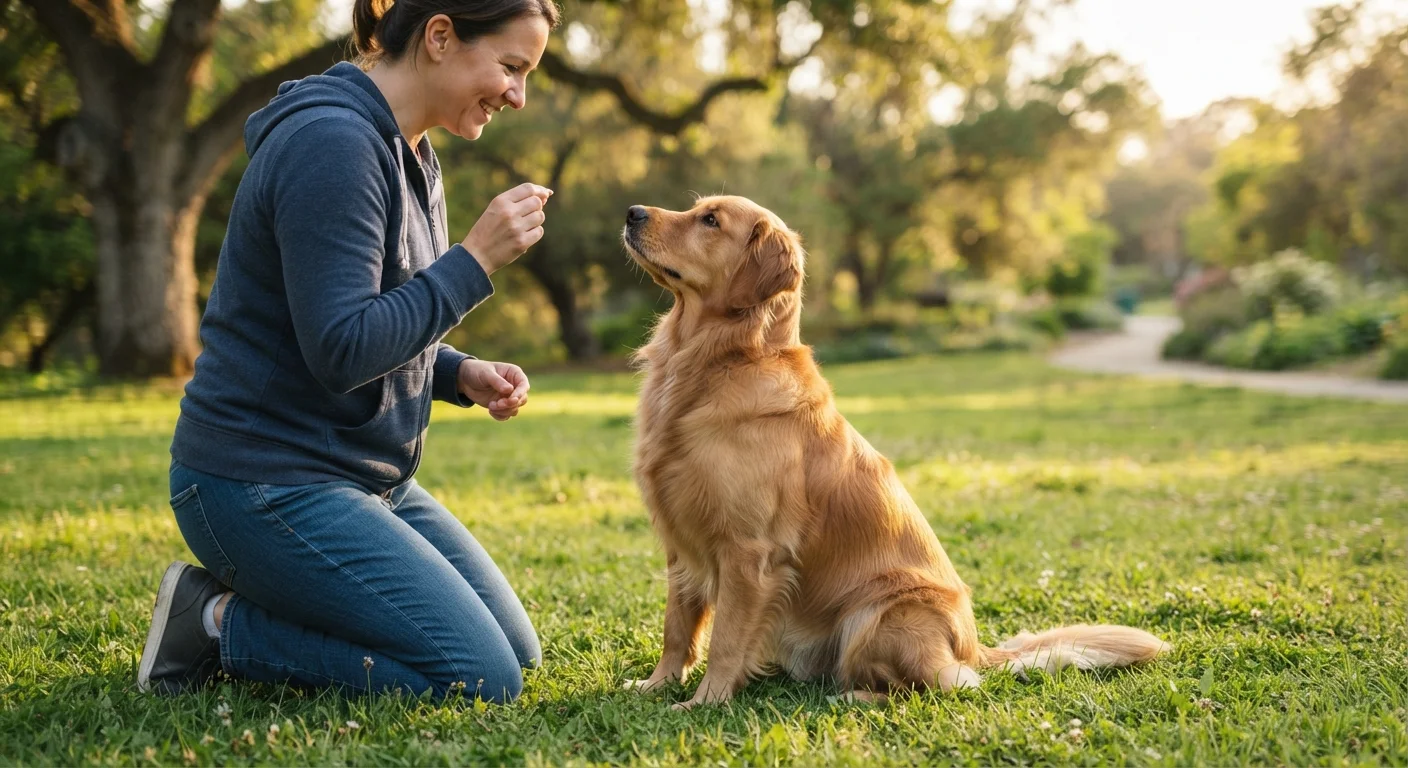
Hold a treat at your dog's nose and slowly move it back over the dog's head toward the tail. As the nose follows the treat upward, the hindquarters naturally lower. The moment the dog's bottom touches the ground, mark (click or say "yes") and deliver the treat.
After five to eight successful repetitions with the lure, begin fading it: make the same hand motion but with no treat in your hand. Mark and reward from your opposite hand when the dog sits. Once the motion reliably produces a sit, introduce the word "sit" just before the hand signal. Within a few sessions most dogs will respond to the word alone.
Add Duration with Stay
Ask for a sit. Pause for one second, then mark and reward while the dog is still sitting - not after it has moved. This is the key distinction: you are rewarding the position, not the completion of it.
Gradually extend the pause in small increments: one second, then two, then three. If the dog breaks position before you mark, simply ask for the sit again and shorten your duration. When the dog holds reliably for five seconds, introduce a calm, flat-palmed hand signal and the word "stay" just before you begin the pause. Build duration, then add small amounts of distance by taking one step back, returning to the dog, and rewarding before releasing.
Teach a clear release word - "free" or "okay" - so the dog understands when the exercise is over. Without it, the dog will release itself, which undermines the behavior.
Build a Reliable Recall with Come
Begin indoors with your dog just a few feet away. Say the dog's name followed by "come" in an upbeat tone, then crouch down and open your arms or pat your legs to invite movement toward you. The moment the dog arrives and makes contact, mark enthusiastically and deliver several treats in a row - recall should always produce a small jackpot compared to routine rewards.
Gradually increase distance across multiple sessions. Move to a long leash (15-30 feet) outdoors once the behavior is consistent indoors. The leash provides a safety net during proofing in partially open environments - never practice an off-leash recall in an unsecured area until the behavior is extremely reliable across many contexts.
Generalize Early, Not Just at the End
Many owners wait until a cue feels "solid" before introducing new environments, but earlier, low-stakes exposure to mild distractions builds a more durable behavior. Try practicing sit in the hallway, near a window, or in the garage before moving fully outdoors. Each new context is its own small challenge the dog needs to solve.
As your dog grows more reliable indoors, begin introducing each cue in new environments: the driveway, a quiet park, a friend's yard. Dogs do not automatically generalize learned behaviors to new contexts, so this "proofing" step is essential before you rely on any cue in a high-stakes moment. For a deeper look at reading your dog's stress signals during this process, see understanding dog body language.
Common Mistakes and How to Avoid Them
Even well-intentioned owners run into predictable friction points. The most frequent issue is repeating the cue word multiple times before the dog responds - "sit, sit, sit" - which teaches the dog that the first word is optional. Say the cue once, wait, and if the dog does not respond, reset and prompt again rather than escalating the verbal request.
The second common mistake is poisoning the recall. If "come" is consistently followed by something the dog dislikes - ending play, being crated, a bath - the dog learns to avoid it. Always make arriving at you feel worthwhile, even when you do need to follow up with something the dog finds less exciting. Use a secondary cue for those moments if needed.
Avoid Practicing in Over-Stimulating Environments Too Soon
Taking a dog to a busy dog park or street corner to practice these cues before they are solid at home is one of the fastest ways to set the training back. High arousal states make it genuinely harder for dogs to process and respond to cues. Build the behavior where the dog can succeed, then raise the distraction level incrementally.
If progress stalls noticeably despite consistent practice, it is worth examining whether the training environment is too distracting, whether the rewards are motivating enough, or whether the steps are advancing too quickly. Our article on navigating training plateaus covers these obstacles in detail. For new dog owners still getting routines established, bringing home your first dog offers helpful context on building a structured daily environment that supports learning.
The content provided on our blog site traverses numerous categories, offering readers valuable and practical information. Readers can use the editorial team’s research and data to gain more insights into their topics of interest. However, they are requested not to treat the articles as conclusive. The website team cannot be held responsible for differences in data or inaccuracies found across other platforms. Please also note that the site might also miss out on various schemes and offers available that the readers may find more beneficial than the ones we cover.