

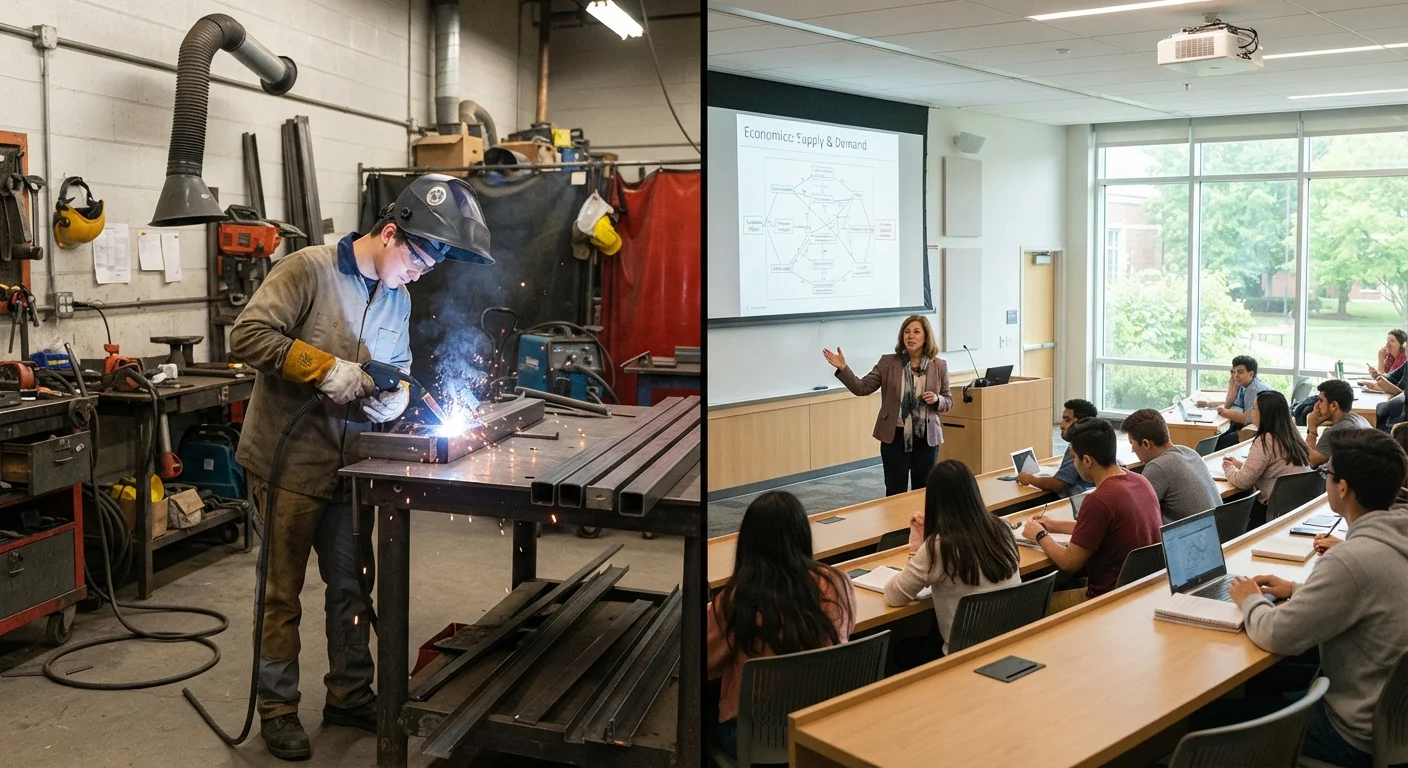
Option A
Trade School
The fast-track, hands-on path to a licensed skilled trade.
Best for: People who want to enter the workforce quickly in a specific technical field with manageable debt.
Option B
Four-Year College
The broader credential for professional, managerial, or research-oriented careers.
Best for: People pursuing fields that require a bachelor's degree for licensure, advancement, or entry-level hiring.
The Core Difference: Structure, Speed, and Purpose
Trade schools - also called vocational or technical schools - are built around a single outcome: preparing students for a specific skilled occupation. Programs in fields like electrical work, HVAC, welding, dental hygiene, or automotive technology are structured to deliver practical, hands-on competency as efficiently as possible. Most run between one and two years and lead directly to a certification, license, or apprenticeship eligibility.
Four-year colleges pursue a different model. The bachelor's degree is a broad academic credential that combines general education requirements with a major field of study. That breadth is intentional - it builds adaptable graduates capable of moving across roles and industries over a career. But it comes with a longer timeline and typically a steeper financial commitment.
The question isn't which model is objectively better. It's which model aligns with where you want to go professionally and what trade-offs you're prepared to make to get there. For a deeper look at what returning to college actually involves day-to-day, see our guide for adult learners returning to college.
| Criterion | Trade School | Four-Year College |
|---|---|---|
| Typical program length | 1-2 years | 4 years |
| Average total cost | Lower (often $5K-$35K) | Higher (often $40K-$200K+) |
| Credential earned | Certificate, diploma, or license | Bachelor's degree |
| Time to first paycheck | Faster entry to workforce | Longer before earning begins |
| Career flexibility | Narrower but deep specialization | Broader across industries |
| Graduate school eligibility | Generally not a direct path | Direct pathway to graduate programs |
| Hands-on training emphasis | High - central to curriculum | Varies by major |
| Median student loan debt | Typically lower | Typically higher |
Earnings, Debt, and the Real Financial Picture
The wage data here is nuanced and worth examining carefully. According to the U.S. Bureau of Labor Statistics, workers with a bachelor's degree earn higher median weekly wages than those with a postsecondary non-degree award - on average. But averages obscure a critical reality: skilled trades can command strong wages, and many trade workers out-earn college graduates in specific fields.
Licensed electricians, plumbers, and elevator installers, for example, frequently earn well above the national median for college-educated workers. Meanwhile, many four-year graduates in lower-demand majors face wages that take years to justify the cost of their degree.
$1,493
Median weekly earnings, bachelor's degree holders
According to U.S. Bureau of Labor Statistics data, full-time workers with a bachelor's degree earn this figure as a weekly median.
$1,001
Median weekly earnings, postsecondary non-degree award
BLS data shows workers with vocational certificates or similar credentials earn this weekly median - though top trades can exceed this figure substantially.
~$30,000
Estimated average trade school total cost
Vocational program costs vary widely by field and institution, but are consistently lower than four-year college tuition and fees.
Debt is the other side of the equation. The average trade school student graduates with far less debt than the average four-year college student. Federal data consistently shows that bachelor's degree graduates carry median loan balances many times higher than vocational program completers. That debt load affects financial flexibility for years after graduation - an important consideration for anyone weighing both paths.
For learners considering options between these two poles, community college vs. four-year university offers a middle-ground comparison worth reviewing.
Career Paths, Ceilings, and Long-Term Flexibility
One concern trade school prospects often raise is ceiling - specifically, whether a vocational credential limits advancement over time. In practice, this varies considerably by field. Many skilled tradespeople move into supervisory, estimating, or business ownership roles without needing additional academic credentials. Others supplement their license with short-term certifications to expand scope.
For those curious about how certifications stack up against degrees in employer hiring decisions, our piece on online certifications vs. degree programs walks through how different fields weigh credentials differently.
Four-year degree holders typically have more explicit pathways into management, graduate school, and roles that require broad organizational thinking. However, this flexibility comes with a longer ramp-up period before earning begins. It's worth noting that some high-demand trade credentials - particularly in IT and healthcare support - can be earned quickly and open real doors, as outlined in our overview of industry certifications worth pursuing without a four-year degree.
Ultimately, neither path locks you in permanently, but each creates a different starting point. The most important variable is whether your target field requires - or strongly prefers - a specific credential at the point of hire. If it does, that requirement should anchor your decision more than any general comparison of the two models. For a step-by-step framework to evaluate your options fully, see our complete guide for adult students going back to school.
The content provided on our blog site traverses numerous categories, offering readers valuable and practical information. Readers can use the editorial team’s research and data to gain more insights into their topics of interest. However, they are requested not to treat the articles as conclusive. The website team cannot be held responsible for differences in data or inaccuracies found across other platforms. Please also note that the site might also miss out on various schemes and offers available that the readers may find more beneficial than the ones we cover.