

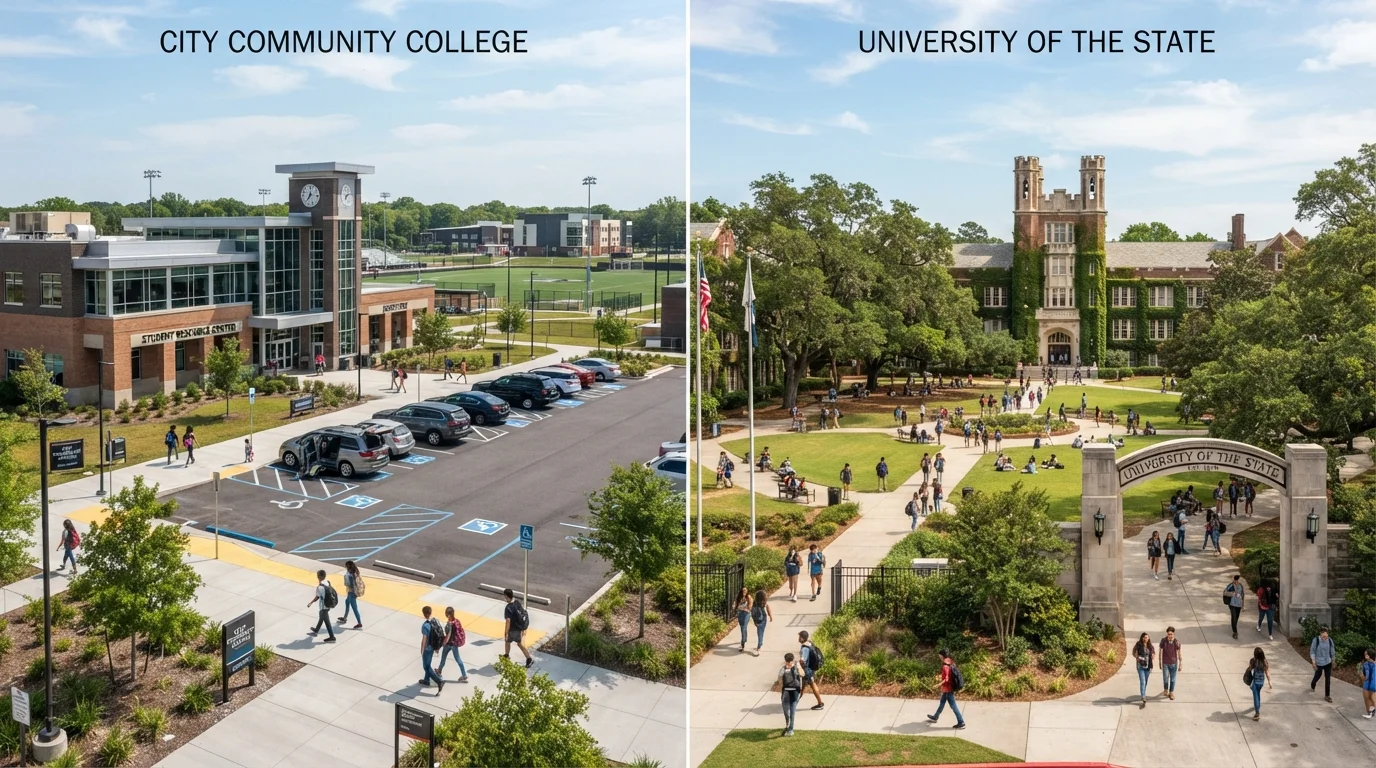
Option A
Community College
The affordable, flexible entry point for adult learners.
Best for: Adults seeking low-cost credentials, associate degrees, or a stepping stone to a four-year program while balancing work and family.
Option B
Four-Year University
The comprehensive path to a bachelor's degree and beyond.
Best for: Adult learners whose career goals require a bachelor's degree and who can commit to a longer, more structured academic program.
Cost and Financial Aid: Where the Numbers Really Differ
Tuition is typically the first number adult learners scrutinize - and for good reason. According to the College Board, the average annual tuition and fees at a public two-year college runs significantly lower than at a public four-year institution. That gap compounds quickly over a multi-year program, especially for adult students who may be managing mortgages, childcare, or existing debt.
That said, cost comparisons aren't always straightforward. Four-year universities often offer more institutional scholarships, and employer tuition assistance programs sometimes cover a larger share of costs at partnered universities. Financial aid - including federal Pell Grants and subsidized loans - is available at both institution types for eligible students. If you're filing FAFSA for the first time as an adult, see our guide on how FAFSA works for adult students over 25 to understand what funding you may qualify for.
| Criterion | Community College | Four-Year University |
|---|---|---|
| Average annual tuition (public) | ~$3,800/year | ~$10,950/year (in-state) |
| Time to credential | 1-2 years (associate/certificate) | 4+ years (bachelor's) |
| Scheduling flexibility | Generally strong; evening/online common | Varies widely by institution |
| Credit transfer risk | Moderate - depends on agreements | Lower - credits earned in-house |
| Prior learning assessment access | Commonly available | Less consistent |
| Federal financial aid eligibility | Yes (Pell, loans) | Yes (Pell, loans, more scholarships) |
| Degree ceiling | Associate degree or certificate | Bachelor's, master's, and beyond |
One cost factor often overlooked: opportunity cost. Community college programs can be completed in one to two years, meaning adult learners re-enter the workforce - or enter a new field - faster. A four-year program delays that return, though it may also deliver a higher salary ceiling depending on the industry.
Flexibility, Format, and Fit for Adult Schedules
Adult learners rarely attend school under the same conditions as traditional 18-to-22-year-olds. Jobs, families, and geographic constraints all shape what's actually possible. Community colleges have historically led the way in serving non-traditional students: evening classes, weekend sessions, accelerated terms, and strong online offerings are common at most two-year institutions.
Four-year universities have caught up considerably. Many now operate dedicated adult learner divisions with asynchronous online programs, cohort-based evening schedules, and credit for prior learning. However, the depth of these offerings varies significantly by institution. Before enrolling anywhere, confirm whether the program you need is available in a format that fits your life. Our comparison of online vs. in-person adult education programs can help you evaluate which delivery format suits your situation.
40%
Share of college students aged 25 or older
According to the National Center for Education Statistics, adult learners make up a substantial portion of total college enrollment in the U.S.
~$7,100
Tuition gap per year between public 2-year and 4-year colleges
Based on College Board data comparing average published tuition and fees at public two-year and in-state four-year institutions.
72%
Community college students who work while enrolled
The American Association of Community Colleges reports that the majority of community college students balance employment alongside their coursework.
If you're considering part-time enrollment - which many adult learners do - understand that it affects your financial aid eligibility and completion timeline at both institution types. The trade-offs of part-time enrollment for adult students are worth examining carefully before you commit to a schedule.
Credit Transfer: The Detail That Can Make or Break Your Plan
If your plan involves starting at a community college and finishing a bachelor's degree at a four-year university, credit transfer is the most critical logistical factor to investigate before you register for a single class.
Many states have formal articulation agreements - contracts between community colleges and state universities guaranteeing that specific courses will transfer and count toward a degree. California's ASSIST system and Florida's statewide articulation framework are examples of well-developed models. But not all states have them, and even within states that do, not every course transfers cleanly into every major.
Verify Transfer Agreements Before You Enroll
Articulation agreements vary significantly by state, institution, and even by major. A course that transfers as a general elective may not satisfy a specific degree requirement. Always request a written transfer credit evaluation from your target four-year institution - not just a general list of transferable courses - before committing to a community college program with transfer in mind.
Prior work experience and military training may also qualify for college credit through prior learning assessment programs, which are more commonly available at community colleges. This is worth exploring if you have substantial professional experience. Learn more in our guide to getting college credit for what you already know.
The safest approach: contact the admissions or transfer office at the four-year institution you plan to attend, identify the exact degree program, and confirm which community college courses will count - in writing - before you begin. Assumptions made at the start of a two-year program can cost significant time and money at the finish line.
Career Outcomes and Credential Weight
The value of your credential depends heavily on the field you're entering. In skilled trades, healthcare support roles, information technology, and business administration, a community college associate degree or certificate is often sufficient - and sometimes preferred by employers who value speed-to-competency over pedigree.
In fields like engineering, law, social work, and many healthcare management roles, a bachelor's degree is a minimum requirement, making the four-year path necessary rather than optional. It's worth comparing pathways honestly. Our article on whether certifications or degree programs carry more weight at work examines how employers in different sectors evaluate credentials.
Neither institution type guarantees employment outcomes. What matters more is whether the credential aligns with your specific industry's expectations and whether you complete the program. Adults who finish a community college degree consistently improve their earnings relative to those with only a high school diploma, and bachelor's degree holders see further gains - but only when the degree is relevant to the work they pursue.
For a broader view of how to approach this decision from start to finish, see our complete guide to going back to school as an adult student, which walks through program selection, credit transfer, and tuition planning in depth.
The content provided on our blog site traverses numerous categories, offering readers valuable and practical information. Readers can use the editorial team’s research and data to gain more insights into their topics of interest. However, they are requested not to treat the articles as conclusive. The website team cannot be held responsible for differences in data or inaccuracies found across other platforms. Please also note that the site might also miss out on various schemes and offers available that the readers may find more beneficial than the ones we cover.