

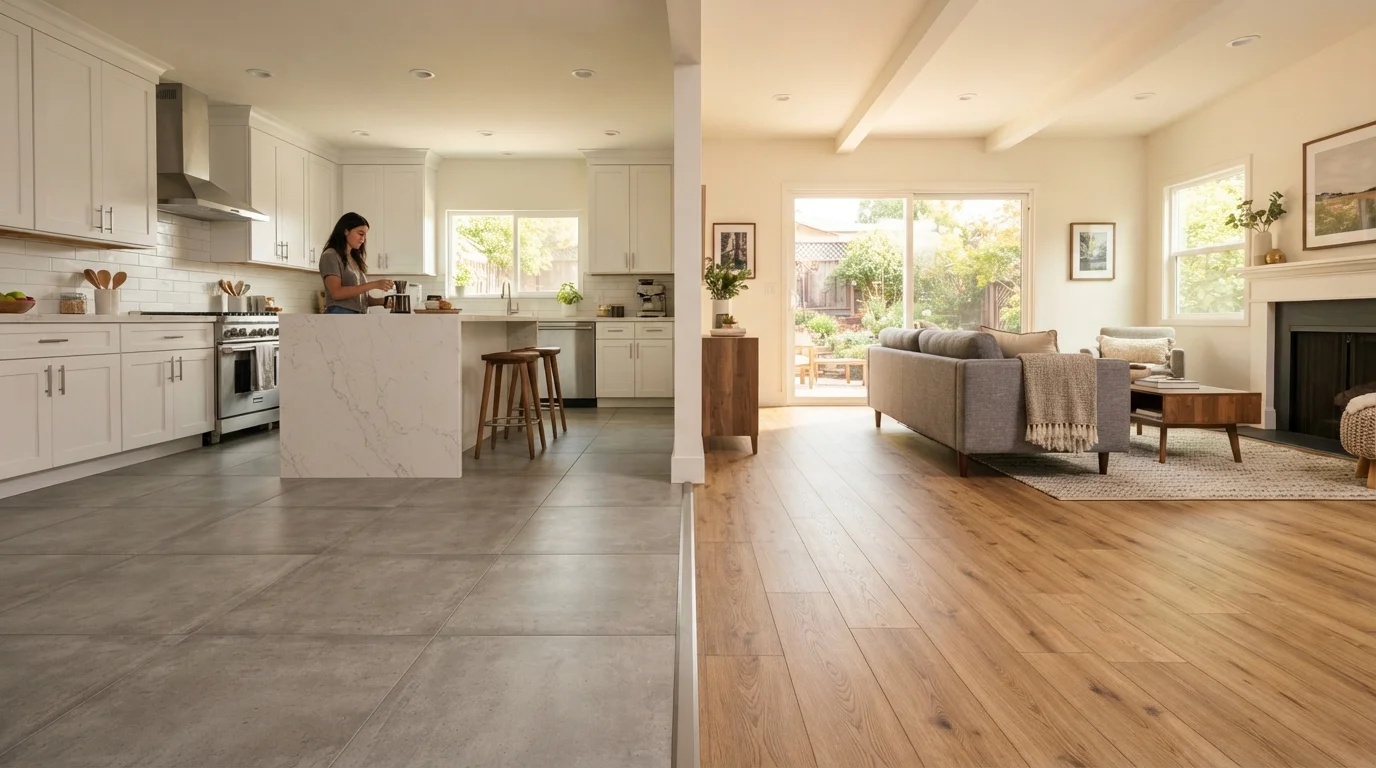
Option A
Ceramic / Porcelain Tile
The time-tested, ultra-durable hard surface.
Best for: Homeowners prioritizing longevity and moisture resistance in bathrooms, kitchens, and entryways.
Option B
Luxury Vinyl Plank (LVP)
The comfortable, DIY-friendly modern alternative.
Best for: Homeowners wanting a warm, quiet floor that installs quickly across large or multi-room areas.
Understanding What Each Floor Actually Is
Ceramic and porcelain tile are kiln-fired clay products - dense, rigid, and inherently inorganic. Porcelain is fired at higher temperatures, making it denser and even less porous than standard ceramic. Both are set into mortar and grouted in place, creating a permanent installation that bonds to the subfloor.
Luxury Vinyl Plank (LVP) is a multi-layer synthetic product: a rigid or semi-rigid core (often stone-plastic composite or wood-plastic composite), a photographic design layer, and a protective wear layer on top. Most modern LVP uses a click-lock floating system - planks interlock and rest on top of the subfloor rather than being bonded to it.
This structural difference shapes nearly every practical comparison between them. Because tile is mortared in place, it requires a flatter, stiffer subfloor with less allowable flex. LVP is more forgiving of minor subfloor imperfections, though both materials benefit enormously from proper subfloor preparation. Learn more about what lies beneath in our guide to underlayment, subfloor, and joists.
Durability, Comfort, and Everyday Performance
Tile is exceptionally hard and scratch-resistant - it won't dent under refrigerators or heavy furniture. That hardness is a double-edged quality: it's unforgiving underfoot during long periods of standing, and a dropped glass stands little chance of surviving. Tile can also crack if the subfloor flexes or settles unevenly after installation.
LVP scores higher on comfort. The slight give in the core material reduces fatigue during long periods of standing, and it stays quieter underfoot - particularly important in upper-level rooms or open-plan spaces. However, LVP's wear layer can be gouged by sharp or heavy point loads, and it has a lower heat tolerance, typically around 85-95°F, which limits compatibility with some radiant heating systems.
| Criterion | Ceramic / Porcelain Tile | Luxury Vinyl Plank (LVP) |
|---|---|---|
| Hardness & scratch resistance | Extremely high | Good; can be gouged |
| Comfort underfoot | Hard; tiring to stand on | Softer, more forgiving |
| Waterproofness | Surface is waterproof; grout needs sealing | 100% waterproof throughout |
| DIY installation | Difficult; usually requires professional | Moderate; click-lock system |
| Radiant heat compatibility | Excellent | Limited by temperature caps |
| Expected lifespan | 50+ years with care | 15-25 years typical |
| Subfloor flatness required | Very strict (3/16" per 10 ft) | More forgiving |
| Noise level | Can echo and feel cold | Quieter, especially with underlayment |
In high-traffic households with pets or young children, both materials perform well day-to-day. The meaningful difference shows up over years: well-maintained tile can last 50 or more years, while most quality LVP products are rated for 15-25 years of residential use.
Installation, Cost, and Maintenance Realities
Tile installation is skilled work. Setting tile correctly involves mixing and spreading mortar (or mastic), laying tile with consistent spacing, allowing cure time, then grouting and sealing. Errors in any step - including an insufficiently flat subfloor - can cause cracked tiles or grout failure within a few years. Most homeowners hire a professional for tile, and labor costs typically represent the majority of the total project expense.
LVP's floating click-lock system is genuinely accessible for DIYers with basic tools, patience, and a willingness to follow manufacturer instructions precisely. That said, cutting around doorways, vents, and irregular walls still takes care. Material costs for quality LVP and tile can overlap considerably, but tile projects almost always carry higher installation costs when professional labor is included.
Moisture Resistance Isn't Identical
Both materials handle surface water well, but the comparison isn't perfectly equal. LVP is waterproof through its entire thickness - water won't damage the plank itself. Tile is also waterproof at its surface, but ungrouted or poorly sealed grout lines allow moisture to reach the mortar bed and subfloor below. In bathrooms and laundry rooms, proper grout sealing is non-negotiable for tile installations. With LVP, protecting the subfloor from moisture intrusion through seams and perimeter gaps still matters.
Maintenance differs meaningfully over time. Tile surfaces are easy to clean, but grout lines are porous and stain if left unsealed - plan to reseal grout every one to three years in wet areas. LVP requires no sealing and cleans with a damp mop, though the surface cannot be refinished if it wears through. Tile, by contrast, can be re-grouted and individual tiles replaced if damaged.
The content provided on our blog site traverses numerous categories, offering readers valuable and practical information. Readers can use the editorial team’s research and data to gain more insights into their topics of interest. However, they are requested not to treat the articles as conclusive. The website team cannot be held responsible for differences in data or inaccuracies found across other platforms. Please also note that the site might also miss out on various schemes and offers available that the readers may find more beneficial than the ones we cover.