

Our Verdict
Attic insulation stands out as one of the most cost-effective home performance upgrades because it addresses heat loss at the source - the roof. While upfront costs and installation complexity are real considerations, the long-term gains in comfort and reduced energy demand are well-documented. Unlike cosmetic improvements, attic insulation works silently and continuously once installed.
Best suited for homeowners in older homes with inadequate or missing attic insulation who want to improve year-round comfort and reduce energy bills before investing in other upgrades.
Why the Attic Comes First
When homeowners think about improving their home's energy performance, windows and doors often get the most attention. But the attic is where thermal performance is won or lost. Heat naturally moves toward cooler spaces - in winter, that means warmth generated inside your home migrates upward and escapes through an under-insulated attic. In summer, radiant heat from the roof bakes down into your living spaces. Addressing the attic before other upgrades means you're solving the biggest problem first.
Most building scientists and energy professionals recommend starting with the building envelope - the shell that separates conditioned living space from the outdoors. The attic sits at the top of that shell, and it's typically the easiest and most impactful place to intervene. Before tackling cosmetic projects, reviewing your seasonal home prep checklist can help you identify whether attic insulation is already on your radar.
Addresses the largest source of home heat loss
The attic accounts for a significant portion of a home's total thermal envelope, making it the highest-leverage point for improving comfort and reducing heating and cooling loads.
Works year-round for heating and cooling benefits
Proper insulation slows heat escape in winter and resists heat gain in summer, making it a dual-season upgrade unlike many single-purpose improvements.
Can often be layered onto existing insulation
In most cases, new insulation can be blown or laid directly over older material, reducing labor and disposal costs compared to a full replacement.
DIY-accessible for straightforward attic configurations
Homeowners with basic skills and the right protective gear can install fiberglass batts or rented-blower cellulose, keeping project costs down.
Improves indoor comfort, not just energy metrics
A well-insulated attic reduces cold ceilings, drafty rooms, and uneven temperatures - improvements that residents notice immediately in daily living.
Understanding Insulation Types and R-Values
Insulation is rated by its R-value - a measure of resistance to heat flow. The higher the R-value, the more effective the insulation. The U.S. Department of Energy publishes recommended R-values by climate zone; attics in most parts of the country should target between R-38 and R-60, which translates roughly to 10-19 inches of material depending on the type used.
Common attic insulation types include:
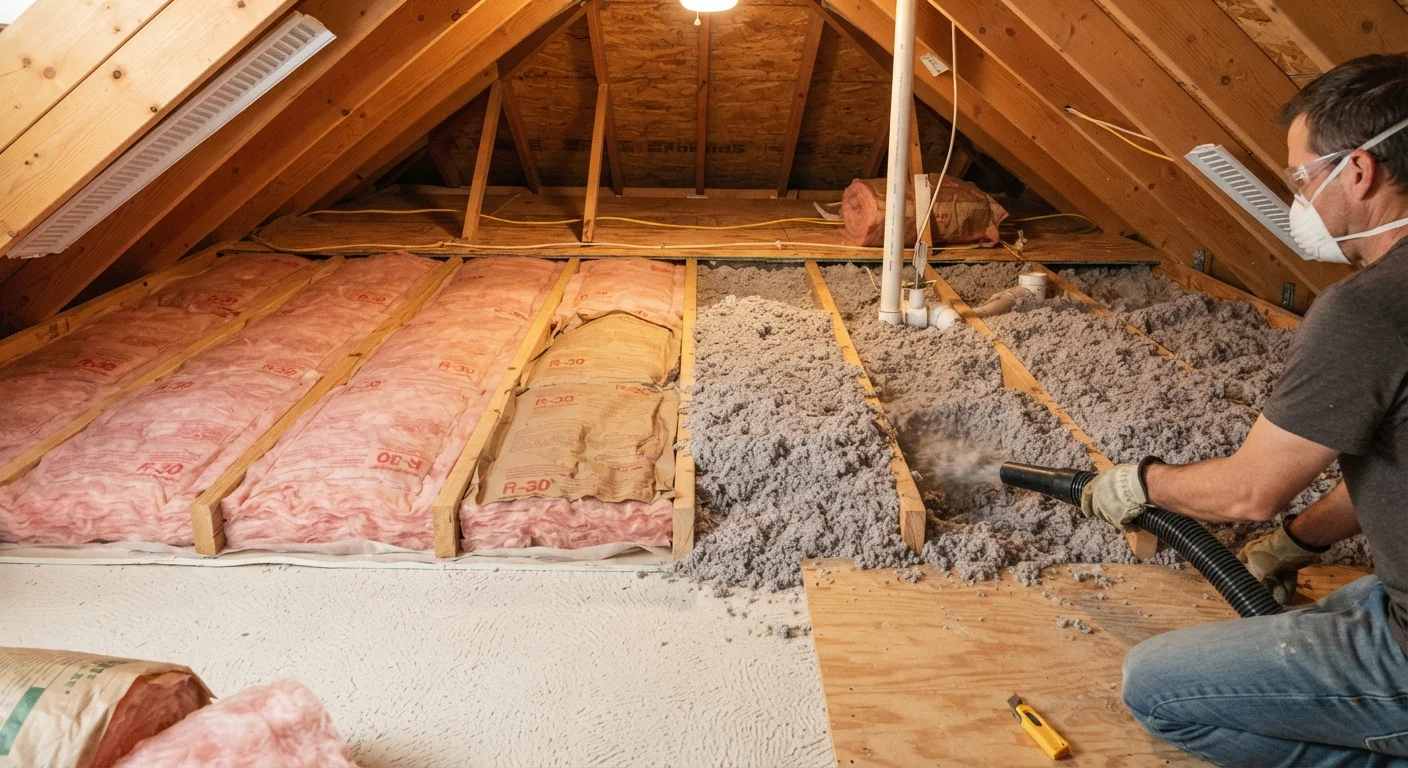
- Fiberglass batts: Pre-cut panels that fit between joists. They're widely available and can be installed as a DIY project, though gaps and compression reduce effectiveness.
- Blown-in cellulose: Made from recycled paper, this material is installed with a blower and conforms well to irregular spaces. It's a popular choice for adding insulation on top of existing material.
- Blown-in fiberglass: Similar application to cellulose but with slightly different fire and moisture characteristics.
- Spray foam: Applied to rafters or the underside of the roof deck to create an unvented, conditioned attic. This is typically a professional installation and is more expensive but effective in certain configurations.
Before adding any new insulation, attic air sealing - closing gaps around light fixtures, plumbing penetrations, and framing - is a critical step that's often overlooked.
R-38 to R-60
Recommended attic R-value for most U.S. climates
The U.S. Department of Energy publishes zone-specific insulation recommendations; most of the continental U.S. falls in the R-38 to R-60 range for attic floors.
~15%
Estimated share of home heating/cooling lost through the attic
The EPA and energy efficiency researchers commonly cite the attic as one of the top two or three pathways for conditioned air loss in typical American homes.
Real Limitations to Plan Around
Attic insulation isn't a set-it-and-forget-it upgrade in every situation. Several factors can complicate an otherwise straightforward project.
Upfront cost can be significant for whole-attic projects
Professional installation for a full attic can run into the thousands of dollars depending on square footage, existing conditions, and insulation type selected.
Existing problems must be resolved first
Moisture intrusion, mold, pest damage, or outdated wiring can all block or complicate insulation installation, adding time and cost before the core work can begin.
Improper installation reduces effectiveness significantly
Compressed batts, gaps around penetrations, or inadequate depth all diminish R-value; the difference between a good and poor installation can be substantial.
Attic access can be physically challenging
Many attics have limited headroom, awkward hatch access, and exposed nails or framing that make working in them uncomfortable and physically demanding.
Ventilation balance must be carefully maintained
Blocking soffit or ridge vents during installation can trap moisture and lead to structural damage or mold - a risk that requires planning and attention to detail.
Homes with older knob-and-tube wiring may require electrical upgrades before insulation can be safely installed above it - a professional assessment is essential in these cases. Similarly, if your attic has existing moisture problems, mold, or pest activity, those issues must be resolved first. Adding insulation over a compromised substrate can trap moisture and worsen damage over time.
Ventilation is another consideration. Most attics rely on passive ventilation through soffits and ridge vents to prevent moisture buildup. Blocking these accidentally during insulation installation is a common mistake that leads to long-term problems. If you're considering spray foam on the roof deck, which effectively eliminates traditional ventilation, the system design changes significantly and should be handled by a qualified contractor.
DIY vs. Professional Installation
Fiberglass batt installation on an accessible attic floor is one of the more approachable DIY home improvement tasks - the materials are available at hardware stores, and the process is well-documented by the Department of Energy and many cooperative extension programs. That said, proper protective gear (respirator, eye protection, gloves, and long sleeves) is non-negotiable when handling fiberglass.
Blown-in insulation requires a machine, which many hardware retailers offer for rent when you purchase sufficient material. The technique takes some practice to achieve consistent depth and coverage, and an accurate depth gauge is needed to verify you've hit your target R-value.
For homes with complex attic geometries, existing moisture or pest issues, spray foam requirements, or electrical concerns, hiring a licensed insulation contractor is the safer path. A professional can also perform a blower door test or thermal imaging assessment to identify air leaks before work begins. Unlike many exterior upgrades, attic insulation delivers performance you'll feel immediately - not just aesthetics you'll see.
Permits and Codes May Apply
In most jurisdictions, adding attic insulation does not require a building permit, but requirements vary by location and project scope. Spray foam insulation applied to the roof deck, or work that involves altering ventilation systems, may trigger local code requirements. Always verify with your local building department before beginning work, and note that some utility rebate programs require professional installation documentation.
The content provided on our blog site traverses numerous categories, offering readers valuable and practical information. Readers can use the editorial team’s research and data to gain more insights into their topics of interest. However, they are requested not to treat the articles as conclusive. The website team cannot be held responsible for differences in data or inaccuracies found across other platforms. Please also note that the site might also miss out on various schemes and offers available that the readers may find more beneficial than the ones we cover.